Short Communication - (2025) Volume 13, Issue 2
Received: 01-Apr-2025, Manuscript No. jcdd-25-175446;
Editor assigned: 03-Apr-2025, Pre QC No. P-175446;
Reviewed: 17-Apr-2025, QC No. Q-175446;
Revised: 22-Apr-2025, Manuscript No. R-175446;
Published:
29-Apr-2025
, DOI: 10.37421/2329-9517.2025.13.667
Citation: Johnson, Sarah. ”Congenital Heart Disease: Comprehensive
Lifelong Management.” J Cardiovasc Dis Diagn 13 (2025):667.
Copyright: © 2025 Johnson S. This is an open-access article distributed under the terms of the Creative Commons Attribution License, which permits unrestricted use,
distribution and reproduction in any medium, provided the original author and source are credited.
Congenital heart disease (CHD) presents a complex and evolving challenge across the lifespan, from fetal development through adulthood. Advancements in medical care mean a growing population of adults are living with these conditions, necessitating specialized diagnostic and management strategies to improve long-term health and quality of life [1].
Understanding the genetic factors at play offers crucial insights into the causes of CHD and potential preventive strategies. These discoveries, spanning chromosomal anomalies to single-gene mutations, are vital for better risk assessment, family counseling, and the development of future targeted therapies [2].
While interventions have improved survival, individuals born with CHD often face unique, long-term challenges. Their journey involves aspects like cardiovascular complications, maintaining quality of life, and a continuous need for specialized care, highlighting that lifelong monitoring and management are essential for optimal health outcomes [3].
Early detection of CHD before birth significantly impacts subsequent management and family planning. Techniques like advanced fetal imaging allow for timely interventions, either in utero or immediately postpartum, which are crucial for improving neonatal outcomes [4].
As these individuals reach adulthood, managing lifestyle factors like exercise becomes important. Evidence-based recommendations, such as those from the American Heart Association, guide personalized exercise plans, balancing physical activity benefits with avoiding undue cardiac stress to promote better cardiovascular health [5].
Pregnancy introduces specific risks for women with CHD. A systematic review outlines elevated obstetric and neonatal risks, underscoring the critical need for preconception counseling, multidisciplinary care during pregnancy, and careful monitoring to manage potential complications effectively [6].
Complications like pulmonary hypertension can arise in adults with CHD. Addressing its pathophysiology, diagnosis, and management in this patient group demands tailored approaches, considering the complex underlying cardiac anomalies, to improve outcomes and manage symptoms [7].
Children with CHD frequently encounter neurodevelopmental challenges, influenced by factors like prenatal brain development, surgical impacts, and post-operative care. Early recognition and targeted developmental support are key to mitigating these issues and enhancing their quality of life [8].
Modern diagnostic tools, particularly advanced imaging techniques like CT and MRI, have transformed how CHD is diagnosed and managed. These non-invasive methods provide precise anatomical and functional information, facilitating better surgical planning, more accurate follow-up, and a deeper understanding of complex heart defects [9].
The transition from pediatric to adult care for those with CHD requires careful navigation. Key considerations involve specialized adult CHD centers and lifelong surveillance to address evolving medical needs and prevent complications unique to this population as they age [10].
Managing congenital heart disease (CHD) spans the entire patient journey, from early diagnosis to lifelong adult care. The increasing number of adults living with CHD highlights the critical need for specialized care, focusing on tailored diagnostic tools and treatment strategies to enhance long-term health and overall quality of life [1]. This requires a specific understanding of their unique medical needs as they transition from pediatric to adult services, emphasizing the importance of dedicated adult CHD centers and continuous surveillance to prevent and manage complications [10].
A foundational aspect of CHD care involves understanding its genetic underpinnings. Delving into the complex genetic factors, from chromosomal anomalies to single-gene mutations, provides insights crucial for risk assessment, family counseling, and potentially future targeted therapies [2]. Building on this early understanding, fetal diagnosis techniques, including advanced imaging, are instrumental. Early identification of CHD in utero allows for timely intervention, whether prenatally or immediately after birth, which can significantly improve neonatal outcomes [4].
Individuals with CHD face distinct long-term outcomes, even after successful initial interventions. These challenges encompass cardiovascular complications, maintaining a good quality of life, and the ongoing demand for specialized medical attention, signifying that lifelong monitoring and management are often non-negotiable for optimal health [3]. Furthermore, specific complications can emerge, such as pulmonary hypertension in adult CHD patients. Addressing the pathophysiology, diagnosis, and management of this serious condition requires tailored approaches due to the intricate underlying cardiac anomalies [7]. Pregnancy also presents unique risks for women with CHD, demanding preconception counseling and multidisciplinary care to mitigate elevated obstetric and neonatal risks [6].
For adults navigating life with CHD, determining safe levels of physical activity is a common concern. Recommendations from bodies like the American Heart Association provide evidence-based guidance for personalized exercise plans. The goal here is to strike a balance between the benefits of physical activity and the need to avoid undue cardiac stress, ultimately promoting better cardiovascular health [5]. In younger patients, CHD often correlates with neurodevelopmental challenges. These difficulties stem from various factors including prenatal brain development, surgical impacts, and post-operative care. Early recognition and targeted developmental support are vital for mitigating these issues and improving children's quality of life [8].
Lastly, advanced imaging techniques, particularly Computed Tomography (CT) and Magnetic Resonance Imaging (MRI), have revolutionized the diagnosis and management of CHD. These non-invasive methods offer precise anatomical and functional details, which translates to improved surgical planning, more accurate follow-up assessments, and a deeper understanding of complex heart defects [9]. This technological progress aids in providing comprehensive care tailored to the individual patient's needs throughout their life.
This collection of articles explores the multifaceted landscape of congenital heart disease (CHD) across all age groups. It highlights the crucial need for specialized care for the growing adult CHD population, emphasizing tailored diagnostic and management strategies [1, 10]. The reviews delve into the genetic underpinnings of CHD, offering insights for prevention and risk assessment, and underscore the impact of fetal diagnosis on neonatal outcomes [2, 4]. Long-term perspectives are covered, detailing challenges faced by individuals with CHD, including cardiovascular complications, quality of life concerns, and specific issues like pulmonary hypertension in adults [3, 7]. For adult patients, guidelines on safe exercise are provided, balancing physical activity benefits with cardiac health [5]. The unique risks of pregnancy for women with CHD are also discussed, stressing the need for multidisciplinary care [6]. Additionally, the papers address neurodevelopmental outcomes in children with CHD, advocating for early intervention [8], and showcase how advanced imaging techniques like CT and MRI are transforming diagnosis and treatment planning [9]. Overall, these articles underscore the complexity of CHD and the ongoing requirement for comprehensive, specialized, and lifelong care.
Indexed at, Google Scholar, Crossref
Indexed at, Google Scholar, Crossref
Indexed at, Google Scholar, Crossref
Indexed at, Google Scholar, Crossref
Indexed at, Google Scholar, Crossref
Indexed at, Google Scholar, Crossref
Indexed at, Google Scholar, Crossref
Indexed at, Google Scholar, Crossref
Indexed at, Google Scholar, Crossref
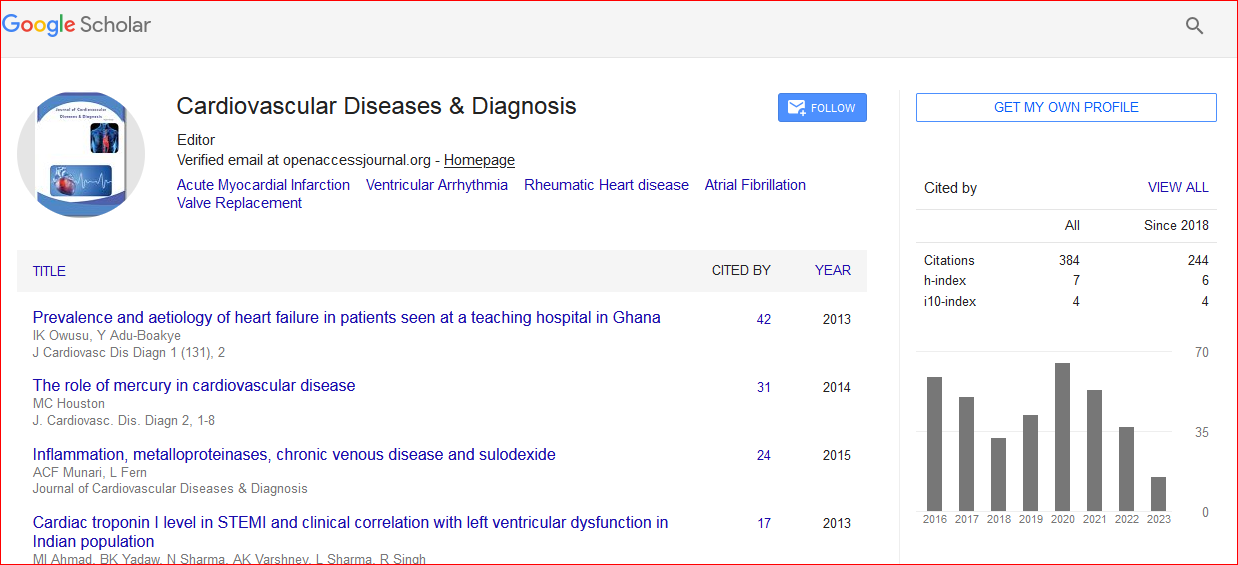
Cardiovascular Diseases & Diagnosis received 427 citations as per Google Scholar report