Brief Report - (2025) Volume 14, Issue 6
Received: 01-Dec-2025, Manuscript No. jme-26-185235;
Editor assigned: 03-Dec-2025, Pre QC No. P-185235;
Reviewed: 17-Dec-2025, QC No. Q-185235;
Revised: 22-Dec-2025, Manuscript No. R-185235;
Published:
29-Dec-2025
, DOI: 10.37421/2169-0022.2025.14.751
Citation: Conti, Paolo. ”Computational Modeling for Advanced
Polymer Materials.” J Material Sci Eng 14 (2025):751.
Copyright: © 2025 Conti P. This is an open-access article distributed under the terms of the Creative Commons Attribution License, which permits unrestricted use, distribution
and reproduction in any medium, provided the original author and source are credited.
The field of materials science has been profoundly transformed by the advent of computational modeling and simulation techniques, offering unprecedented capabilities to predict material properties, elucidate complex phenomena, and accelerate the discovery of novel materials. These in silico approaches are becoming indispensable tools for researchers and engineers seeking to push the boundaries of material performance and application. Computational modeling provides a powerful paradigm shift, enabling a deeper understanding of materials at various scales, from the atomic to the macroscopic.
The application of computational methods is particularly impactful in the realm of polymer science and nanocomposites. These advanced materials, engineered with tailored properties, often exhibit intricate behaviors that are challenging to unravel through experimental means alone. Computational simulations offer a cost-effective and efficient way to explore a vast design space, guiding experimental efforts and optimizing material formulations for specific end-uses. Techniques such as Density Functional Theory (DFT), Molecular Dynamics (MD), and Monte Carlo (MC) methods are at the forefront of these advancements. DFT, for instance, allows for the detailed investigation of electronic structures and bonding at the atomic level, providing fundamental insights into material properties. MD simulations, on the other hand, enable the tracking of atomic and molecular movements over time, revealing dynamic processes and mechanical behaviors. MC methods are often employed for exploring statistical properties and phase transitions. In the context of polymer nanocomposites, the precise arrangement and interaction of constituent components significantly influence the overall performance. Computational simulations are instrumental in dissecting these complex relationships. They can predict how the dispersion of nanoparticles, the nature of interfacial interactions, and the morphology of the composite affect macroscopic properties like strength, stiffness, and viscoelasticity. The synergy between computational modeling and experimental validation is a cornerstone of modern materials research. Simulations can guide the design of experiments by highlighting critical parameters to investigate or by suggesting optimal material compositions. Conversely, experimental data can be used to validate and refine computational models, ensuring their predictive accuracy and reliability. Machine learning (ML) is increasingly integrated with traditional computational methods to further accelerate materials discovery. By training ML models on large datasets generated from simulations, researchers can develop highly accurate predictive tools for material properties. This approach significantly reduces the need for exhaustive experimental screening, expediting the identification of promising new materials. For polymer nanocomposites, understanding the fundamental properties of interfaces is crucial. DFT calculations, for example, can provide atomic-level insights into charge transfer and bonding at polymer-filler interfaces. This detailed understanding is vital for predicting interfacial adhesion and the extent of mechanical reinforcement imparted by fillers. Multi-scale modeling approaches are also essential for capturing the full spectrum of material behavior. By bridging atomistic simulations with continuum mechanics, researchers can predict properties relevant to different length and time scales. This integrated approach is particularly valuable for understanding complex polymer dynamics, such as viscoelasticity. The ability to simulate complex phenomena like phase separation and microstructural evolution is critical for designing advanced polymer systems. Methods like phase-field modeling allow for the investigation of morphology development, enabling the tailoring of polymers for specific applications such as self-assembly or advanced functional materials. Furthermore, computational tools extend to the simulation of polymer processing itself. Computational Fluid Dynamics (CFD) can predict flow behavior, fiber orientation, and temperature distributions during manufacturing processes. This capability is indispensable for process optimization, defect reduction, and the production of high-performance polymer composites.Computational modeling and simulation have emerged as pivotal methodologies in advancing materials science, offering a powerful complement to experimental investigations. The ability to predict material properties and understand complex behaviors at multiple scales has revolutionized the discovery and design of new materials. Techniques such as Density Functional Theory (DFT), Molecular Dynamics (MD), and Monte Carlo (MC) simulations are central to this paradigm shift, enabling detailed exploration of atomic, molecular, and mesoscopic phenomena. These methods are particularly impactful in the development of advanced materials like polymers and nanocomposites, where intricate structure-property relationships govern performance.
In the realm of polymer nanocomposites, computational simulations play a critical role in elucidating the impact of nanoscale filler dispersion and interfacial interactions on macroscopic properties. Coarse-grained molecular dynamics simulations, for instance, are employed to predict mechanical characteristics and phase behavior, providing insights into how to tailor composite performance through controlled morphology and interface engineering. This approach underscores the importance of understanding how molecular-level events translate to bulk material behavior. The integration of machine learning (ML) with high-throughput computations represents a significant acceleration in materials discovery. By leveraging large datasets generated from simulations, ML models can rapidly predict material properties, thereby minimizing the extensive experimental screening traditionally required. This synergy promises to expedite the identification of novel polymers and composites with desired attributes. At the fundamental level, Density Functional Theory (DFT) is instrumental in characterizing the electronic and structural properties of polymer-filler interfaces within nanocomposites. By providing atomic-level insights into phenomena such as charge transfer and bonding, DFT calculations are crucial for predicting interfacial adhesion and the degree of mechanical reinforcement. Accurate DFT simulations are therefore vital for the rational design of high-performance composites. Multi-scale modeling strategies are essential for capturing the diverse behaviors of polymeric materials across different length and time scales. An integrated approach that bridges atomistic simulations with continuum mechanics allows for the prediction of properties such as viscoelasticity in polymer melts and blends. This enables the parameterization of mesoscale models from atomistic simulations, facilitating the prediction of rheological properties relevant to polymer processing. Phase-field modeling offers a powerful tool for investigating the microstructural evolution and phase separation in polymer systems, including blends and block copolymers. This technique allows for the simulation of complex morphologies and their dependence on thermodynamic parameters and processing conditions, providing critical insights for designing polymers with specific self-assembly characteristics and functionalities. Computational Fluid Dynamics (CFD) plays a crucial role in simulating the processing of polymer composites, such as injection molding. CFD simulations can predict flow behavior, fiber orientation, and temperature distributions during manufacturing, which directly influence the final material properties. Accurate CFD modeling is indispensable for optimizing processing conditions and minimizing defects in manufactured parts. Atomistic simulations provide detailed insights into the mechanical deformation mechanisms occurring at polymer-nanomaterial interfaces. By focusing on stress transfer and the impact of interfacial defects on strength and toughness, these simulations contribute to the design of stronger and more durable polymer nanocomposites. Understanding these nanoscale deformation processes is key to achieving enhanced mechanical performance. Kinetic Monte Carlo (KMC) simulations are employed to model the self-assembly and morphology development of block copolymers. This method facilitates the exploration of how variations in chain architecture and thermodynamic conditions influence the formation of ordered nanostructures. The findings are critical for developing materials for advanced nanotechnology applications, including nanopatterning and drug delivery systems. Reactive force fields in molecular dynamics simulations enable the study of chemical reactions at polymer interfaces, such as degradation or cross-linking. This advanced capability allows for the simulation of complex chemical processes that are difficult to capture with conventional force fields, providing a deeper understanding of material stability and reactivity, which is essential for designing more durable and reliable polymers.This collection of research highlights the transformative role of computational modeling and simulation in materials science, particularly for polymers and nanocomposites. Advanced techniques like DFT, MD, and MC simulations are used to predict material properties, understand atomic-level interactions, and guide experimental design. Multi-scale modeling, machine learning integration, and specialized methods like phase-field and CFD modeling are accelerating materials discovery and optimizing processing. These computational tools provide fundamental insights into interfacial phenomena, mechanical behavior, microstructural evolution, and chemical processes, leading to the development of novel and high-performance polymeric materials.
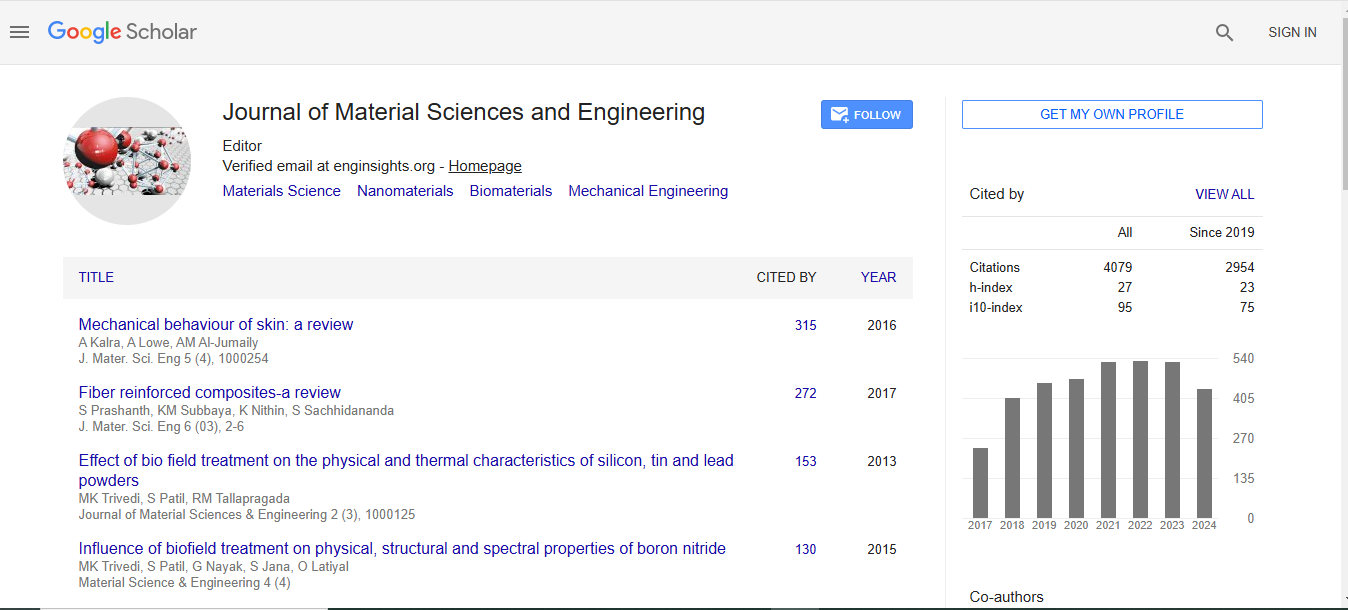
Journal of Material Sciences & Engineering received 3677 citations as per Google Scholar report