Brief Report - (2025) Volume 9, Issue 4
Received: 01-Jul-2025, Manuscript No. jchd-26-185694;
Editor assigned: 03-Jul-2025, Pre QC No. P-185694;
Reviewed: 17-Jul-2025, QC No. Q-185694;
Revised: 22-Jul-2025, Manuscript No. R-185694;
Published:
29-Jul-2025
, DOI: 10.37421/2684-6020.2024.9.250
Citation: Tanaka, Hiroshi. ”Comprehensive Coronary Heart Disease
Management Strategies.” J Coron Heart Dis 09 (2025):250.
Copyright: © 2025 Tanaka H. This is an open-access article distributed under the terms of the Creative Commons Attribution License, which permits unrestricted use,
distribution and reproduction in any medium, provided the original author and source are credited.
The comprehensive management of coronary heart disease (CHD) necessitates a multifaceted strategy that integrates lifestyle modifications, pharmacological interventions, and psychosocial support to foster well-being and prevent adverse events [1].
This approach recognizes that living with CHD extends beyond medical treatment to encompass emotional and social factors crucial for long-term health [1].
A cornerstone of managing CHD involves personalized risk assessment, which leverages a combination of genetic, lifestyle, and clinical data to tailor treatment strategies for improved patient outcomes [2].
This precision medicine approach aims to proactively identify and mitigate individual risk factors, thereby reducing the incidence of cardiovascular events [2].
Furthermore, the profound impact of lifestyle interventions on the progression of coronary atherosclerosis is increasingly evident, with studies demonstrating that consistent adoption of healthy habits can lead to stabilization or even regression of plaque burden [3].
These findings underscore the transformative potential of lifestyle changes as a primary therapeutic modality in established coronary artery disease (CAD) [3].
Pharmacological therapies remain vital in the armamentarium against CHD, with a range of medications employed to address specific risk factors and prevent complications such as thrombosis and hypertension [4].
The efficacy and safety profiles of these drugs are continuously refined, with ongoing research exploring novel agents and future therapeutic directions [4].
Beyond the physical manifestations, the psychological well-being of individuals living with CHD is a critical component of their overall health and recovery [5].
Common psychological challenges, including anxiety and depression, often accompany the diagnosis and can significantly impact quality of life, highlighting the need for targeted psychological interventions [5].
Cardiac rehabilitation programs play an indispensable role in the recovery and long-term management of patients with CHD, offering a structured environment for exercise, education, and psychosocial support [6].
These comprehensive programs are instrumental in improving functional capacity, reducing risk factors, and ultimately enhancing the quality of life for individuals navigating life after a cardiac event [6].
Advancements in interventional cardiology have revolutionized the treatment of complex coronary artery disease, offering sophisticated techniques and novel technologies to address challenging lesions and high-risk patient populations [7].
Percutaneous coronary intervention (PCI) continues to evolve, providing less invasive options for revascularization and improved outcomes [7].
Central to effective CHD management is empowering patients through robust education and dedicated self-management support systems [8].
When patients are equipped with knowledge and tools to actively participate in their care, treatment adherence improves, leading to better health outcomes and a greater sense of control over their condition [8].
The crucial role of social support in the recovery and long-term adherence to healthy lifestyles for CHD patients cannot be overstated; strong connections with family and peers significantly contribute to better management of medications, diet, and exercise [9].
This network of support fosters improved cardiovascular health and overall well-being [9].
Finally, surgical interventions, particularly coronary artery bypass grafting (CABG), remain a significant option for managing severe coronary artery disease, with ongoing advancements in techniques aimed at improving patient outcomes and reducing recovery times [10].
These surgical strategies, including minimally invasive approaches, offer further avenues for effective disease management [10].
The management of coronary heart disease (CHD) is a dynamic and intricate process that requires a comprehensive, patient-centered approach, encompassing lifestyle adjustments, medical treatments, and psychosocial support to enhance patient well-being and prevent further cardiovascular events [1].
This holistic perspective acknowledges that effective CHD management extends beyond the confines of clinical interventions, critically involving the emotional and social dimensions of living with a chronic condition, thereby promoting overall thriving [1].
A fundamental element in the modern approach to CHD is personalized risk assessment, a strategy that integrates a patient's unique genetic makeup, lifestyle habits, and clinical data to meticulously tailor treatment plans, ultimately aiming to optimize patient outcomes and minimize the occurrence of cardiovascular incidents [2].
This paradigm shift towards precision medicine allows for the proactive identification and mitigation of individual risk factors, significantly contributing to a reduction in the incidence of adverse cardiovascular events [2].
Furthermore, the substantial influence of lifestyle interventions on the trajectory of coronary atherosclerosis progression is becoming increasingly clear, with compelling evidence suggesting that consistent adherence to a heart-healthy lifestyle can lead to either stabilization or even a reversal of atherosclerotic plaque burden in individuals diagnosed with established coronary artery disease [3].
These findings collectively emphasize the profound therapeutic potential of comprehensive lifestyle modifications as a primary treatment strategy for patients with CAD [3].
Pharmacological therapies continue to represent an indispensable pillar in the therapeutic arsenal against CHD, employing a diverse array of medications designed to effectively manage specific risk factors and to avert potential complications such as thrombotic events and uncontrolled hypertension [4].
The ongoing refinement of drug efficacy and safety profiles, coupled with active research into novel therapeutic agents and future pharmacological strategies, ensures a continually evolving landscape of treatment options [4].
Beyond the physiological aspects of the disease, the psychological well-being of individuals diagnosed with CHD constitutes a paramount concern for their overall health and successful recovery journey [5].
The emotional challenges, including heightened levels of anxiety, depressive symptoms, and a pervasive fear of recurrence, frequently accompany a CHD diagnosis and can profoundly diminish an individual's quality of life, thereby underscoring the critical necessity of tailored psychological interventions [5].
Cardiac rehabilitation programs are established as an essential component in the recovery trajectory and long-term management of patients diagnosed with CHD, providing a structured and supportive environment that integrates supervised exercise, comprehensive health education, and vital psychosocial support services [6].
These multifaceted programs are demonstrably effective in augmenting functional capacity, mitigating risk factors, and significantly improving the overall quality of life for individuals navigating the complexities of life post-cardiac event [6].
Significant advancements in the field of interventional cardiology have profoundly transformed the therapeutic landscape for complex coronary artery disease, introducing sophisticated techniques and cutting-edge technologies designed to effectively manage challenging arterial lesions and to care for high-risk patient cohorts [7].
Percutaneous coronary intervention (PCI) continues to be a rapidly evolving area, offering increasingly less invasive revascularization strategies that translate into improved patient outcomes [7].
A crucial aspect of effectively managing CHD involves the proactive empowerment of patients through comprehensive educational initiatives and robust self-management support systems [8].
When patients are adequately equipped with knowledge and practical tools to actively engage in their own healthcare journey, there is a marked improvement in treatment adherence, leading to demonstrably better health outcomes and an enhanced sense of personal agency over their condition [8].
The profound impact of social support on the recovery process and the sustained adherence to healthy lifestyle practices among patients with CHD cannot be adequately emphasized; strong familial and peer support networks have been consistently linked to superior adherence to medication regimens, dietary recommendations, and exercise protocols, thereby contributing to improved cardiovascular health [9].
This robust support system is a critical factor in fostering better overall cardiovascular health and well-being [9].
Lastly, surgical interventions, most notably coronary artery bypass grafting (CABG), remain a critical therapeutic option for the management of severe coronary artery disease, with continuous progress in surgical methodologies aimed at enhancing patient outcomes and expediting recovery periods [10].
These advanced surgical approaches, including innovative minimally invasive techniques, further broaden the spectrum of effective disease management strategies [10].
Coronary heart disease (CHD) management requires a comprehensive approach, integrating lifestyle changes, medical treatments, and psychosocial support. Personalized risk assessment using genetic, lifestyle, and clinical data is crucial for tailoring treatment. Lifestyle interventions, such as a plant-based diet and exercise, can impact atherosclerosis progression. Pharmacological therapies, including statins and antiplatelets, are vital for risk factor control. Psychological well-being is important, with interventions like CBT helping manage anxiety and depression. Cardiac rehabilitation programs improve functional capacity and quality of life. Interventional cardiology offers advanced treatment options for complex cases. Patient education and self-management empower individuals to actively participate in their care. Social support significantly enhances adherence to healthy lifestyles. Surgical options like CABG remain important for severe disease.
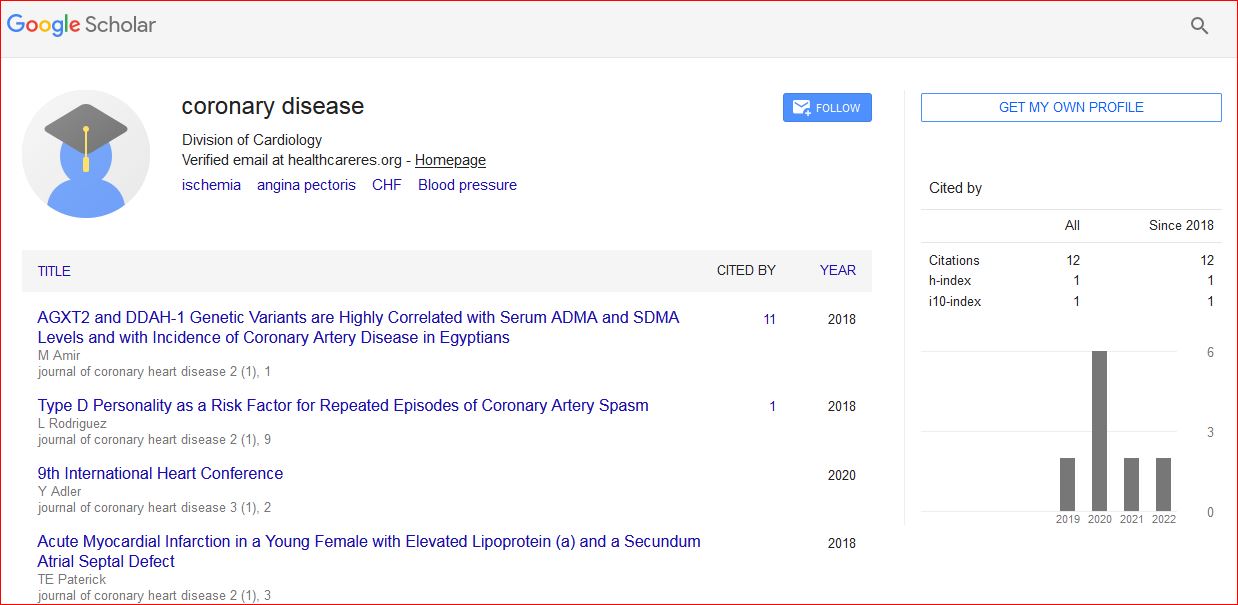
Journal of Coronary Heart Diseases received 15 citations as per Google Scholar report