Perspective - (2025) Volume 9, Issue 5
Received: 01-Sep-2025, Manuscript No. jchd-26-185711;
Editor assigned: 03-Sep-2025, Pre QC No. P-185711;
Reviewed: 17-Sep-2025, QC No. Q-185711;
Revised: 22-Sep-2025, Manuscript No. R-185711;
Published:
29-Sep-2025
, DOI: 10.37421/2684-6020.2024.9.267
Citation: Kowalski, Tomasz. ”Comprehensive Approach to Coronary
Heart Disease.” J Coron Heart Dis 09 (2025):267.
Copyright: © 2025 Kowalski T. This is an open-access article distributed under the terms of the Creative Commons Attribution License, which permits unrestricted use,
distribution and reproduction in any medium, provided the original author and source are credited.
The multifaceted fight against coronary heart disease (CHD) necessitates a comprehensive and adaptive strategy. Despite notable advancements in treatment modalities and public health interventions, persistent challenges demand intensified efforts, particularly in prevention. The escalating prevalence of lifestyle-related risk factors, including obesity, diabetes, and hypertension, underscores the urgent need for more robust preventive measures. Early detection, coupled with personalized risk assessment and equitable access to healthcare services, are fundamental pillars in this ongoing battle. Strengthening community-based programs and strategically leveraging technological innovations are crucial for expanding the reach and effectiveness of public health initiatives. Therefore, it is evident that significant work remains, and continuous adaptation of strategies is essential to effectively curb the substantial burden of CHD on a global scale [1].
Precision medicine presents a promising frontier in the management of CHD, offering the potential to tailor treatments to individual patient profiles. By considering an individual's unique genetic makeup, lifestyle characteristics, and specific disease presentation, treatment outcomes can be significantly enhanced. This paradigm shift involves the identification of novel biomarkers and the development of targeted therapeutic agents that extend beyond conventional treatment approaches. What this signifies is a movement towards more personalized and effective interventions for CHD, although widespread clinical integration necessitates continued research and development [2].
The pivotal role of lifestyle interventions in both the prevention and management of CHD cannot be overstated. Empowering individuals with knowledge and practical tools for adopting healthy dietary habits, engaging in regular physical activity, achieving smoking cessation, and effectively managing stress forms the bedrock of proactive cardiovascular care. These interventions are not merely advisory; they represent potent, cost-effective strategies capable of dramatically altering the natural course of CHD. Ensuring continuous reinforcement of these healthy behaviors and providing accessible support programs are vital for achieving sustained success in long-term patient well-being [3].
Technological advancements are actively reshaping the landscape of CHD care, offering innovative solutions for enhanced patient management. The integration of remote monitoring devices, sophisticated telehealth platforms, and artificial intelligence-driven diagnostic tools is significantly improving early detection capabilities, fostering greater patient engagement, and promoting better adherence to prescribed treatments. This technological evolution enables the extension of care beyond traditional clinical settings, making it more accessible and responsive to the dynamic needs of patients. Consequently, continued innovation in this domain is imperative for scaling effective CHD management strategies to a broader population [4].
Addressing the pervasive socioeconomic disparities that influence CHD is a critical, albeit often underemphasized, aspect of our collective efforts. Unequal access to high-quality healthcare, nutritious food options, and safe environments conducive to physical activity disproportionately affects certain populations. These systemic inequities contribute substantially to the elevated burden of CHD observed in specific communities, highlighting the urgent need for targeted interventions and policy reforms to ensure equitable opportunities for achieving and maintaining cardiovascular health [5].
The intricate role of inflammation in the pathogenesis of CHD remains a primary focus of ongoing research endeavors. A deeper understanding of the complex inflammatory pathways implicated in the disease process holds the potential to unlock the development of novel anti-inflammatory therapeutic strategies. This exploration into the fundamental mechanisms of CHD aims to uncover new avenues for treatment that may prove more efficacious for particular patient subgroups, offering a more nuanced approach to disease management [6].
Public health campaigns and educational initiatives play an indispensable role in elevating public awareness regarding CHD risk factors and actively promoting preventive behaviors. Sustained and meticulously targeted outreach efforts are essential to effectively engage diverse populations and disseminate critical health information. The ultimate success of these campaigns is intrinsically linked to the clarity of their messaging, the accessibility of the platforms utilized, and the active involvement of community stakeholders in their implementation and dissemination [7].
Effective management of comorbidities, such as diabetes and hypertension, is of paramount importance in both the prevention and treatment of CHD. These chronic conditions frequently coexist with cardiovascular disease and significantly amplify an individual's overall cardiovascular risk. Therefore, adopting an integrated approach that addresses these interconnected diseases is crucial for achieving improved patient outcomes and optimizing the management of cardiovascular health [8].
Comprehending the genetic predispositions associated with CHD can significantly inform the development of highly personalized prevention strategies. Implementing genetic screening and risk assessment protocols allows for the identification of individuals at elevated risk, thereby enabling earlier and more precisely targeted interventions. This proactive approach complements traditional risk factor management and introduces novel pathways for the implementation of comprehensive cardiovascular care [9].
The continuous pursuit of novel pharmacological agents for the treatment of CHD remains a vital area of research and development. Investigations into new drug targets and the refinement of drug delivery mechanisms are driven by the aim of enhancing therapeutic efficacy while simultaneously minimizing adverse side effects. This ongoing evolution within the pharmaceutical landscape for CHD offers substantial hope for the advent of more effective and well-tolerated treatments in the foreseeable future [10].
The fight against coronary heart disease (CHD) requires a multifaceted approach, acknowledging that despite advancements, significant challenges persist due to rising lifestyle-related risk factors like obesity, diabetes, and hypertension. Intensified preventive strategies are crucial, focusing on early detection, personalized risk assessment, and equitable access to care. Bolstering community-based programs and leveraging technological innovations are key to expanding reach and effectiveness. Continuous effort and adaptation are essential to truly curb the burden of CHD [1].
Precision medicine offers considerable promise for CHD management by tailoring treatments based on an individual's genetic makeup, lifestyle, and specific disease profile, aiming to significantly improve outcomes. This involves identifying novel biomarkers and developing targeted therapies that go beyond traditional approaches, moving towards a more personalized and effective way of treating CHD, although widespread implementation requires further research and integration into clinical practice [2].
The role of lifestyle interventions in CHD prevention and management is fundamental. Empowering individuals with knowledge and tools for healthy eating, regular physical activity, smoking cessation, and stress reduction are potent, cost-effective strategies that can dramatically alter the trajectory of CHD. Continuous reinforcement and accessible programs are vital for long-term success and patient well-being [3].
Technological advancements are transforming CHD care through remote monitoring devices, telehealth platforms, and AI-driven diagnostic tools, enhancing early detection, patient engagement, and treatment adherence. This allows care to extend beyond clinic walls, making it more accessible and responsive to patient needs, with continued innovation being crucial for scaling effective CHD management [4].
Addressing socioeconomic disparities in CHD is critical, as unequal access to quality healthcare, healthy food, and safe environments for physical activity contributes significantly to the disproportionate burden of CHD in certain communities. Focused interventions and policy changes are needed to ensure equitable opportunities for cardiovascular health [5].
The role of inflammation in the pathogenesis of CHD continues to be a major research focus. Understanding the intricate inflammatory pathways involved can lead to the development of novel anti-inflammatory therapies, delving deeper into the fundamental mechanisms of the disease to find new avenues for treatment that might be more effective for certain patient groups [6].
Public health campaigns and educational initiatives are vital for raising awareness about CHD risk factors and promoting preventive behaviors. Sustained and targeted efforts are needed to reach diverse populations effectively, with their success hinging on clear messaging, accessible platforms, and community engagement [7].
The management of comorbidities, such as diabetes and hypertension, is paramount in CHD prevention and treatment, as these conditions often coexist and significantly amplify cardiovascular risk. An integrated approach to managing these interconnected diseases is necessary to achieve better overall patient outcomes [8].
Understanding the genetic predispositions to CHD can inform personalized prevention strategies. Genetic screening and risk assessment can identify individuals at higher risk, allowing for earlier and more targeted interventions, complementing traditional risk factor management and opening new avenues for proactive cardiovascular care [9].
The development of novel pharmacological agents for CHD is an ongoing pursuit, with research into new drug targets and improved delivery mechanisms aiming to enhance efficacy and reduce side effects. The pharmaceutical landscape for CHD is constantly evolving, offering hope for more effective treatments in the future [10].
Coronary heart disease (CHD) remains a significant global health challenge requiring a comprehensive approach to prevention and treatment. Rising lifestyle-related risk factors necessitate intensified preventive strategies, early detection, personalized risk assessment, and equitable access to care. Precision medicine offers tailored treatments based on individual profiles, while lifestyle interventions focusing on diet, exercise, and stress management are crucial. Technological advancements like remote monitoring and telehealth enhance care accessibility and effectiveness. Addressing socioeconomic disparities is vital for health equity. Research into inflammation and genetic predispositions offers new therapeutic targets and personalized strategies. Public health campaigns and effective management of comorbidities like diabetes and hypertension are essential components of a robust CHD strategy. Ongoing development of novel pharmacological agents promises more effective future treatments.
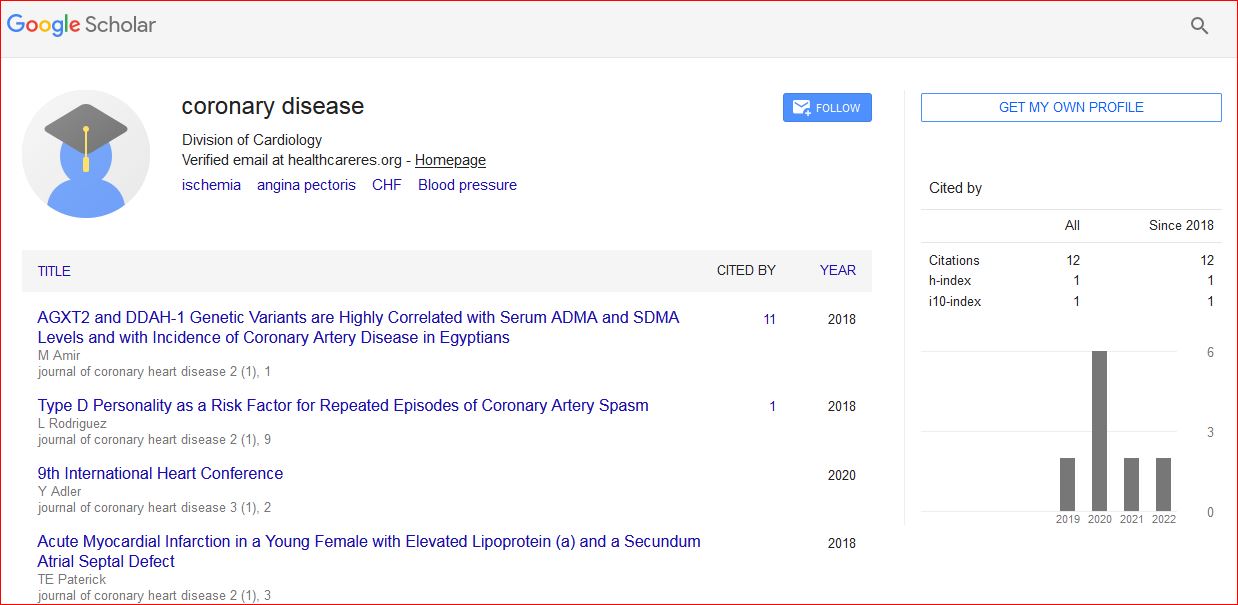
Journal of Coronary Heart Diseases received 15 citations as per Google Scholar report