Opinion - (2025) Volume 16, Issue 6
Received: 01-Nov-2025, Manuscript No. bej-26-182557;
Editor assigned: 03-Nov-2025, Pre QC No. P-182557;
Reviewed: 17-Nov-2025, QC No. Q-182557;
Revised: 22-Nov-2025, Manuscript No. R-182557;
Published:
29-Nov-2025
, DOI: 10.37421/2161-6219.2025.16.586
Citation: Schmidt, Nicolai. ”Competition: Driving Efficiency, Innovation,
and Economic Growth.” Bus Econ J 16 (2025):586.
Copyright: © 2025 Schmidt N. This is an open-access article distributed under the terms of the Creative Commons Attribution License, which permits unrestricted use,
distribution and reproduction in any medium, provided the original author and source are credited.
The relationship between business competition and economic efficiency is a foundational concept in economic theory, with a broad consensus that vigorous competition generally fosters positive outcomes for economies. This has been extensively studied, revealing that industries characterized by a multitude of market participants and low entry barriers are often hotbeds of innovation and cost reduction. Firms in such environments are compelled by competitive pressures to refine their production methods and optimize resource allocation, ultimately leading to enhanced consumer benefits through lower prices and superior products and services. However, it is also acknowledged that the intensity of competition can sometimes lead to adverse effects, such as market instability or a reluctance to invest in long-term research and development initiatives [1].
The intricate dynamics of market structure and its influence on innovation and productivity have been a subject of considerable research, often revealing a curvilinear relationship. Evidence suggests that moderate levels of market competition are most conducive to fostering innovation, stimulating the development of novel products and efficient processes. Conversely, markets that are highly concentrated may experience a reduction in the incentive for innovation due to complacency, and intensely competitive markets can sometimes divert resources away from essential long-term strategic investments through price wars [2].
The regulatory landscape plays a crucial role in shaping the competitive arena and, consequently, overall economic efficiency. Well-structured regulations are instrumental in promoting fair competition by proactively preventing monopolistic practices and establishing a balanced playing field for all market actors. Nevertheless, regulations that are excessively burdensome or inadequately implemented can inadvertently stifle competition, escalate business operational costs, and negatively impact economic performance. Therefore, there is a consistent emphasis on the necessity for adaptive and evidence-based policymaking in this domain [3].
Empirical analyses of firm-level data have consistently demonstrated a positive correlation between operating in more competitive sectors and exhibiting higher levels of total factor productivity. This effect is particularly pronounced in industries that are characterized by rapid technological advancements and a diverse array of competitors. The underlying mechanism appears to be that competitive intensity acts as a continuous impetus, compelling firms to perpetually enhance their operational strategies and product offerings to ensure survival and achieve growth [4].
The advent and proliferation of digital platforms have introduced new dimensions to the study of market competition and economic efficiency. These platforms possess the capacity to significantly reduce transaction costs and ease market entry for smaller enterprises, thereby potentially amplifying competition. However, these developments also engender concerns regarding the concentration of market power within dominant platforms and highlight the urgent need for the adaptation of antitrust frameworks to address these evolving market structures [5].
International trade has a notable impact on domestic competition and the pursuit of economic efficiency. Increased openness to international trade generally correlates with heightened domestic competition, which in turn pressures firms to improve their efficiency and innovative capacities to successfully contend with foreign competitors. The most significant benefits are typically observed in sectors that were previously protected and less competitive in the domestic market [6].
Mergers and acquisitions (M&A) present a complex interplay with market competition and economic efficiency. While certain M&A activities can yield economies of scale and scope, thereby enhancing efficiency, others may lead to increased market concentration and a reduction in competitive pressures, potentially diminishing consumer welfare. Consequently, a thorough and careful scrutiny of M&A transactions is essential to ensure that they contribute positively to the overall economy [7].
Examining the link between competition within labor markets and broader economic efficiency reveals significant insights. Competitive labor markets, where employees possess a degree of mobility and bargaining power, tend to facilitate a more effective allocation of human capital and consequently elevate productivity. Conversely, rigid labor market structures, characterized by substantial barriers to entry or exit for workers, can introduce inefficiencies and impede the optimal deployment of talent [8].
The role of competition in driving the adoption of environmental innovations is another critical area of investigation. Competitive pressures can serve as a powerful incentive for firms to invest in greener technologies and sustainable practices, either to secure a competitive advantage or to align with evolving consumer preferences and regulatory mandates. However, the initial financial outlay required for environmental innovation can pose a significant barrier, particularly for firms operating in highly competitive, low-margin industries [9].
Finally, the dynamic relationship between competition and firm survival is a key aspect of market evolution. Firms operating within intensely competitive markets often face amplified pressure to adapt and innovate, which can result in higher rates of both new firm entry and existing firm exit. While this continuous churn might appear disruptive, it ultimately contributes to a more efficient allocation of resources and a more robust economy by facilitating the replacement of less efficient firms with those that are more competitive and innovative [10].
The intricate relationship between business competition and economic efficiency is a widely recognized driver of economic progress. Vigorous competition, defined by numerous market players and minimal barriers to entry, is generally understood to stimulate innovation and reduce operational costs. This competitive pressure encourages firms to adopt more efficient production methods and to allocate resources more effectively, ultimately benefiting consumers through lower prices and improved product and service quality. However, the literature also cautions that excessive or predatory competitive practices can lead to market instability and may even discourage long-term investment in research and development [1].
The impact of market structure on the pace of innovation and overall productivity is multifaceted, often exhibiting a curvilinear pattern. Research indicates that moderate levels of competition appear to be most beneficial, fostering a fertile environment for the development of new products and processes. In contrast, highly concentrated markets might experience a decline in innovative drive due to complacency, while the intense price competition in highly fragmented markets can sometimes detract from necessary strategic investments in innovation [2].
The influence of regulatory frameworks on the competitive landscape and economic efficiency is substantial. Properly designed regulations can effectively promote fair competition by preventing monopolistic tendencies and ensuring a level playing field for all businesses. Conversely, regulations that are overly burdensome or poorly executed can have the unintended consequence of stifling competition, increasing operating expenses for businesses, and hindering overall economic performance. This underscores the critical need for adaptable and evidence-based regulatory policymaking [3].
Analyses of firm-level data consistently reveal that companies operating in more competitive industry environments tend to demonstrate higher levels of total factor productivity. This effect is particularly evident in sectors marked by rapid technological change and a diverse competitive landscape. The underlying principle is that the intensity of competition acts as a constant motivator, compelling firms to continuously refine their operations and offerings to remain competitive and achieve success [4].
The emergence and dominance of digital platforms have significantly altered the dynamics of market competition and economic efficiency. These platforms can play a role in reducing transaction costs and facilitating market entry for smaller businesses, potentially intensifying competition. However, they also raise important concerns regarding the concentration of market power in the hands of a few dominant platforms and highlight the necessity for updated antitrust regulations and enforcement mechanisms [5].
The effect of international trade on domestic competition and economic efficiency is generally positive. Greater trade openness typically leads to an increase in domestic competition, prompting firms to enhance their efficiency and innovativeness to compete effectively with international counterparts. The most significant benefits are often realized in industries that were previously protected and exhibited lower levels of domestic competition [6].
Mergers and acquisitions (M&A) have a complex and varied impact on market competition and economic efficiency. While some M&A activities can result in economies of scale and scope, leading to improved efficiency, others can lead to increased market concentration and reduced competition, potentially negatively affecting consumer welfare. Therefore, a rigorous evaluation of M&A transactions is crucial to ensure they contribute positively to economic outcomes [7].
Competition within labor markets is also a key determinant of overall economic efficiency. Competitive labor markets, characterized by worker mobility and bargaining power, can lead to a more efficient allocation of human capital and improved productivity. Conversely, labor markets with significant restrictions or barriers can result in inefficiencies and a suboptimal distribution of talent, hindering overall economic performance [8].
The relationship between competition and the adoption of environmental innovations is an area of growing importance. Competitive pressures can encourage firms to invest in sustainable technologies and practices to gain a competitive edge or to meet evolving market demands. However, the initial costs associated with environmental innovation can present a barrier, particularly for firms in highly competitive, low-margin industries where immediate profitability is paramount [9].
The dynamic interplay between competition and firm survival is fundamental to market evolution. Firms in highly competitive markets face significant pressure to adapt and innovate, leading to a higher rate of both new firm entry and existing firm exit. This market churn, while potentially disruptive in the short term, ultimately drives a more efficient allocation of resources and a stronger economy as less competitive firms are replaced by more dynamic and efficient ones [10].
Competition is a critical driver of economic efficiency, fostering innovation, cost reduction, and improved consumer welfare. Vigorous competition, characterized by multiple firms and low entry barriers, incentivizes firms to adopt efficient practices. However, excessive competition can lead to instability. Market structure plays a role, with moderate competition often being optimal for innovation. Regulations are vital for fair competition, but can also stifle it if poorly designed. Competitive sectors generally exhibit higher productivity. Digital platforms create new competitive dynamics and concerns about market power. International trade and M&A activities have complex effects on competition and efficiency. Competitive labor markets improve human capital allocation. Competition can also drive environmental innovation, though initial costs can be a barrier. Finally, competition influences firm survival, leading to resource reallocation and a stronger economy.
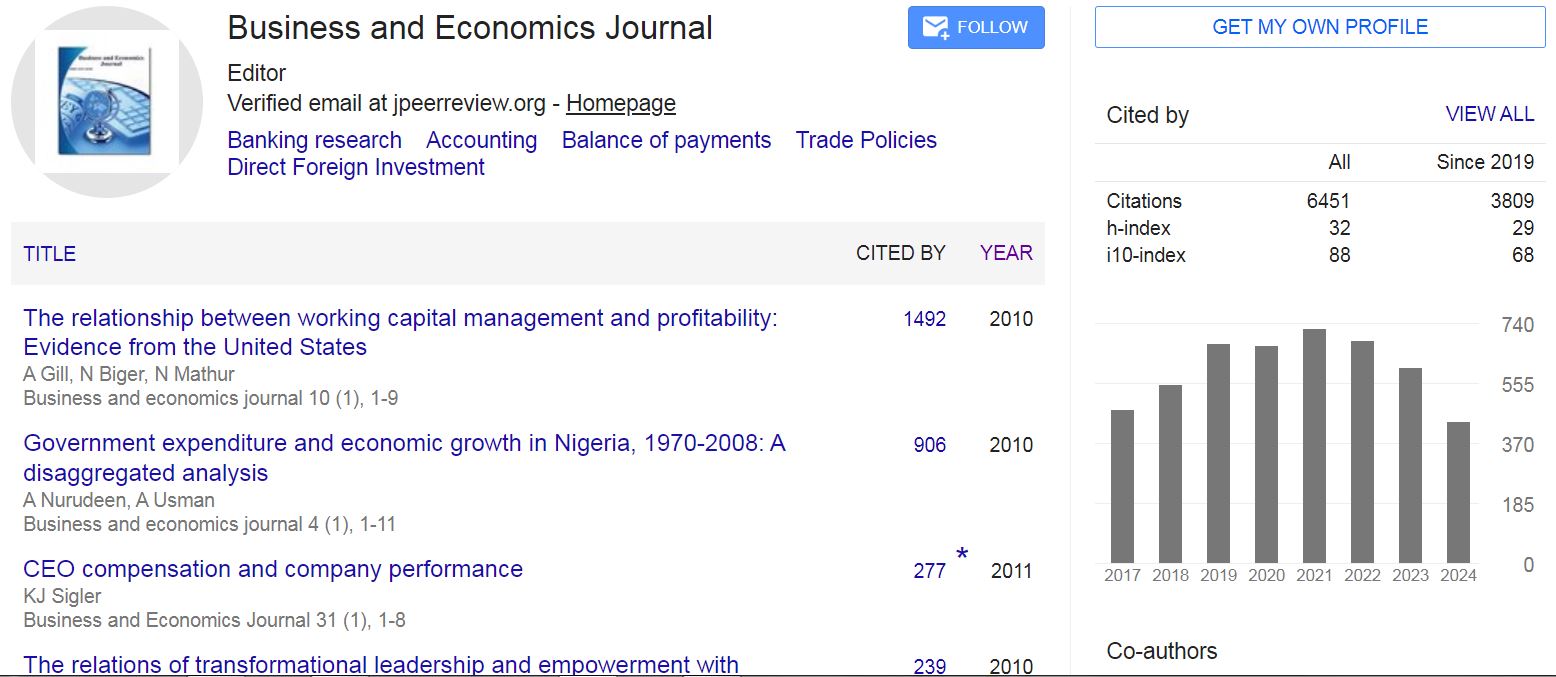
Business and Economics Journal received 6451 citations as per Google Scholar report