Brief Report - (2025) Volume 10, Issue 3
Received: 02-Jun-2025, Manuscript No. jcct-26-183211;
Editor assigned: 04-Jun-2025, Pre QC No. P-183211;
Reviewed: 18-Jun-2025, QC No. Q-183211;
Revised: 23-Jun-2025, Manuscript No. R-183211;
Published:
30-Jun-2025
, DOI: 10.37421/2577-0535.2025.9.309
Citation: Zhou, Mei-Ling. ”Combination Therapy For Advanced Cancer: A New Era.” J Cancer Clin Trials 10 (2025):309.
Copyright: © 2025 Zhou M. This is an open-access article distributed under the terms of the Creative Commons Attribution License, which permits unrestricted use, distribution and reproduction in any medium, provided the original author and source are credited.
Combination therapy has emerged as a cornerstone in the management of advanced cancers, representing a sophisticated approach to overcome intrinsic or acquired resistance mechanisms and ultimately enhance patient outcomes. This strategy is built on the principle of simultaneously or sequentially applying multiple therapeutic agents, each with distinct mechanisms of action, to target cancer cells more effectively and broadly than monotherapy. The evolving landscape of clinical trials is central to understanding and optimizing these multifaceted treatment regimens. Ongoing and recently completed clinical trials are actively investigating a wide array of combination therapies, providing critical insights into their rationale, intricate design, and preliminary findings. A significant focus of this research is placed on elucidating the synergistic interactions that can occur between different drug classes, such as the potent combination of immunotherapy with traditional chemotherapy or with targeted agents. The aim is to leverage these synergies to achieve deeper and more durable responses. In the realm of advanced non-small cell lung cancer (NSCLC), combination therapy trials are pivotal in pushing the boundaries of treatment efficacy. These studies explore novel pairings that aim to address the heterogeneity of NSCLC and its propensity for developing resistance to single-agent therapies. The findings from these trials are instrumental in refining treatment paradigms for this challenging disease [1].
Furthermore, the investigation into novel combinations involving immunotherapy with other treatment modalities is crucial for improving response rates and the durability of responses in patients with advanced solid tumors. This involves strategically combining checkpoint inhibitors with chemotherapy, targeted therapies, or radiation, underscoring the importance of patient selection biomarkers and optimizing treatment sequencing to maximize benefit [2].
Targeted therapies, when judiciously combined, offer a refined and personalized approach to treating advanced cancers that are driven by specific molecular alterations. These combinatorial strategies aim to hit multiple oncogenic pathways simultaneously or sequentially, thereby mitigating the development of resistance and enhancing therapeutic efficacy. The design and interpretation of these complex trials present unique challenges [3].
The integration of chemotherapy with novel agents, including immunotherapies and targeted drugs, represents a key area of research in advanced hematologic malignancies. Clinical trials in this domain are meticulously evaluating various drug pairings to assess their impact on response rates, survival, and toxicity profiles, while also considering dose optimization and schedule modifications [4].
Precision medicine in the context of advanced cancers is intrinsically linked to the development and implementation of effective combination strategies. These approaches leverage detailed molecular profiling of tumors to guide the selection of therapies that target multiple oncogenic pathways or employ dual targeting strategies. Adaptive trial designs are also being utilized to rapidly identify the most effective treatment combinations for diverse patient populations [5].
The role of immunotherapy in combination with chemotherapy is continuously expanding in the treatment of advanced gastrointestinal cancers. Synthesizing results from recent clinical trials is essential for understanding the optimal chemotherapy backbones, managing overlapping toxicities, and predicting response to these combined modalities across various subtypes of these cancers [6].
Combination therapy trials in advanced renal cell carcinoma (RCC) have centered on optimizing immunotherapy regimens and integrating targeted agents. These trials are investigating combinations such as PD-1/PD-L1 inhibitors with CTLA-4 inhibitors or VEGF inhibitors, assessing their impact on survival outcomes and exploring novel combination approaches [7].
Finally, trials exploring combination therapies for advanced prostate cancer are essential for overcoming treatment resistance, particularly in metastatic castration-resistant prostate cancer (mCRPC). Current strategies involve combining androgen receptor signaling inhibitors with chemotherapy, novel hormonal agents, and emerging immunotherapies to improve patient outcomes in advanced settings [8].
Combination therapy trials in advanced ovarian cancer are crucial for enhancing efficacy and preventing recurrence. Recent investigations have focused on combining chemotherapy with PARP inhibitors, antiangiogenic agents, and immunotherapy, addressing challenges in trial design, patient stratification, and the impact on clinical outcomes in both platinum-sensitive and platinum-resistant disease [9].
Given the limited efficacy of single-agent treatments in advanced pancreatic cancer, combination therapy trials are of paramount importance. Recent trials are exploring combinations of standard chemotherapy with novel agents like targeted therapies, immunotherapies, and oncolytic viruses, with a focus on overcoming the immunosuppressive tumor microenvironment and improving treatment response in this challenging disease [10].
Combination therapy is a critical strategy in advanced cancer treatment, aimed at improving efficacy by overcoming resistance and enhancing patient outcomes. The ongoing exploration of novel combinations through rigorous clinical trials is shaping the future of cancer care, with a particular emphasis on synergistic interactions between different therapeutic modalities. Understanding these complex interactions is key to unlocking the full potential of multi-agent treatments. Recent clinical trials are extensively investigating various combinations, from immunotherapy paired with chemotherapy or targeted agents to other novel therapeutic pairings, particularly in advanced non-small cell lung cancer (NSCLC). The rationale behind these combinations, their design, and preliminary findings are being meticulously documented to guide further research and clinical application in different advanced cancer types [1].
In the broader context of advanced solid tumors, the investigation of novel immunotherapy combinations is paramount for improving response rates and achieving durable responses. This includes combining checkpoint inhibitors with chemotherapy, targeted therapies, and radiation, with a strong focus on identifying predictive biomarkers for patient selection and optimizing the sequence of treatment administration to achieve optimal therapeutic benefit [2].
For advanced cancers driven by specific molecular alterations, targeted therapies are being combined to offer a more refined treatment approach. These combinations aim to inhibit multiple key signaling pathways simultaneously or sequentially, thereby overcoming acquired resistance and improving overall efficacy. The design and interpretation of these sophisticated clinical trials are complex and require careful consideration of numerous factors [3].
The integration of chemotherapy with emerging agents like immunotherapies and targeted drugs is a significant focus in the treatment of advanced hematologic malignancies. Clinical trials in this area are reviewing the rationale for specific drug pairings and their impact on crucial endpoints such as response rates, survival, and toxicity profiles, with attention to dose and schedule adjustments [4].
Precision medicine in advanced cancers is heavily reliant on the development of effective combination strategies. These strategies are guided by comprehensive molecular profiling of individual tumors, leading to combinations that target multiple oncogenic pathways or employ dual targeting. The use of adaptive trial designs allows for rapid identification of effective combinations for diverse patient populations [5].
The combination of chemotherapy with immunotherapy is a rapidly expanding area in the treatment of advanced gastrointestinal cancers. Recent clinical trials are being synthesized to identify optimal chemotherapy backbones, manage overlapping toxicities, and predict patient response to these combined modalities across various gastrointestinal cancer subtypes [6].
In advanced renal cell carcinoma (RCC), combination therapy trials are primarily focused on optimizing immunotherapy regimens and integrating targeted agents. These studies explore combinations of PD-1/PD-L1 inhibitors with other agents like CTLA-4 inhibitors and VEGF inhibitors, evaluating their impact on progression-free and overall survival, and exploring novel combinations [7].
For advanced prostate cancer, especially in the metastatic castration-resistant setting (mCRPC), combination therapies are crucial for overcoming treatment resistance. Current clinical trials are examining combinations of androgen receptor signaling inhibitors with chemotherapy, novel hormonal agents, and immunotherapies to improve outcomes in these advanced stages [8].
In advanced ovarian cancer, combination therapies are increasingly employed to enhance treatment efficacy and prevent disease recurrence. Recent trials have focused on combinations of chemotherapy with PARP inhibitors, antiangiogenic agents, and immunotherapy. Challenges related to trial design, patient stratification, and the impact of these combinations on clinical outcomes are being addressed [9].
Advanced pancreatic cancer, notoriously challenging to treat with single agents, necessitates extensive research into combination therapies. Recent trials are evaluating combinations of standard chemotherapy with novel agents, including targeted therapies, immunotherapies, and oncolytic viruses, with the goal of overcoming the immunosuppressive tumor microenvironment and improving treatment response [10].
Combination therapy is a vital strategy in advanced cancer management, aiming to overcome resistance and improve patient outcomes through the synergistic use of multiple agents. Clinical trials are exploring various combinations, including immunotherapy with chemotherapy or targeted agents, in diverse cancer types like NSCLC, solid tumors, and hematologic malignancies. Precision medicine leverages molecular profiling to guide these combinations, targeting multiple pathways. Studies in gastrointestinal cancers, renal cell carcinoma, prostate cancer, ovarian cancer, and pancreatic cancer are investigating novel pairings to enhance efficacy, manage resistance, and improve survival. Challenges in trial design, patient selection, and toxicity management are being addressed to advance treatment paradigms.
None
None
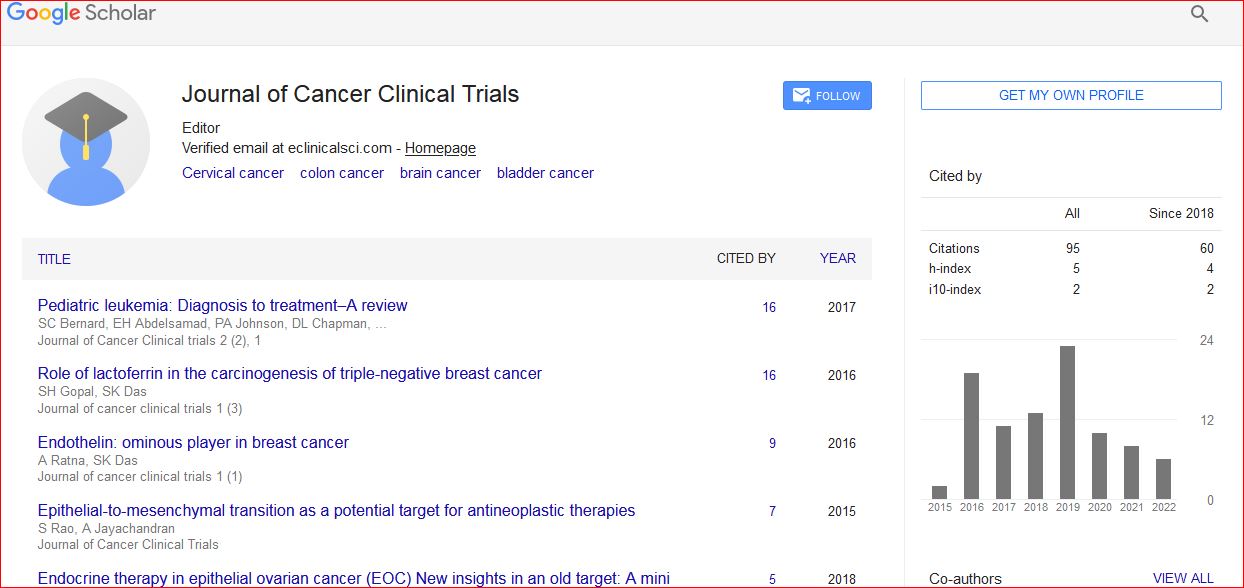
Journal of Cancer Clinical Trials received 95 citations as per Google Scholar report