Short Communication - (127) Volume 14, Issue 4
Received: 01-Dec-2025, Manuscript No. ara-25-175635;
Editor assigned: 03-Dec-2025, Pre QC No. P-175635;
Reviewed: 17-Dec-2025, QC No. Q-175635;
Revised: 22-Dec-2025, Manuscript No. R-175635;
Published:
29-Dec-2025
, DOI: 10.37421/2168-9695.2025.14.351
Citation: Li, Wenhao. ”Cloud Robotics: Evolution, Capabilities, Challenges.” Adv Robot Autom 14 (2025):351.
Copyright: © 2025 Li W. This is an open-access article distributed under the terms of the Creative Commons Attribution License, which permits unrestricted use, distribution and reproduction in any medium, provided the original author and source are credited.
This foundational work establishes cloud robotics as a critical area, leveraging vast cloud computing capabilities. Robots gain an ability to offload intensive tasks like complex path planning and significant data processing, which greatly enhances their functionality while simultaneously cutting down on the need for powerful local hardware. This initial survey lays out the core architectural principles that underpin this transformative approach, making it clear how distributed intelligence fundamentally changes what robots can achieve[1].
Moving beyond centralized models, the concept of edge cloud robotics emerges, addressing crucial real-time application needs. Integrating edge computing directly tackles the persistent issues of latency and bandwidth limitations, which are often roadblocks for responsive robotic operations. This shift promises a more distributed model, presenting both exciting new opportunities and inherent challenges that must be navigated for seamless, real-time robotic interactions and controls[2].
The advent of 5G technology marks a significant leap for cloud robotics, unlocking new architectural designs and practical applications. The high bandwidth and remarkably low latency offered by 5G networks enable instantaneous and highly reliable communication between robotic units and their cloud-based infrastructure. This connectivity paves the way for advanced remote control, complex collaborative robotics, and truly real-time Artificial Intelligence processing capabilities, fundamentally changing the operational landscape for these systems[3].
Artificial Intelligence (AI) plays a pivotal role in evolving cloud robotics toward more intelligent automation across diverse sectors. The powerful combination of AI algorithms, particularly those in deep learning, with scalable cloud infrastructure empowers robots with superior perception, more robust decision-making abilities, and enhanced learning capacities. These combined attributes are indispensable for robots operating effectively in dynamic and often unpredictable environments, leading to unprecedented levels of autonomy[4].
Cloud robotics finds a vital application in fostering collaborative industrial tasks, where human and robotic agents can work in concert. Cloud platforms are instrumental in orchestrating multiple robots, maintaining shared knowledge bases, and providing immediate support for human-robot interactions. This integration is designed to substantially boost efficiency and elevate safety standards within demanding environments such as manufacturing and logistics operations, creating more harmonious work settings[5].
For cloud robotics to operate efficiently and scale effectively, resource optimization is absolutely essential. This area of research explores a variety of strategies and sophisticated algorithms specifically designed to manage and allocate computational resources, storage, and network bandwidth within the cloud environment. The ultimate goal is to minimize latency and maximize throughput for all robotic tasks, ensuring that performance remains high even under heavy loads[6].
The healthcare sector stands to gain immensely from the transformative potential of cloud robotics. This involves developing specific architectural models for deploying robots in critical medical settings. Cloud integration here promises to significantly enhance diagnostic capabilities, offer precision assistance during complex surgeries, and elevate overall patient care through remote operational control and instant access to vast, critical medical datasets. However, this domain also introduces unique and complex challenges that require careful consideration[7].
The integration of digital twin technology with cloud robotics is particularly impactful for intelligent manufacturing. By creating precise virtual replicas of physical robots and their operational environments within the cloud, manufacturers can achieve real-time monitoring, implement predictive maintenance strategies, and exercise optimized control over their systems. This synergistic approach leads directly to more agile, efficient, and responsive production processes, marking a significant advancement in industrial automation[8].
As cloud robotics systems become more prevalent, addressing critical privacy and security challenges becomes paramount. This systematic review identifies vulnerabilities associated with data transmission, storage, and processing within the cloud infrastructure. It delves into the serious implications these vulnerabilities pose for sensitive user and environmental data, while also proposing crucial directions for developing comprehensive and robust security frameworks to protect these evolving systems[9].
Achieving energy efficiency in cloud robotics is a key area of investigation, especially through intelligent task offloading mechanisms. Researchers propose innovative approaches, such as deep reinforcement learning, to dynamically determine whether computational tasks are best processed locally by the robot or offloaded to the cloud. This strategic decision-making aims to minimize overall energy consumption without compromising performance, ensuring sustainable and effective long-term operation for robotic systems[10].
Cloud robotics fundamentally transforms robotic capabilities by integrating with powerful cloud computing resources. This allows robots to offload demanding computations, such as intricate path planning and processing massive datasets, to the cloud. The result is enhanced robot functionality and reduced reliance on heavy, local hardware. This foundational approach establishes the architecture for robots to leverage distributed intelligence efficiently[1]. Evolving from this, edge cloud robotics introduces a more distributed processing model, moving away from purely centralized cloud operations. This paradigm addresses critical real-time application requirements by tackling latency issues and bandwidth constraints, which are significant for responsive robotic systems. It represents a hybrid approach with both considerable opportunities and unique challenges for performance optimization[2].
Technological enablers significantly shape the future of cloud robotics. The deployment of 5G technology has a profound impact, facilitating new architectural possibilities and applications due to its high bandwidth and low latency. This ensures more reliable and instantaneous communication between robots and cloud infrastructure, essential for advanced remote control, complex collaborative tasks, and real-time Artificial Intelligence (AI) processing[3]. Furthermore, Artificial Intelligence is actively transforming cloud robotics, leading to sophisticated automation across diverse industries. The synergy between advanced AI algorithms, especially deep learning, and robust cloud infrastructure provides robots with superior perception, refined decision-making, and enhanced learning capabilities. These are critical attributes for operating effectively in dynamic and complex environments[4].
Cloud robotics is finding diverse and impactful applications across various sectors. For instance, in industrial settings, it facilitates collaborative tasks where humans and robots work together seamlessly. Cloud platforms coordinate multiple robotic units, manage shared knowledge bases, and provide real-time support for human-robot interaction, thereby boosting efficiency and safety in manufacturing and logistics[5]. The healthcare sector also presents a transformative potential for cloud robotics. Architectural models for medical robot deployment leverage cloud integration to enhance diagnostic abilities, assist in surgeries, and improve patient care through remote operation and access to extensive medical data, despite inherent challenges[7]. In intelligent manufacturing, integrating digital twin technology with cloud robotics is proving revolutionary. By creating virtual replicas of physical robots and their environments in the cloud, real-time monitoring, predictive maintenance, and optimized control become possible, resulting in more agile and efficient production processes[8].
Efficient and scalable operations in cloud robotics critically depend on resource optimization. This involves developing and implementing strategies and algorithms to effectively manage and allocate computational resources, storage, and network bandwidth within the cloud. The goal is to minimize latency and maximize throughput for all robotic tasks, ensuring consistent performance[6]. However, this advanced paradigm is not without its hurdles. Privacy and security challenges are significant, as cloud robotics systems involve vulnerabilities related to data transmission, storage, and processing. These issues have serious implications for sensitive user and environmental data, necessitating the development of robust security frameworks[9]. Another area of focus is achieving energy efficiency, particularly through intelligent task offloading. Research explores deep reinforcement learning approaches to dynamically decide whether computational tasks should be processed locally on the robot or offloaded to the cloud, ultimately aiming to reduce overall energy consumption while maintaining high performance standards[10].
Cloud robotics integrates powerful cloud computing with robotic systems, allowing robots to offload complex computations like path planning and large-scale data processing. This setup enhances robot capabilities while reducing local hardware needs. The field is evolving, with edge cloud robotics emerging to address latency and bandwidth limitations by distributing processing closer to the robots. This hybrid approach offers significant opportunities for real-time applications. Key advancements include the impact of 5G technology, which provides high bandwidth and low latency for reliable communication, enabling advanced remote control and collaborative robotics. Artificial Intelligence, particularly deep learning, further transforms cloud robotics by empowering robots with enhanced perception, decision-making, and learning capabilities, crucial for dynamic environments. Applications span collaborative industrial tasks, where cloud platforms coordinate multiple robots and manage shared knowledge, improving efficiency and safety. Resource optimization is vital for scalable cloud robotics, involving strategies to manage computational resources, storage, and network bandwidth to minimize latency and maximize throughput. Cloud robotics also shows transformative potential in healthcare, assisting in diagnostics, surgeries, and patient care through remote operation and access to vast medical data. Digital twin technology integrates with cloud robotics for intelligent manufacturing, creating virtual replicas for real-time monitoring and predictive maintenance. However, the paradigm faces challenges, particularly regarding privacy and security, which involve vulnerabilities in data transmission, storage, and processing. Energy efficiency is another crucial aspect, with research focusing on intelligent task offloading mechanisms to minimize overall energy consumption through approaches like deep reinforcement learning.
None
None
Se-Bin H, Jin-Sung K, Se-Hyeon L. "Cloud Robotics: A Survey".IEEE Access 8 (2020):147098-147112.
Indexed at, Google Scholar, Crossref
Li DX, Hongwei L, Robert HD. "Edge Cloud Robotics: Opportunities and Challenges".IEEE Trans. Ind. Inform. 17 (2021):7291-7299.
Indexed at, Google Scholar, Crossref
Kaushal SK, Ghanshyam KS, Vikas KS. "A Survey on 5G-Enabled Cloud Robotics: Architectures, Applications, and Future Directions".IEEE Commun. Surv. Tutor. 24 (2022):1113-1147.
Indexed at, Google Scholar, Crossref
Yang W, Zhiyuan L, Xiang C. "AI-Powered Cloud Robotics for Intelligent Automation".Eng. Appl. Artif. Intell. 122 (2023):106437.
Indexed at, Google Scholar, Crossref
Muhammad MRMN, Roslizal R, N. ARA. "Towards Collaborative Cloud Robotics for Industrial Applications".J. Phys. Conf. Ser. 1874 (2021):012012.
Indexed at, Google Scholar, Crossref
Shakeel RA, M. JK, M. AK. "Resource Optimization in Cloud Robotics: A Survey".Appl. Sci. 12 (2022):3604.
Indexed at, Google Scholar, Crossref
Ahmad MHFS, Khalid E, Adel MA. "Cloud Robotics in Healthcare: Architectures, Challenges, and Future Trends".IEEE Trans. Ind. Inform. 19 (2023):6940-6950.
Indexed at, Google Scholar, Crossref
Zhiwei R, Sheng H, Xi C. "Digital Twin and Cloud Robotics for Intelligent Manufacturing: A Review".J. Manuf. Syst. 66 (2023):162-175.
Indexed at, Google Scholar, Crossref
Aisha AA, Mazen LNA, Mahmoud KH. "Privacy and Security Challenges in Cloud Robotics: A Systematic Literature Review".Symmetry 13 (2021):582.
Indexed at, Google Scholar, Crossref
Majid AAA, Mohammad SO, Mohammad A. "Energy-Efficient Task Offloading in Cloud Robotics: A Deep Reinforcement Learning Approach".IEEE Trans. Green Commun. Netw. 7 (2023):257-268.
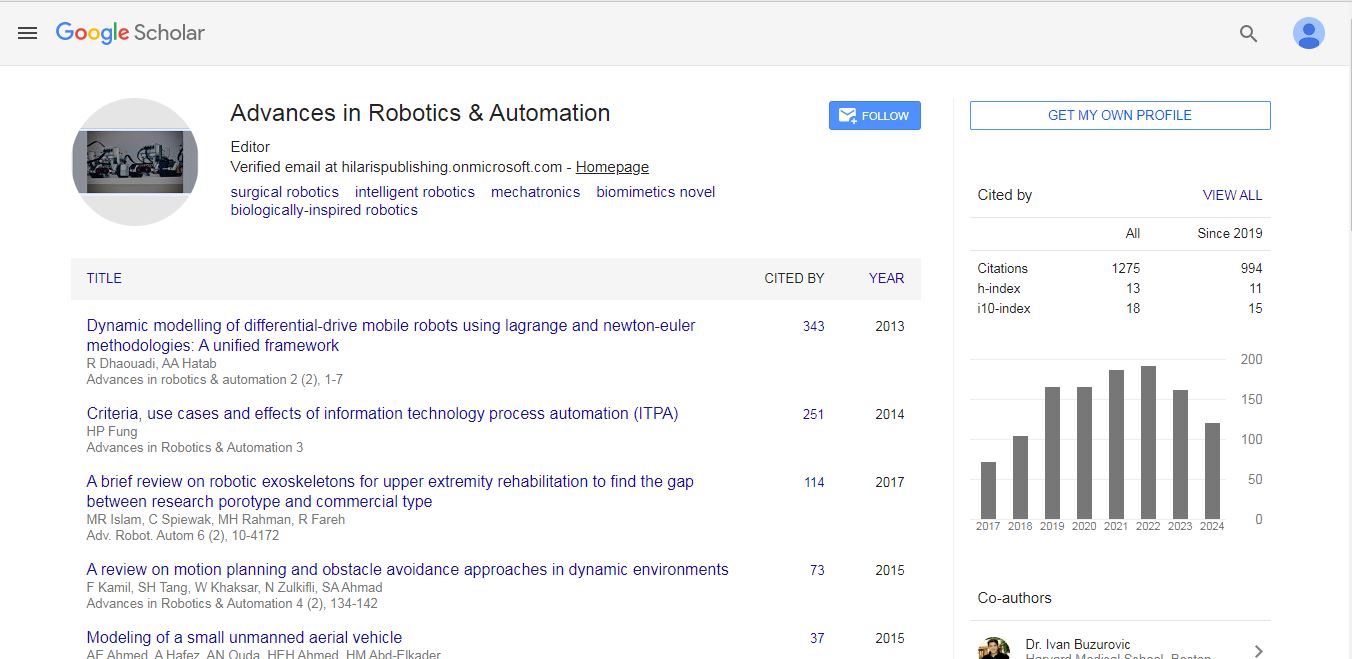
Advances in Robotics & Automation received 1275 citations as per Google Scholar report