Brief Report - (2025) Volume 16, Issue 5
Received: 01-Sep-2025, Manuscript No. hycr-25-175000;
Editor assigned: 03-Sep-2025, Pre QC No. P-175000;
Reviewed: 17-Sep-2025, QC No. Q-175000;
Revised: 22-Sep-2025, Manuscript No. R-175000;
Published:
29-Sep-2025
, DOI: 10.37421/2157-7587.2025.16.616
Citation: Santoro, Diego. ”Climate-Driven Rainfall: Impacts on Health and Society.” Hydrol Current Res 16 (2025):616.
Copyright: © 2025 Santoro D. This is an open-access article distributed under the terms of the Creative Commons Attribution License, which permits unrestricted use,
distribution and reproduction in any medium, provided the original author and source are credited.
The planet faces a critical challenge as rising global temperatures intensify extreme rainfall events worldwide. Advanced climate models predict future trends, highlighting the increased frequency and severity of these events, posing significant challenges for flood management and infrastructure resilience across different regions [1].
Understanding the human contribution to these changes is paramount. Research has actively investigated the role of human-induced climate change in recent extreme rainfall events observed across Europe. This work utilizes a robust attribution framework to quantify precisely how much climate change has increased the likelihood and intensity of these events, providing crucial insights for the development of regional climate adaptation strategies [2].
Beyond direct flood risks and infrastructural strain, altered rainfall patterns have profound and often devastating implications for public health, especially concerning vector-borne diseases globally. For example, comprehensive studies analyzing global rainfall patterns reveal a strong correlation with the incidence of dengue fever outbreaks. These studies demonstrate how shifts in rainfall, particularly extreme events, directly create favorable conditions for mosquito breeding and accelerate disease transmission, thereby offering critical insights for enhanced public health surveillance and the development of effective early warning systems [3].
Similarly, specific rainfall conditions have been identified as significant contributors to an increased risk of malaria transmission within the Brazilian Amazon region. Through detailed spatiotemporal analysis, researchers pinpoint these specific conditions, providing valuable geographical insights that are essential for designing targeted public health interventions against the disease [5].
Furthering this crucial understanding, a longitudinal study conducted in endemic regions of Nepal meticulously examines the correlation between rainfall, ambient temperature, and the incidence of visceral leishmaniasis. This research highlights how specific climatic variables, including distinctive rainfall patterns, profoundly influence the disease vector's ecology and its transmission dynamics, thereby supporting the implementation of climate-sensitive health interventions [7].
The link between rainfall variability and the prevalence of waterborne diseases also presents a major and immediate public health concern. Research investigating the explicit association of rainfall patterns with waterborne disease outbreaks in Bangladesh clearly reveals that specific rainfall conditions, such as heavy downpours immediately followed by widespread flooding, significantly increase the risk of such outbreaks. This information is absolutely crucial for informing effective public health interventions and robust disaster preparedness planning [4].
In a similar vein, a detailed spatiotemporal analysis meticulously links rainfall patterns to severe cholera outbreaks in Yemen, a country already severely impacted by ongoing humanitarian crises. This analysis precisely identifies specific environmental conditions, particularly intense heavy rainfall and subsequent extensive flooding, that demonstrably exacerbate cholera transmission. Such data offers crucial guidance for targeted aid and preventative measures in vulnerable populations [6].
Furthermore, a comprehensive review synthesizes the current body of research on how rainfall events, particularly extreme ones, directly affect water quality and subsequently impact public health. This review emphatically emphasizes the various pathways through which rainfall-induced changes in water quality directly lead to increased risks of waterborne diseases, underscoring the pressing need for integrated and adaptive water resource management strategies [8].
Beyond the direct challenges to public health, changing rainfall patterns have far-reaching and often detrimental consequences for fundamental societal pillars. For instance, extensive research examines how altered rainfall patterns directly affect agricultural productivity and, consequently, threaten food security, especially in already vulnerable regions worldwide. This work carefully elucidates the complex mechanisms through which altered rainfall variability, intensity, and timing significantly impact crop yields and proposes practical adaptation strategies designed to enhance agricultural resilience against these pervasive climate-induced challenges [9].
Whatâ??s more, there is an increasingly recognized yet still under-explored link between heavy rainfall events and an observable increase in the incidence of psychiatric emergencies. A systematic review synthesizes compelling evidence suggesting that extreme weather conditions, like severe rainfall, can exacerbate existing mental health conditions, possibly due to factors such as forced displacement, heightened stress levels, or the disruption of essential social support networks. This research calls urgently for integrated and proactive disaster mental health preparedness planning [10].
Collectively, these diverse and impactful studies consistently underscore the widespread, multifaceted, and deeply interconnected impacts of changing rainfall patterns, driven by an accelerating warming climate, on intricate ecological systems, fragile public health infrastructures, global economic stability, and overall social well-being across the globe.
The intensification of extreme rainfall events globally, driven by rising temperatures, presents significant challenges for modern societies [1]. Climate models are increasingly sophisticated in predicting these trends, highlighting the need for robust flood management and resilient infrastructure. Understanding how human activity contributes to these climatic shifts is a key research area. Studies, such as those focusing on Europe, quantify the extent to which human-induced climate change increases the likelihood and intensity of extreme rainfall, offering vital insights for regional adaptation strategies [2]. This deep dive into climate attribution underscores the urgent need for comprehensive environmental policies and proactive measures to mitigate the far-reaching impacts of a warming planet.
One major area of concern is the impact of rainfall shifts on public health, particularly the proliferation of vector-borne diseases. Global rainfall patterns are strongly correlated with outbreaks of diseases like dengue fever. Changes in rainfall, especially extreme events, create ideal conditions for mosquito breeding, which directly escalates disease transmission. These insights are fundamental for developing effective public health surveillance and early warning systems to protect vulnerable populations [3]. Similarly, research in the Brazilian Amazon region has identified specific rainfall conditions that elevate the risk of malaria transmission. Through detailed spatiotemporal analysis, these studies provide crucial geographical insights, enabling more targeted and effective public health interventions against the disease in endemic areas [5]. Furthermore, a longitudinal study in Nepal explores the intricate relationship between rainfall, temperature, and visceral leishmaniasis. It reveals how specific climatic variables, including distinct rainfall patterns, significantly influence the ecology of the disease vector and its transmission dynamics, which is vital for designing climate-sensitive health interventions that can anticipate and respond to changing environmental conditions [7].
The link between rainfall and waterborne disease outbreaks also represents a critical public health challenge, particularly in regions prone to heavy precipitation and flooding. For instance, investigations in Bangladesh clearly demonstrate that specific rainfall conditions, such as intense downpours followed by widespread flooding, substantially increase the risk of waterborne disease outbreaks. This understanding is indispensable for guiding public health interventions and strengthening disaster preparedness measures [4]. In a humanitarian context, a spatiotemporal analysis in Yemen meticulously links rainfall patterns to cholera outbreaks. It identifies particular environmental conditions, especially heavy rainfall and subsequent flooding, as key drivers exacerbating cholera transmission. This research provides critical data for informing targeted aid efforts and implementing preventative strategies in severely affected areas [6]. Moreover, a comprehensive review synthesizes existing research on how rainfall events, particularly extreme ones, impact water quality and consequently public health. This review highlights the various pathways through which rainfall-induced alterations in water quality lead to elevated risks of waterborne diseases, thereby emphasizing the urgent necessity for integrated water resource management to safeguard community health [8].
Beyond the direct health implications, changing rainfall patterns exert profound effects on economic stability and social well-being. Agricultural productivity, a cornerstone of food security, is particularly vulnerable. Research examining these impacts in vulnerable regions elucidates the mechanisms through which altered rainfall variability, intensity, and timing significantly affect crop yields. It proposes concrete adaptation strategies aimed at enhancing agricultural resilience against these climate-induced challenges, ensuring sustainable food production [9]. Moreover, an emerging area of research explores the often-overlooked connection between heavy rainfall events and an increased incidence of psychiatric emergencies. A systematic review gathers evidence suggesting that extreme weather can indeed exacerbate mental health conditions. Potential factors include forced displacement, heightened stress, and the disruption of vital social support networks. This highlights a pressing need for integrating mental health preparedness into comprehensive disaster response frameworks, acknowledging the full spectrum of climate change impacts on human well-being [10].
The collective body of research underscores that understanding rainfall dynamics is central to addressing global health, environmental, and socio-economic challenges. From predicting future climate trends and attributing human influence to extreme events, to formulating targeted public health strategies for vector- and waterborne diseases, and developing adaptive measures for agriculture and mental health, the interconnectedness of these issues demands integrated and proactive solutions. These studies collectively inform policy-making, resource allocation, and community resilience building in the face of an increasingly volatile climate.
Rising global temperatures are intensifying extreme rainfall events, posing significant challenges for flood management, infrastructure, and public health worldwide. Research consistently demonstrates that human-induced climate change is increasing both the likelihood and intensity of these extreme events, underscoring the urgent need for robust climate adaptation strategies at global and regional scales. Altered rainfall patterns are strongly linked to the incidence and spread of various infectious diseases. For instance, extreme rainfall creates favorable conditions for mosquito breeding, contributing to outbreaks of dengue fever and increased malaria transmission in vulnerable regions. Similarly, heavy downpours and subsequent widespread flooding are key drivers behind waterborne disease outbreaks, including cholera, by compromising water quality and directly impacting community health. Beyond infectious diseases, the shifting nature of rainfall patterns severely impacts agricultural productivity, thereby threatening food security in vulnerable regions through unpredictable effects on crop yields and overall agricultural stability. Furthermore, an emerging understanding points to a concerning association between heavy rainfall events and an increased incidence of psychiatric emergencies. Evidence suggests that extreme weather conditions can exacerbate existing mental health conditions, often due to factors like forced displacement, heightened stress, and the disruption of crucial social support networks. This comprehensive body of work collectively highlights the multifaceted and deeply interconnected impacts of climate-driven rainfall changes on environmental systems, human health, economic stability, and overall societal well-being. It emphasizes the critical need for integrated resource management and climate-sensitive interventions across all sectors to build resilience and mitigate these adverse outcomes effectively.
None
None
Indexed at, Google Scholar, Crossref
Indexed at, Google Scholar, Crossref
Indexed at, Google Scholar, Crossref
Indexed at, Google Scholar, Crossref
Indexed at, Google Scholar, Crossref
Indexed at, Google Scholar, Crossref
Indexed at, Google Scholar, Crossref
Indexed at, Google Scholar, Crossref
Indexed at, Google Scholar, Crossref
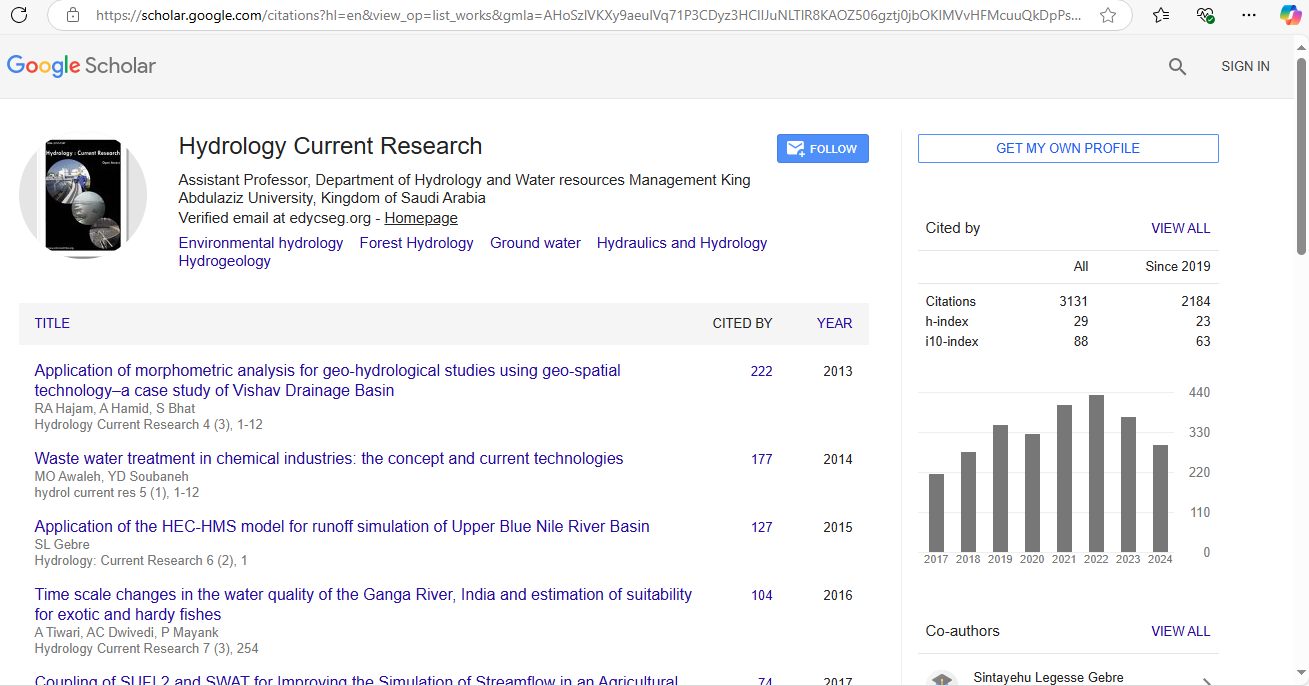
Hydrology: Current Research received 2843 citations as per Google Scholar report