Commentary - (2025) Volume 16, Issue 2
Received: 01-May-2025, Manuscript No. hgec-25-174724;
Editor assigned: 05-May-2025, Pre QC No. P-174724;
Reviewed: 19-May-2025, QC No. Q-174724;
Revised: 22-May-2025, Manuscript No. R-174724;
Published:
29-May-2025
, DOI: 10.37421/2161-0436.2025.16.280
Citation: Bracken, Samuel H.. ”Chromosomes: Organization, Function, Health, Disease, Therapy.” Human Genet Embryol 16 (2025):280.
Copyright: © 2025 Bracken H. Samuel This is an open-access article distributed under the terms of the Creative Commons Attribution License, which permits unrestricted use, distribution and reproduction in any medium, provided the original author and source are credited.
This article explores how gene transcription and the three-dimensional organization of chromosomes are tightly linked, revealing a dynamic interplay crucial for precise gene regulation. It highlights mechanisms by which transcriptional activity can reshape chromatin structure, influencing processes like DNA replication, repair, and cell differentiation, thereby offering insights into the complexity of genomic function [1].
This review focuses on the intricate mechanisms ensuring proper chromosome segregation during cell division, a fundamental process for maintaining genomic stability. It discusses how errors in segregation lead to aneuploidy, a hallmark of many human diseases, including cancer and developmental disorders, emphasizing the critical role of these processes for cellular health [2].
This article delves into the profound influence of epigenetic mechanisms on chromosome structure and function. It elucidates how chemical modifications to DNA and associated proteins, without altering the underlying sequence, can regulate gene expression, affect chromatin compaction, and contribute to cell identity and disease states, highlighting the dynamic nature of epigenetic control [3].
This paper discusses telomeres, the protective caps at the ends of chromosomes, highlighting their critical roles in maintaining genomic integrity and stability. It explores how telomere shortening and dysfunction contribute to aging and age-related diseases, as well as their involvement in cancer, emphasizing the cellular mechanisms designed to protect and repair these vital structures [4].
This article examines how various environmental factors and modern lifestyle choices contribute to chromosome damage, a key driver of various health issues including cancer and developmental abnormalities. It discusses the molecular mechanisms of damage induction and the cellular repair pathways, emphasizing the urgent need for strategies to mitigate these risks and preserve genomic integrity [5].
This article delves into the crucial role of condensin complexes in shaping chromosome structure during mitosis. It explains how these protein complexes facilitate the compact condensation of chromosomes and ensure their accurate segregation into daughter cells, processes vital for genomic stability and proper cell division, and highlights their implications in disease when dysfunctional [6].
This article explores the intricate connection between the three-dimensional organization of chromosomes and the pathogenesis of various human diseases. It highlights recent discoveries in how alterations in chromatin architecture, rather than just DNA sequence, contribute to conditions like cancer and developmental disorders, suggesting novel therapeutic targets [7].
This article provides a concise overview of the latest advancements in understanding the evolution of sex chromosomes, detailing the various pathways and mechanisms by which these specialized chromosomes diverge and differentiate across species. It emphasizes the complex interplay of genetic and environmental factors driving their evolution and raises new questions for future research [8].
This review explores the exciting potential of chromosome engineering in developing advanced gene and cell therapies. It discusses techniques for precise manipulation of large chromosomal regions, including artificial chromosomes, for disease modeling, gene correction, and therapeutic protein production, outlining current progress and the challenges ahead in clinical translation [9].
This review highlights the fundamental connections between the physical organization of chromosomes within the nucleus and the intricate control of gene expression. It discusses how specific chromatin structures and spatial genomic interactions regulate transcriptional activity, offering insights into potential therapeutic interventions for diseases rooted in aberrant gene regulation [10].
The precise regulation of genes relies heavily on the dynamic interplay between gene transcription and the three-dimensional organization of chromosomes [1]. This dynamic relationship means that how DNA is packaged and structured can be actively reshaped by transcriptional activity. This reshaping isn't just a byproduct; it influences crucial biological processes such as DNA replication, repair mechanisms, and cell differentiation, offering a deeper understanding of how the genome functions at a fundamental level. A crucial aspect of maintaining genomic integrity is the accurate segregation of chromosomes during cell division [2]. Any errors in this fundamental process lead to aneuploidy, a condition characterized by an abnormal number of chromosomes. Aneuploidy is a significant factor in numerous human diseases, including various cancers and developmental disorders, highlighting just how critical these segregation processes are for overall cellular health and survival.
Central to the structural dynamics of chromosomes, particularly during mitosis, are condensin complexes [6]. These specialized protein complexes are indispensable for compacting chromosomes into their recognizable, condensed forms, ensuring they can be accurately partitioned into daughter cells during cell division. Their proper function is vital for maintaining genomic stability and facilitating correct cell division, and their malfunction is directly implicated in disease states. Beyond the mitotic phase, the physical organization of chromosomes within the nucleus profoundly controls gene expression [10]. Specific chromatin structures, along with spatial genomic interactions, act as critical regulators of transcriptional activity. Understanding these intricate connections offers compelling insights into potential therapeutic interventions for a range of diseases that stem from aberrant gene regulation, suggesting avenues beyond just DNA sequence modifications.
What this really means is that epigenetic mechanisms exert a significant influence on both chromosome structure and function [3]. These mechanisms involve chemical modifications to DNA and its associated proteins, which occur without altering the underlying DNA sequence itself. Such modifications can precisely regulate gene expression, dictate the level of chromatin compaction, and play a pivotal role in establishing cell identity and the progression of various disease states. This underscores the incredibly dynamic nature of epigenetic control. The three-dimensional organization of chromosomes isn't merely a structural detail; it has profound implications for the pathogenesis of numerous human diseases [7]. Recent discoveries show that alterations in chromatin architecture itself, rather than just changes in the DNA sequence, contribute significantly to conditions like cancer and various developmental disorders. This insight suggests entirely new avenues for therapeutic targeting, shifting focus from pure genetics to the structural context of the genome.
Here's the thing: telomeres, the protective caps found at the very ends of chromosomes, play a critically important role in safeguarding genomic integrity and stability [4]. Their proper function is essential, as telomere shortening and dysfunction are known contributors to aging and various age-related diseases. They also have a recognized role in the development and progression of cancer. Cells have evolved complex mechanisms specifically designed to protect and repair these vital telomeric structures. Unfortunately, various environmental factors and choices related to modern lifestyles are major contributors to chromosome damage [5]. This damage is a significant underlying cause of a range of health issues, including cancer and developmental abnormalities. Understanding the precise molecular mechanisms by which this damage is induced and how cellular repair pathways attempt to counteract it is an urgent area of research. Ultimately, this knowledge is needed to develop effective strategies to mitigate these risks and preserve genomic integrity in the face of modern challenges.
On a different note, our understanding of the evolution of sex chromosomes continues to advance [8]. Researchers are detailing the diverse pathways and mechanisms through which these specialized chromosomes diverge and differentiate across various species. This evolutionary journey involves a complex interplay of both genetic and environmental factors, which together drive their diversification and raise intriguing new questions for future research into genomic adaptation. Looking ahead, chromosome engineering presents exciting potential for the development of advanced gene and cell therapies [9]. Techniques are emerging that allow for the precise manipulation of large chromosomal regions, including the creation of artificial chromosomes. These capabilities are being explored for applications such as creating more accurate disease models, correcting genetic errors, and improving the production of therapeutic proteins. While significant progress has been made, substantial challenges remain in translating these innovative approaches into widespread clinical use.
The dynamic organization and function of chromosomes are central to genomic health and disease. Gene transcription is tightly linked with chromosome structure, actively reshaping chromatin and influencing critical processes like DNA replication, repair, and cell differentiation [1]. Proper chromosome segregation during cell division is fundamental for genomic stability, as errors can lead to aneuploidy, a hallmark of many human diseases, including cancer [2]. Epigenetic mechanisms further influence chromosome structure and gene expression through chemical modifications, impacting cell identity and disease states [3]. Telomeres, the protective caps, are crucial for genomic integrity, with their dysfunction contributing to aging and cancer [4]. Environmental factors and lifestyle choices are significant contributors to chromosome damage, driving various health issues and highlighting the need for mitigation strategies [5]. Key protein complexes like condensins ensure chromosome condensation and accurate segregation during mitosis, vital for genomic stability [6]. Alterations in the three-dimensional chromatin architecture, rather than just DNA sequence, are recognized as contributors to diseases like cancer and developmental disorders, suggesting novel therapeutic targets [7]. The evolution of sex chromosomes shows a complex interplay of genetic and environmental factors driving their divergence [8]. Finally, chromosome engineering offers exciting prospects for gene and cell therapies through precise manipulation of chromosomal regions for disease modeling and gene correction [9], while the overall physical organization of chromosomes within the nucleus is fundamentally connected to gene expression control, opening new therapeutic opportunities for aberrant gene regulation [10].
None
None
Indexed at, Google Scholar, Crossref
Indexed at, Google Scholar, Crossref
Indexed at, Google Scholar, Crossref
Indexed at, Google Scholar, Crossref
Indexed at, Google Scholar, Crossref
Indexed at, Google Scholar, Crossref
Indexed at, Google Scholar, Crossref
Indexed at, Google Scholar, Crossref
Indexed at, Google Scholar, Crossref
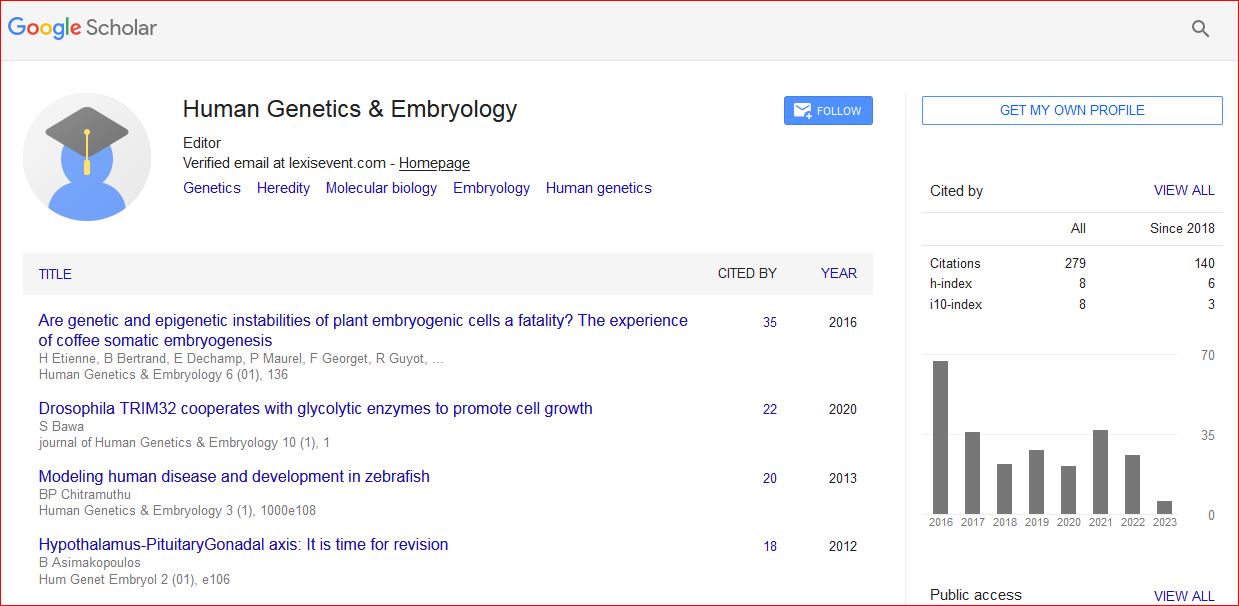
Human Genetics & Embryology received 309 citations as per Google Scholar report