Short Communication - (2025) Volume 16, Issue 5
Received: 01-Oct-2025, Manuscript No. csj-26-183472;
Editor assigned: 03-Oct-2025, Pre QC No. P-183472;
Reviewed: 17-Oct-2025, QC No. Q-183472;
Revised: 22-Oct-2025, Manuscript No. R-183472;
Published:
29-Oct-2025
, DOI: 10.37421/2160-3494.2025.16.482
Citation: Zahran, Mohamed. ”Chemistry of Advanced Coatings and Surface Treatments.” Chem Sci J 16 (2025):482.
Copyright: © 2025 Zahran M. This is an open-access article distributed under the terms of the Creative Commons Attribution License, which permits unrestricted use, distribution and reproduction in any medium, provided the original author and source are credited.
The field of surface science and coatings is experiencing rapid advancement, driven by a fundamental understanding of chemistry and its application to materials engineering. Advanced coatings and surface treatments are crucial for enhancing material performance and enabling novel functionalities. Precise control over molecular structure and interfacial interactions allows for the design of materials with tailored properties, such as improved corrosion resistance, enhanced adhesion, and unique optical or electronic characteristics. This is achieved by carefully managing surface energy, surface tension, and chemical bonding in various applications [1].
Furthermore, the development of self-healing coatings represents a significant breakthrough in material durability and longevity. These coatings incorporate mechanisms, often through microcapsules or vascular networks, that release healing agents upon damage. These agents then initiate chemical reactions that effectively repair the coating, restoring its mechanical integrity and barrier properties. Research in this area explores diverse healing chemistries like polymerization, sol-gel reactions, and epoxy-amine curing [2].
Achieving extreme water repellency, commonly known as superhydrophobicity, relies heavily on the precise chemical design of coatings. Strategies involve utilizing low surface energy materials, creating hierarchical surface structures, and forming stable air-water interfaces. The chemical principles behind developing durable and robust superhydrophobic surfaces are critical for applications ranging from anti-icing to self-cleaning surfaces [3].
Surface functionalization with plasmonic nanoparticles offers a powerful route to imbue materials with specific optical and catalytic properties. The chemical synthesis and characterization of these nanoparticles are key, as their size, shape, and composition dictate their surface plasmon resonance characteristics. Chemical methods for grafting these nanoparticles onto various substrates are detailed for applications such as SERS substrates, catalytic surfaces, and optical sensors [4].
Passivation layers play a vital role in protecting metallic surfaces from corrosion. The formation of these protective oxide or salt layers is governed by electrochemical and chemical processes. Understanding the influence of surface chemistry, electrolyte composition, and applied potential on the structure, composition, and protective effectiveness of these passive films is essential for effective corrosion prevention [5].
Atomic Layer Deposition (ALD) has emerged as a premier technique for creating ultrathin coatings with atomic precision. This method relies on sequential, self-limiting surface reactions to achieve conformal coating of complex geometries. The chemistry of common ALD precursors and their interactions with diverse substrate surfaces are analyzed to understand their impact on film properties and growth kinetics [6].
Biocompatible coatings for medical devices are critical for improving patient outcomes. The surface chemistry of these coatings is tailored through chemical modifications and functionalization to promote cell adhesion, reduce inflammatory responses, and prevent biofouling. The strategic use of specific chemical functional groups and biomolecules allows for the precise control of surface properties to enhance biocompatibility [7].
Conductive polymer coatings offer unique properties for various electronic applications. Their performance is deeply rooted in their electrochemistry and chemical kinetics. The polymerization process and the resulting chemical structure of these polymers significantly influence their conductivity, stability, and adhesion to substrates, making them suitable for sensors, energy storage, and anti-corrosion applications [8].
Barrier coatings are indispensable in packaging, particularly for applications requiring resistance to gas and moisture permeation. The molecular structure of the polymers used and the incorporation of specific additives are critical determinants of a coating's barrier performance. Chemical strategies for engineering high-performance and sustainable barrier coatings are continually being explored [9].
Plasma treatments are a versatile method for modifying material surfaces. This process involves the generation of reactive species in plasma that interact with surfaces to alter their chemical composition, introduce functional groups, and improve adhesion. Tailoring plasma parameters is crucial for achieving specific surface treatment outcomes and unlocking new material capabilities [10].
The chemical underpinnings of advanced coatings and surface treatments are explored, emphasizing how manipulating molecular structures and interfacial interactions leads to materials with superior properties like corrosion resistance and enhanced adhesion. The foundational roles of surface energy, surface tension, and chemical bonding in achieving desired performance characteristics across diverse applications are highlighted, underscoring the chemical perspective in material design [1].
The mechanisms behind self-healing coatings are a focal point, detailing how incorporated agents within microcapsules or vascular networks are released upon damage to initiate chemical repair processes. The article delves into various healing chemistries, including polymerization and sol-gel reactions, and assesses their effectiveness in restoring the structural integrity and protective qualities of the coating [2].
Strategies for chemically designing superhydrophobic coatings are investigated, focusing on the chemical approaches used to achieve extreme water repellency. This includes an examination of the role of low surface energy materials, the creation of intricate surface architectures, and the formation of stable air-water interfaces, crucial for durable and effective water-repellent surfaces [3].
The synthesis and characterization of plasmonic nanoparticles for surface functionalization are detailed, emphasizing how controlling nanoparticle attributes like size and shape influences their optical properties. The chemical methodologies for attaching these nanoparticles to substrates are discussed for their utility in creating advanced substrates for sensing and catalysis [4].
The chemical processes involved in the formation of passivation layers on metallic surfaces are examined, focusing on the electrochemical and chemical transformations that create protective oxide or salt films. The impact of various chemical factors, including surface chemistry and electrolyte composition, on the effectiveness of these passive layers in preventing corrosion is thoroughly analyzed [5].
Atomic Layer Deposition (ALD) for ultrathin coatings is explained through its chemical principles, focusing on the sequential, self-limiting surface reactions that allow for atomic-level precision in coating complex shapes. The chemistry of precursor materials and their reactions with different surfaces is analyzed for its influence on film properties and growth [6].
The surface chemistry of biocompatible coatings for medical implants is explored, detailing how chemical modifications and functionalization are employed to promote favorable biological interactions. The use of specific chemical functional groups and biomolecules to achieve desired biocompatibility, such as enhanced cell adhesion and reduced inflammation, is discussed [7].
The electrochemistry and chemical kinetics governing conductive polymer coatings are investigated, explaining how polymerization chemistry and structure affect conductivity and stability. The applications of these coatings in sensors, energy storage, and corrosion protection are examined from a chemical perspective [8].
The chemical design of barrier coatings for packaging applications is reviewed, highlighting how polymer structure and additives influence permeability to gases and moisture. The article examines chemical approaches for developing high-performance, sustainable barrier materials essential for modern packaging solutions [9].
Plasma treatments as a surface modification technique are explored through the lens of surface chemistry and transformations. The article discusses how plasma-generated reactive species interact with surfaces to alter composition and improve adhesion, providing insights into controlling these processes for tailored surface properties [10].
This collection of research explores the fundamental chemistry underlying various advanced coatings and surface treatments. Key areas of focus include the chemical principles of creating materials with tailored properties through molecular control, the mechanisms of self-healing coatings, and the chemical strategies for achieving superhydrophobic surfaces. The synthesis and application of plasmonic nanoparticles for surface functionalization are detailed, alongside the chemistry of passivation layers for metal protection. Atomic Layer Deposition for ultrathin coatings, surface chemistry for biocompatible medical devices, and the electrochemical and chemical aspects of conductive polymer coatings are also discussed. Furthermore, the chemical design of barrier coatings for sustainable packaging and the surface chemistry transformations induced by plasma treatments are examined, highlighting the broad impact of chemistry in developing next-generation materials and surfaces.
None
None
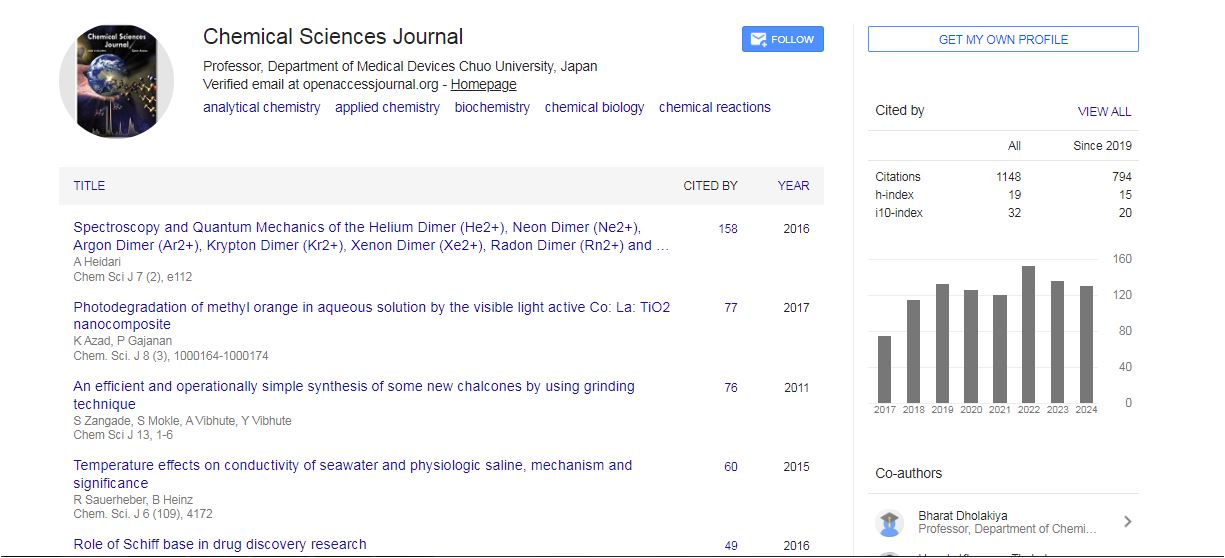
Chemical Sciences Journal received 912 citations as per Google Scholar report