Opinion - (2025) Volume 12, Issue 2
Received: 01-Apr-2025, Manuscript No. jreac-26-185798;
Editor assigned: 03-Apr-2025, Pre QC No. P-185798;
Reviewed: 17-Apr-2025, QC No. Q-185798;
Revised: 22-Apr-2025, Manuscript No. R-185798;
Published:
29-Apr-2025
, DOI: 10.37421/2380-2391.2025.12.420
Citation: Almeida, Lucas. ”Chemical Speciation: Enhancing Environmental Risk Assessment.” J Environ Anal Chem 12 (2025):420.
Copyright: © 2025 Almeida L. This is an open-access article distributed under the terms of the Creative Commons Attribution License, which permits unrestricted use, distribution and reproduction in any medium, provided the original author and source are credited.
Understanding chemical speciation is of paramount importance for a comprehensive evaluation of environmental risks associated with contaminants. It necessitates a move beyond merely determining the total concentration of a substance to identifying its precise chemical form, which fundamentally dictates its mobility, bioavailability, and inherent toxicity. This granular understanding is indispensable for accurately predicting the behavior of chemical agents across diverse environmental matrices, including water, soil, and air, as well as their potential interactions with living organisms [1].
Achieving accurate speciation analysis frequently demands the utilization of sophisticated analytical methodologies. The principle of 'what you measure is what you get' holds critical significance, as inappropriate sample handling protocols or analytical techniques can severely distort the original speciation state. Such alterations can lead to profoundly misleading risk assessments, underscoring the continuous and vital efforts dedicated to the development and rigorous validation of robust speciation methods [2].
For certain elemental contaminants, such as lead, arsenic, and mercury, their toxicological profiles are inextricably linked to their specific chemical forms. For example, inorganic arsenic species, namely arsenite and arsenate, are generally recognized as exhibiting greater toxicity compared to their organic counterparts. Speciation analysis provides the crucial capability to differentiate these forms, thereby furnishing a more precise and informative assessment of potential health hazards [3].
While environmental regulations often establish permissible limits based on total metal concentrations, a speciation-centric approach offers a pathway to more effective and targeted risk management strategies. This perspective can illuminate scenarios where total concentrations may appear elevated but the predominant species present are relatively benign. Conversely, it can highlight situations where seemingly lower total concentrations are associated with the presence of highly toxic species, necessitating a more cautious regulatory stance [4].
The significance of speciation analysis is particularly pronounced when dealing with complex environmental matrices like soils and sediments. Within these heterogeneous environments, intricate interactions involving organic matter, mineral components, and microbial communities can substantially influence the prevailing chemical forms of contaminants. A thorough understanding of these interactions is essential for improving the predictive accuracy of contaminant fate and transport processes [5].
Beyond metals, the concept of speciation also extends its relevance to organic pollutants, although it may encompass different forms such as isomers, degradation products, or residues bound within environmental matrices. The precise identification of these various forms is instrumental in deciphering their persistence in the environment, elucidating their degradation pathways, and evaluating their propensity for bioaccumulation in living organisms [6].
For essential nutrients like nitrogen and phosphorus, understanding their speciation is critically important for comprehending the dynamics of eutrophication processes and their subsequent impact on aquatic ecosystems. Different chemical species, such as dissolved inorganic nitrogen versus organic nitrogen, exhibit vastly different potentials to support excessive algal growth, a hallmark of eutrophication [7].
Speciation analysis serves as a fundamental cornerstone in the strategic design and implementation of effective environmental remediation approaches. By accurately identifying the species that are most bioavailable and consequently pose the greatest toxicological threat, it becomes possible to devise targeted removal or transformation methods. This precision in targeting leads to more efficient and economically viable environmental clean-up operations [8].
The integration of detailed speciation data into environmental exposure models represents a critical advancement for refining the accuracy of environmental risk assessments. This enhanced integration facilitates a more realistic estimation of the actual doses received by various receptors, thereby augmenting the precision of risk characterization and providing a stronger scientific justification for the implementation of regulatory actions [9].
The advent and continuous development of advanced hyphenated analytical techniques, which synergistically combine sophisticated separation methods with highly sensitive detection capabilities, have profoundly transformed the landscape of speciation analysis. These powerful tools enable the precise identification and quantification of even trace levels of specific species within complex environmental samples, thereby significantly expanding the frontiers of scientific understanding in this field [10].
The fundamental importance of chemical speciation lies in its indispensable role for the accurate assessment of environmental risks. It transcends the mere determination of a contaminant's total concentration, focusing instead on identifying its specific chemical form. This form is the primary determinant of the substance's mobility, its bioavailability to organisms, and its inherent toxicity. Consequently, understanding speciation is crucial for predicting how a substance will behave in various environmental compartments, such as water, soil, and air, and how it might interact with living entities [1].
Accurate speciation analysis is often contingent upon the application of sophisticated analytical techniques. The guiding principle of 'what you measure is what you get' is of utmost importance, as improper sample handling or the use of inappropriate analytical methods can drastically alter the original speciation of the analyte. Such alterations can lead to significantly flawed risk assessments, highlighting the continuous need for the development and validation of robust speciation methods [2].
For specific elements like lead, arsenic, and mercury, their toxicity is heavily influenced by their chemical form. For instance, inorganic arsenic species, namely arsenite and arsenate, are generally considered more toxic than organic arsenic species. Speciation analysis enables the differentiation of these forms, providing a more precise understanding of the potential health hazards associated with arsenic exposure [3].
While current environmental regulations frequently set limits based on total metal concentrations, a speciation-based approach can facilitate more effective risk management. It can identify situations where total concentrations might appear high, but the dominant species are less harmful. Conversely, it can reveal instances where lower total concentrations are associated with highly toxic species, necessitating a more nuanced regulatory response [4].
The role of speciation is particularly critical in complex environmental matrices such as soils and sediments. In these settings, interactions with organic matter, minerals, and microbial communities can significantly alter the chemical forms of contaminants. Understanding these complex interactions is key to accurately predicting the fate and transport of contaminants within these environments [5].
For organic pollutants, speciation also holds considerable importance, though it may refer to different forms such as isomers, degradation products, or residues bound within environmental matrices. The identification of these specific forms is essential for understanding their environmental persistence, their degradation pathways, and their potential to bioaccumulate in food chains [6].
The speciation of vital nutrients like nitrogen and phosphorus plays a critical role in understanding eutrophication processes and their consequent impact on aquatic ecosystems. Different species, for example, dissolved inorganic nitrogen versus organic nitrogen, possess varying potentials to fuel excessive algal growth, a primary driver of eutrophication [7].
Speciation analysis is a fundamental component in the development of effective strategies for environmental remediation. By accurately identifying the species that are most bioavailable and toxic, targeted removal or transformation methods can be specifically designed. This targeted approach leads to more efficient and cost-effective clean-up of contaminated environments [8].
The integration of chemical speciation data into environmental exposure models is crucial for enhancing the accuracy of risk assessments. This integration allows for a more realistic estimation of the doses received by exposed organisms, thereby improving the precision of risk characterization and providing stronger justification for regulatory actions [9].
The development of advanced hyphenated techniques, which combine separation science with sensitive detection methods, has revolutionized speciation analysis. These powerful analytical tools allow for the identification and quantification of trace species within complex environmental samples, pushing the boundaries of our scientific understanding in this field [10].
Chemical speciation is essential for accurate environmental risk assessment, moving beyond total concentration to identify specific chemical forms that dictate mobility, bioavailability, and toxicity. Sophisticated analytical techniques are crucial, as improper handling can alter speciation, leading to flawed assessments. The toxicity of elements like arsenic, lead, and mercury is highly dependent on their specific chemical form, making speciation analysis vital for health hazard evaluation. While regulations often focus on total concentrations, speciation offers a more effective risk management approach, identifying scenarios with less harmful or more toxic species. This is particularly important in complex matrices like soils and sediments where interactions influence contaminant forms. Speciation also applies to organic pollutants, helping understand their persistence and bioaccumulation. For nutrients, speciation is key to understanding eutrophication. Speciation analysis informs effective remediation strategies by targeting the most bioavailable and toxic species. Integrating speciation data into exposure models refines risk assessments. Advanced hyphenated analytical techniques have significantly advanced speciation analysis capabilities.
None
None
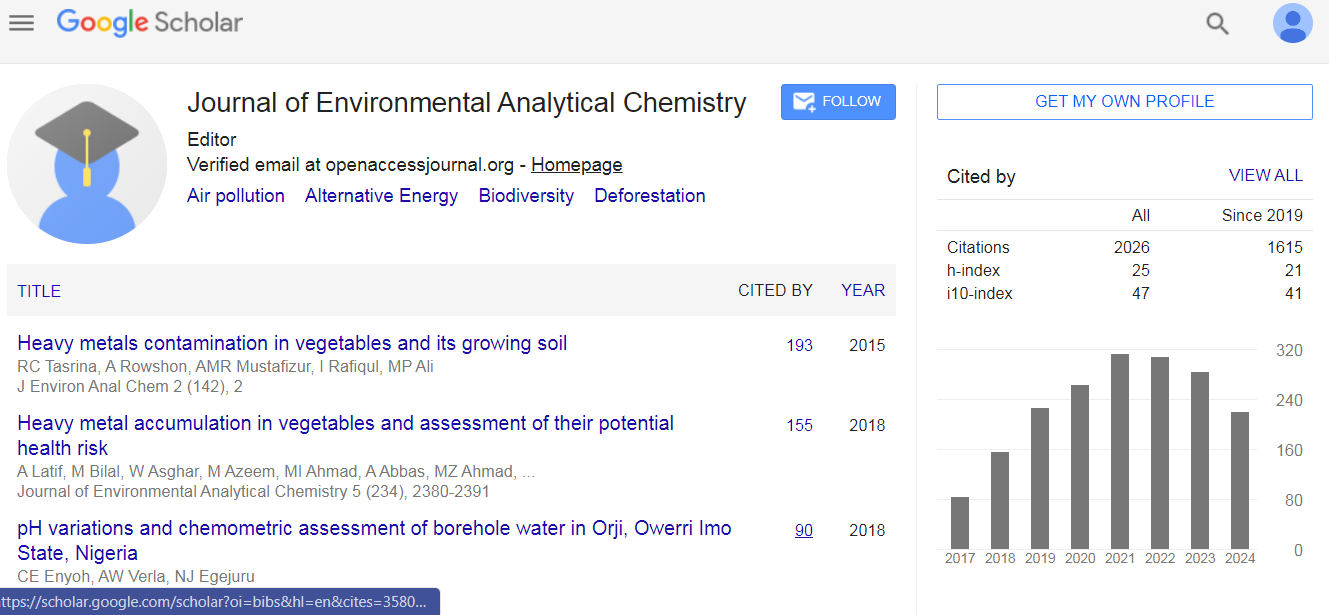
Journal of Environmental Analytical Chemistry received 1781 citations as per Google Scholar report