Commentary - (2025) Volume 16, Issue 2
Received: 02-Mar-2025, Manuscript No. jpm-26-179353;
Editor assigned: 04-Mar-2025, Pre QC No. P-179353;
Reviewed: 18-Mar-2025, QC No. Q-179353;
Revised: 24-Mar-2025, Manuscript No. R-179353;
Published:
31-Mar-2025
, DOI: 10.37421/2090-0902.2025.16.526
Citation: Zhao, Mei-Ling. ”Chaos Theory: Pervasive Influence Across Science.” J Phys Math 16 (2025):526.
Copyright: © 2025 Zhao M. This is an open-access article distributed under the terms of the Creative Commons Attribution License, which permits unrestricted use, distribution and reproduction in any medium, provided the original author and source are credited.
This work delves into the fundamental principles of dynamical systems and chaos theory, exploring their pervasive influence across a multitude of physical phenomena. It elucidates how even straightforward nonlinear systems can manifest intricate and unpredictable behaviors, characterized by a profound sensitivity to initial conditions, thereby giving rise to complex emergent properties. The research navigates a broad spectrum of applications, spanning from the dynamics of fluid motion and the complexities of weather forecasting to the gravitational interactions within celestial mechanics and the delicate stability of biological populations. A significant contribution lies in the identification of universal pathways leading to chaotic behavior, the detailed characterization of strange attractors, and the development of quantitative measures for chaotic dynamics, such as Lyapunov exponents and fractal dimensions. A comprehensive grasp of these principles is paramount for the accurate modeling and predictive capabilities in numerous scientific disciplines [1].
The intricate behavior of complex fluids, particularly in the context of turbulent flows, is thoroughly examined through the lens of nonlinear dynamics and chaos. Advanced computational methodologies are employed to dissect the statistical attributes of turbulent eddies and their inherent hierarchical organization. This research establishes that chaotic dynamics are integral to the processes of energy dissipation and mixing within these fluid systems. The inherent chaotic nature of turbulent flows presents considerable obstacles to achieving precise long-term predictions, yet the study proposes viable approaches for statistical forecasting and the comprehension of averaged quantities [2].
An in-depth exploration into the application of chaos theory is undertaken to unravel the complex dynamics governing planetary orbits, with a specific focus on systems involving multiple interacting bodies. The findings reveal how subtle gravitational perturbations can instigate chaotic behavior, ultimately leading to orbital instability over extended periods and potentially the ejection of celestial bodies from their systems. The research concentrates on pinpointing regions within phase space that are particularly susceptible to chaotic influences and characterizing the temporal scales over which these chaotic effects become significant. These insights are indispensable for comprehending the evolutionary trajectories of planetary systems and assessing their long-term stability [3].
The emergence of chaotic patterns within biological populations, particularly in predator-prey interactions, is a focal point of this paper. Mathematical models are utilized to illustrate how nonlinear interdependencies and temporal delays can precipitate complex population fluctuations that defy straightforward prediction. The study underscores the pivotal roles of feedback mechanisms and environmental variability in driving chaotic population cycles. A nuanced understanding of these dynamics is essential for the formulation of effective conservation strategies and the judicious management of ecological resources, as it illuminates the inherent unpredictability embedded within natural ecosystems [4].
This research investigates the application of fractal geometry and chaos theory to the intricate structural analysis of fractured materials. It scrutinizes how the propagation of cracks and the phenomenon of material failure can exhibit fractal characteristics, indicative of a self-similar structure across various scales. Nonlinear dynamics are employed to model the stress concentrations and instabilities that culminate in fracture. The knowledge acquired holds considerable value for materials science, facilitating more accurate predictions of material strength and the design of inherently more resilient materials [5].
The significant role of chaos in the dynamics of phase transitions within physical systems is meticulously detailed in this article. It examines how nonlinear interactions and fluctuations can instigate abrupt alterations in the macroscopic properties of matter. The research probes the universality of critical phenomena and the manifestation of chaotic behavior in proximity to phase transition points. Understanding these dynamics is crucial for diverse fields such as condensed matter physics and statistical mechanics, offering a robust framework for the description of complex emergent behaviors [6].
The emergence of chaos within coupled oscillator systems, which are foundational to a wide array of physical phenomena including synchronization in electrical grids and neuronal networks, is the subject of this investigation. The study analyzes how the interactions among multiple nonlinear oscillators can result in complex and unpredictable collective behaviors. It identifies the specific conditions under which chaotic dynamics can disrupt synchronization and explores strategies for controlling or mitigating such effects. This work holds considerable significance for the understanding of emergent behavior in complex network structures [7].
This study centers on the application of nonlinear dynamical systems theory to the analysis of laser behavior, systems known for exhibiting complex temporal dynamics, including chaotic behavior. It examines how feedback mechanisms and external influences can induce chaotic pulsing and mode-hopping phenomena. The research provides a theoretical foundation for comprehending and regulating laser output, which is critically important for applications in telecommunications, spectroscopy, and scientific instrumentation [8].
The role of chaotic mixing in chemical reactions is explored, with a particular emphasis on its application in microfluidic reactors. The findings demonstrate that chaotic advection can substantially boost reaction rates and enhance product yields by fostering efficient reactant transport. Dynamical systems models are utilized to visualize and quantify these chaotic stirring patterns. These insights are vital for the optimization of chemical processes and the development of innovative reactor designs for efficient synthesis [9].
This work investigates the theoretical underpinnings of chaotic itinerancy in complex dynamical systems, a phenomenon characterized by intermittent transitions between various metastable states. These concepts are applied to elucidate phenomena such as the dynamics of neural networks and the behavior of disordered physical systems. The paper emphasizes how chaotic itinerancy can lead to rich and intricate emergent behaviors that are not easily predictable by simpler models, making this research foundational for understanding complex adaptive systems [10].
This foundational work investigates the intricate interplay between dynamical systems and chaos theory across a broad spectrum of physical phenomena. It emphasizes how simple nonlinear systems can exhibit unpredictable behavior and sensitive dependence on initial conditions, leading to complex emergent properties. The research spans applications from fluid dynamics and weather forecasting to celestial mechanics and the stability of biological populations. Key insights include the identification of universal routes to chaos, the characterization of strange attractors, and the development of methods for quantifying chaotic behavior, such as Lyapunov exponents and fractal dimensions. Understanding these principles is crucial for accurate modeling and prediction in many scientific disciplines [1].
Complex fluids, especially in turbulent flows, are analyzed through the lens of nonlinear dynamics and chaos. Advanced computational techniques are used to study the statistical properties of turbulent eddies and their hierarchical structure. The research demonstrates the fundamental role of chaotic dynamics in energy dissipation and mixing within these systems. The paper highlights the challenges in achieving precise long-term predictions of turbulent flows due to their inherent chaotic nature, while also proposing methods for statistical forecasting and understanding averaged quantities [2].
This article delves into the application of chaos theory to understand the dynamics of planetary orbits, particularly in multi-body systems. It reveals how gravitational perturbations can lead to chaotic behavior, resulting in long-term orbital instability and potential ejections of celestial bodies. The research focuses on identifying regions of phase space prone to chaos and characterizing the timescales over which these effects become significant. The findings are crucial for understanding the evolution of planetary systems and their long-term stability [3].
The emergence of chaotic patterns in biological populations, specifically in predator-prey dynamics, is explored. Mathematical models are used to show how nonlinear interactions and time delays can cause complex, unpredictable population fluctuations. The research highlights the role of feedback mechanisms and environmental stochasticity in driving chaotic population cycles. Understanding these dynamics is essential for effective conservation strategies and ecological resource management, revealing the inherent unpredictability in natural ecosystems [4].
This research applies fractal geometry and chaos theory to analyze the complex structure of fractured materials. It investigates how crack propagation and material failure can exhibit fractal characteristics, suggesting a self-similar structure across scales. Nonlinear dynamics are used to model the stress concentrations and instabilities leading to fracture. These insights are valuable for material science, enabling better prediction of material strength and the development of more resilient materials [5].
The role of chaos in phase transitions within physical systems is examined. The article explores how nonlinear interactions and fluctuations can lead to abrupt changes in macroscopic properties. Research investigates the universality of critical phenomena and the emergence of chaotic behavior near phase transition points. Understanding these dynamics is essential for fields like condensed matter physics and statistical mechanics, providing a framework for describing complex emergent behaviors [6].
The emergence of chaos in coupled oscillator systems, fundamental to phenomena like synchronization in electrical grids and neuronal networks, is investigated. The study analyzes how interactions between multiple nonlinear oscillators can lead to complex, unpredictable collective behaviors. It identifies conditions under which synchronization is lost due to chaotic dynamics and explores strategies for control or mitigation. This work is significant for understanding emergent behavior in complex networks [7].
This study applies nonlinear dynamical systems theory to analyze laser behavior, which is known to exhibit complex temporal dynamics, including chaos. It explores how feedback mechanisms and external forcing can induce chaotic pulsing and mode hopping. The research provides a theoretical framework for understanding and controlling laser output, critical for applications in telecommunications, spectroscopy, and scientific instrumentation [8].
Chaotic mixing in chemical reactions, particularly in microfluidic reactors, is investigated. The paper demonstrates how chaotic advection can significantly enhance reaction rates and improve product yields by promoting efficient reactant transport. Dynamical systems models are used to visualize and quantify chaotic stirring patterns. The insights are vital for optimizing chemical processes and developing novel reactor designs for efficient synthesis [9].
Theoretical foundations of chaotic itinerancy in complex dynamical systems, describing intermittent hopping between metastable states, are explored. These concepts are applied to understand phenomena like neural network dynamics and the behavior of disordered physical systems. The paper highlights how chaotic itinerancy can lead to rich, complex emergent behaviors not easily predictable by simpler models, making this research foundational for understanding complex adaptive systems [10].
This collection of research highlights the pervasive influence of chaos theory and nonlinear dynamics across diverse scientific fields. Studies explore chaotic behavior in physical phenomena, complex fluids, planetary orbits, biological populations, material science, phase transitions, coupled oscillators, lasers, chemical reactions, and neural networks. Key themes include the sensitive dependence on initial conditions, the emergence of complex patterns from simple systems, and the development of methods to quantify and understand these dynamics. While chaos introduces unpredictability, it also offers profound insights into system evolution, stability, and efficiency, driving advancements in modeling, prediction, and technological applications.
None
None
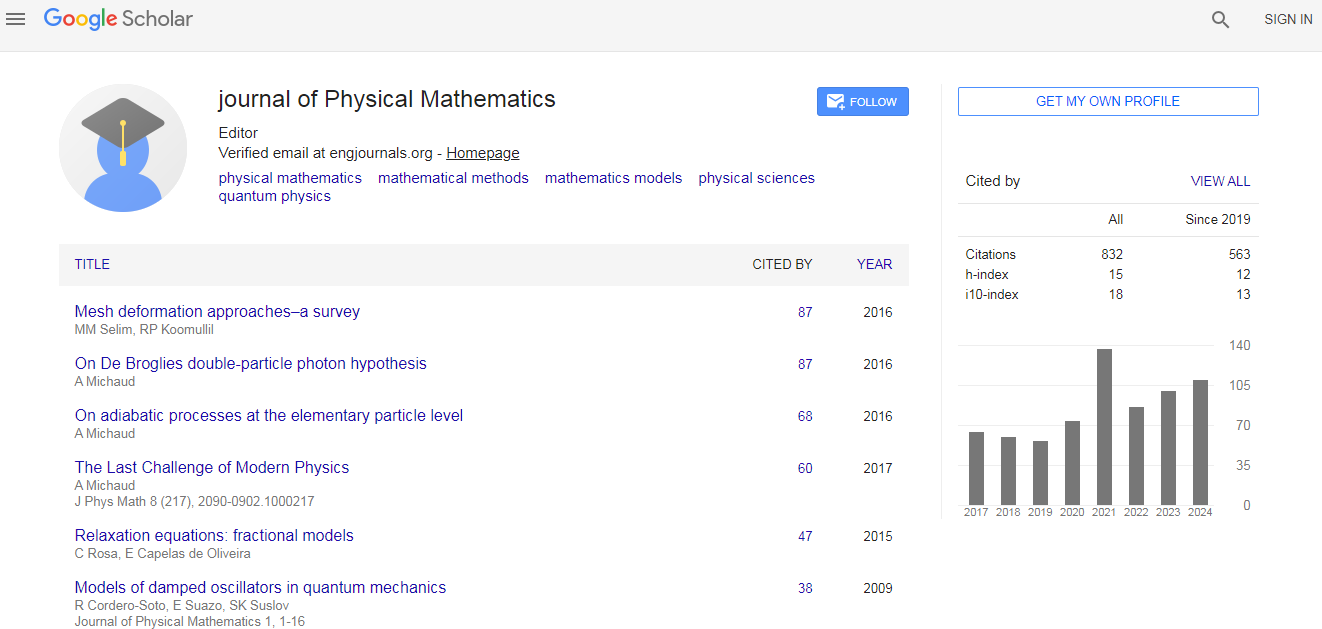
Physical Mathematics received 686 citations as per Google Scholar report