Commentary - (2025) Volume 13, Issue 3
Received: 02-Jun-2025, Manuscript No. jcdd-25-176790;
Editor assigned: 04-Jun-2025, Pre QC No. P-176790;
Reviewed: 18-Jun-2025, QC No. Q-176790;
Revised: 23-Jun-2025, Manuscript No. R-176790;
Published:
30-Jun-2025
, DOI: 10.37421/2329-9517.2025.13.673
Citation: Lucas Dupont. âCardiac Stress Testing: Modalities,
Guidelines, Advancements.â J Cardiovasc Dis Diagn 13 (2025):673.
Copyright: © 2025 D. Lucas This is an open-access article distributed under the terms of the Creative Commons Attribution License, which permits unrestricted use, distribution
and reproduction in any medium, provided the original author and source are credited.
Cardiac stress testing remains a cornerstone in diagnosing and managing cardiovascular diseases. A comprehensive overview highlights current indications, various imaging modalities, and recent advancements in this field, covering the clinical utility of different types like exercise electrocardiography, stress echocardiography, and nuclear stress imaging, discussing their respective strengths and limitations [1].
Evidence-based clinical guidelines specifically address the growing complexities of patient populations, delving into appropriate use criteria, diagnostic accuracy, and risk stratification strategies. These guidelines emphasize personalized approaches to optimize the use of various stress testing modalities in diverse patient cohorts for improved clinical outcomes [2].
Stress echocardiography, for example, plays a significant role in diagnosing coronary artery disease. This non-invasive imaging technique involves detailed methodologies, demonstrates strong diagnostic performance, and has broad clinical applications. Its importance extends to risk stratification and guiding management decisions for patients suspected of or known to have ischemic heart disease, showcasing both its advantages and limitations compared to other diagnostic tools [3].
Myocardial Perfusion Imaging (MPI) represents another critical stress test modality. A critical assessment of its current state and future directions reveals advancements in imaging technology, novel tracers, and quantification techniques that significantly enhance diagnostic accuracy for coronary artery disease. The clinical impact of MPI is profound, guiding revascularization decisions and improving patient outcomes, while also navigating emerging challenges and opportunities in the field [4].
Exercise testing, particularly exercise electrocardiography, retains a contemporary and crucial role in individuals with suspected or known coronary artery disease. Even in an era dominated by advanced imaging, its cost-effectiveness, prognostic value, and utility in assessing functional capacity and guiding lifestyle interventions are undeniable. It continues to be highly relevant in comprehensive cardiovascular risk assessment [5].
Pharmacologic stress testing offers an alternative for patients unable to perform exercise. Updates in this area review the current landscape, covering mechanisms of action, clinical indications, and comparative efficacy of agents like adenosine, dipyridamole, dobutamine, and regadenoson. Patient selection, potential side effects, and practical considerations are crucial for optimizing diagnostic yield and safety in clinical practice [6].
Beyond coronary artery disease, Cardiopulmonary Exercise Testing (CPET) is vital for risk stratification in patients with valvular heart disease. CPET provides objective measures of exercise capacity and ventilatory efficiency, offering critical prognostic information that goes beyond standard clinical assessments. It helps identify patients who would benefit from early intervention and optimizes the timing for surgical referral, ultimately improving long-term outcomes [7].
Stress Cardiac Magnetic Resonance Imaging (CMR) represents a powerful tool with superior spatial resolution and tissue characterization capabilities. Its clinical applications and future directions involve detecting myocardial ischemia, infarction, and viability. CMR plays a key role in risk stratification, guiding revascularization, and assessing microvascular dysfunction, solidifying its position as a key non-invasive stress test modality [8].
The integration of Artificial Intelligence (AI) is set to transform cardiac stress imaging. This field is seeing rapid development and application of AI algorithms to enhance image acquisition, processing, interpretation, and clinical decision-making across various stress modalities. The potential of AI to improve diagnostic accuracy, streamline workflows, and personalize patient management in cardiovascular stress testing is substantial [9].
Finally, noninvasive methods are advancing for assessing coronary microvascular dysfunction (CMD), a condition often missed by traditional stress tests. Advanced imaging techniques, including PET, SPECT, and CMR, are instrumental in quantifying myocardial blood flow and flow reserve to identify CMD. These approaches are crucial for understanding pathophysiology, improving diagnosis, and guiding treatment strategies for patients with atypical chest pain and preserved epicardial coronary arteries [10].
Cardiac stress testing is a fundamental diagnostic tool used to evaluate cardiovascular health and disease, encompassing a broad array of methodologies and technologies. This field continually evolves, integrating advancements in imaging and patient management strategies. The primary goal is to assess myocardial ischemia and functional capacity, guiding therapeutic decisions and improving patient outcomes.
One essential aspect involves understanding the current indications, various imaging modalities, and recent advancements in cardiac stress testing [1]. Clinical guidelines are becoming increasingly important, especially given the growing complexity of patient populations. These guidelines focus on appropriate use criteria, diagnostic accuracy, and robust risk stratification, pushing for personalized approaches to optimize the use of stress testing modalities across diverse patient groups [2].
Specific imaging modalities offer distinct advantages. Stress echocardiography, for instance, is a critical non-invasive technique for diagnosing coronary artery disease. It provides detailed insights into methodologies, diagnostic performance, and practical clinical applications. Its role in risk stratification and management guidance for patients with suspected or confirmed ischemic heart disease is considerable, despite some limitations compared to other options [3]. Myocardial Perfusion Imaging (MPI) also stands out, with ongoing advancements in imaging technology, novel tracers, and quantification techniques. These developments enhance diagnostic accuracy for coronary artery disease and significantly impact revascularization decisions and patient outcomes [4].
Traditional methods like exercise testing, specifically exercise electrocardiography, still hold significant value. Its cost-effectiveness, strong prognostic capabilities, and utility in assessing functional capacity make it a relevant tool in comprehensive cardiovascular risk assessment, even alongside more advanced imaging techniques [5]. For patients unable to exercise, pharmacologic stress testing offers a crucial alternative. Updates in this area cover the mechanisms of action and comparative efficacy of various agents, alongside practical considerations for patient selection and safety to maximize diagnostic yield [6].
Beyond coronary artery disease, Cardiopulmonary Exercise Testing (CPET) offers vital insights for risk stratification in valvular heart disease. By providing objective measures of exercise capacity and ventilatory efficiency, CPET offers prognostic information beyond standard clinical assessments, aiding in early intervention and optimal surgical timing [7]. Stress Cardiac Magnetic Resonance (CMR) imaging is emerging as a powerful non-invasive modality due to its superior spatial resolution and tissue characterization. It is increasingly used for detecting myocardial ischemia, infarction, and viability, playing a significant role in risk stratification and guiding revascularization strategies [8].
The landscape of cardiac stress imaging is also being revolutionized by Artificial Intelligence (AI). AI algorithms are being developed to enhance everything from image acquisition and processing to interpretation and clinical decision-making. This promises improved diagnostic accuracy, streamlined workflows, and highly personalized patient management [9]. Furthermore, there is a growing focus on noninvasive methods for assessing coronary microvascular dysfunction (CMD), a condition often overlooked by conventional stress tests. Advanced imaging techniques like PET, SPECT, and CMR are pivotal in quantifying myocardial blood flow and flow reserve, crucial for understanding pathophysiology and guiding treatment in patients with atypical chest pain [10]. This comprehensive approach ensures that stress testing continues to be at the forefront of cardiovascular diagnostics.
Cardiac stress testing is a vital diagnostic tool for evaluating cardiovascular diseases, encompassing a range of techniques from traditional exercise electrocardiography to advanced imaging modalities. Recent advancements and comprehensive guidelines underscore its evolving role in patient care. An overview highlights the utility of various stress test types, including exercise electrocardiography, stress echocardiography, and nuclear stress imaging, detailing their strengths and limitations for diagnosis and management. Evidence-based clinical guidelines provide frameworks for appropriate use, diagnostic accuracy, and risk stratification, promoting personalized approaches for diverse patient populations. Specific imaging modalities like stress echocardiography are crucial for diagnosing coronary artery disease, offering detailed methodologies and clinical applications for risk stratification. Myocardial Perfusion Imaging (MPI) continues to advance, improving diagnostic accuracy through novel technologies and guiding revascularization decisions. While sophisticated imaging grows, exercise testing retains its importance due to cost-effectiveness, prognostic value, and utility in assessing functional capacity. Pharmacologic stress testing serves as an alternative, with ongoing updates on agents and safety considerations. Beyond coronary artery disease, Cardiopulmonary Exercise Testing (CPET) provides critical prognostic information for valvular heart disease patients, aiding in intervention timing. Stress Cardiac Magnetic Resonance (CMR) imaging is recognized for its superior resolution and tissue characterization, detecting ischemia and guiding management. The future of cardiac stress imaging is being shaped by Artificial Intelligence (AI), enhancing image interpretation and clinical decision-making. Additionally, noninvasive methods for assessing coronary microvascular dysfunction (CMD) are improving diagnosis for conditions often missed by traditional tests, utilizing advanced imaging techniques. This integrated approach ensures robust cardiovascular assessment.
Indexed at, Google Scholar, Crossref
Indexed at, Google Scholar, Crossref
Indexed at, Google Scholar, Crossref
Indexed at, Google Scholar, Crossref
Indexed at, Google Scholar, Crossref
Indexed at, Google Scholar, Crossref
Indexed at, Google Scholar, Crossref
Indexed at, Google Scholar, Crossref
Indexed at, Google Scholar, Crossref
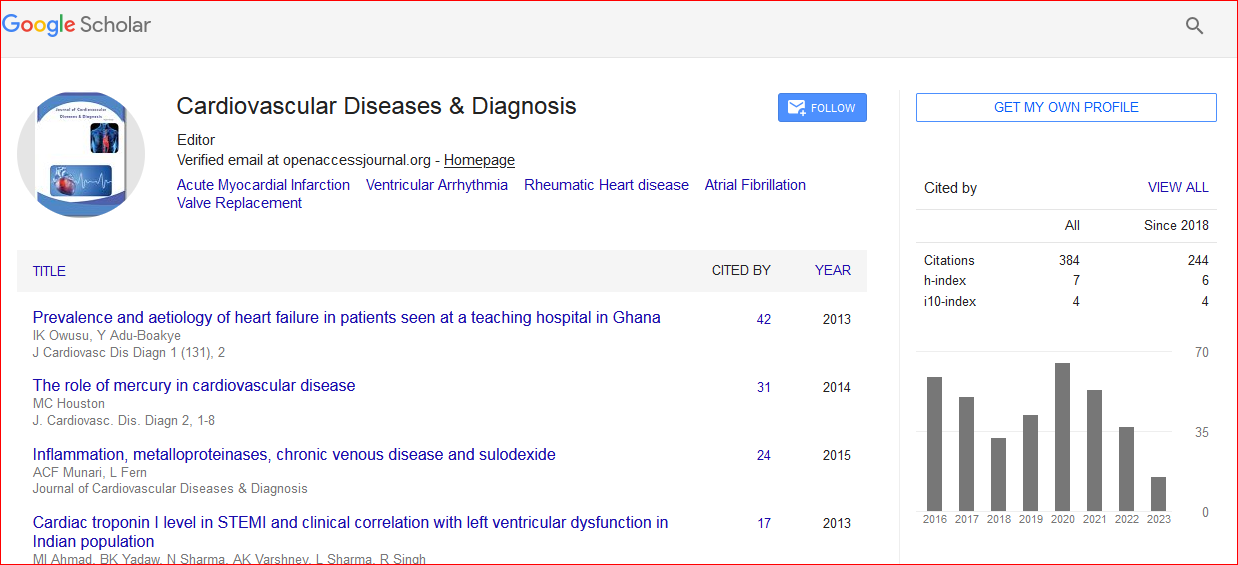
Cardiovascular Diseases & Diagnosis received 427 citations as per Google Scholar report