Perspective - (2025) Volume 12, Issue 5
Received: 01-Oct-2025, Manuscript No. jreac-26-188339;
Editor assigned: 03-Oct-2025, Pre QC No. P-188339;
Reviewed: 17-Oct-2025, QC No. Q-188339;
Revised: 22-Oct-2025, Manuscript No. R-188339;
Published:
29-Oct-2025
, DOI: 10.37421/2380-2391.2025.12.450
Citation: Al-Kuwaiti, Hassan. ”Capillary Electrophoresis for Environmental Elemental Speciation.” J Environ Anal Chem 12 (2025):450.
Copyright: © 2025 Al-Kuwaiti H. This is an open-access article distributed under the terms of the Creative Commons Attribution License, which permits unrestricted use,
distribution and reproduction in any medium, provided the original author and source are credited.
Capillary electrophoresis (CE) has been established as a highly effective and adaptable technique for the speciation of elements that are crucial in environmental studies, especially metals. Its inherent advantages, such as superior separation capabilities, minimal sample volume requirements, and compatibility with a wide array of detection systems, notably inductively coupled plasma mass spectrometry (ICP-MS), render it exceptionally suitable for the intricate analysis of diverse environmental matrices, including water, soil, and biological specimens. This powerful combination allows for the precise differentiation of various metal species, each possessing distinct toxicological and ecological implications, which is indispensable for accurate risk evaluation and diligent environmental monitoring [1].
The application of CE coupled with ICP-MS for the detailed speciation of arsenic in drinking water has been demonstrably successful. This refined methodology efficiently distinguishes between inorganic arsenic forms, such as arsenite and arsenate, and common organic arsenic compounds. Such discrimination is of paramount importance, given the significantly divergent toxicities associated with these species, making an understanding of their distribution vital for safeguarding public health and ensuring the quality of water resources. The CE-ICP-MS approach provides both high sensitivity and excellent selectivity for the accurate determination of these arsenic species [2].
Addressing the speciation of chromium, particularly the critical distinction between the less toxic Cr(III) and the highly carcinogenic Cr(VI), presents a significant environmental challenge. This particular research effectively showcases the utility of CE, when coupled with UV-Vis detection, for accomplishing this vital task. The method offers a practical, cost-effective, and highly efficient means to accurately quantify Cr(VI) within industrial wastewater, thereby significantly supporting regulatory compliance and bolstering efforts in environmental protection [3].
Exploration into the speciation of mercury within marine organisms, employing the CE-ICP-MS technique, highlights its efficacy in complex biological samples. Mercury's propensity to bioaccumulate and biomagnify, primarily in the form of methylmercury, poses substantial risks to both aquatic ecosystems and human health. The CE-ICP-MS method presented here facilitates the precise determination of methylmercury and inorganic mercury within fish tissues, yielding essential data crucial for comprehensive food safety assessments [4].
The speciation of selenium in various environmental samples is of considerable scientific interest due to its dual nature: it acts as an essential nutrient at low concentrations but can become a potent toxicant at higher levels, depending entirely on its chemical form. This study utilized CE combined with electrochemical detection (ECD) to achieve the simultaneous determination of selenite, selenate, and selenomethionine in extracted soil samples. The CE-ECD system demonstrates commendable sensitivity and represents a practical and viable option for routine speciation analyses in environmental settings [5].
This research places a specific focus on the speciation of platinum group metals (PGMs) found within urban dust samples, employing the advanced CE-ICP-MS technique. With the escalating utilization of PGMs in automotive catalytic converters, their subsequent release into the environment has become an issue of increasing concern. The CE-ICP-MS methodology proves adept at both separating and quantifying different PGM species, thereby offering valuable insights into their environmental dispersal patterns and potential pathways for human exposure [6].
The study delves into the speciation of lead within various fractions of contaminated soil, utilizing a sequential extraction protocol integrated with CE-ICP-MS analysis. Comprehending the mobility and bioavailability of lead in soil environments is absolutely essential for accurately assessing the risks associated with contamination. CE-ICP-MS provides the capability to effectively differentiate lead species bound to different soil constituents, thus furnishing a more precise understanding of its complex environmental behavior [7].
This work introduces a robust CE-UV method specifically designed for the speciation of both labile and organic copper species in natural water bodies. The speciation of copper profoundly influences its bioavailability and its potential toxicity to various aquatic organisms. The CE-UV approach is characterized by its rapidity and relative simplicity, making it an effective tool for assessing the distribution of different copper forms in water samples, a crucial step for conducting thorough ecological risk assessments [8].
The speciation of uranium in groundwater samples is meticulously investigated using the sophisticated CE-ICP-MS technique. The chemical form, or speciation, of uranium significantly dictates its mobility and its potential to contaminate groundwater resources. The methodology described herein enables the precise differentiation of key uranium species, thereby generating critical data for the assessment of uranium contamination and its broader environmental implications in affected geographical regions [9].
This particular study addresses the critical issue of palladium speciation within automotive exhaust particulate matter, leveraging the capabilities of CE-ICP-MS. Palladium is a vital component of modern catalytic converters, and its emission into the atmosphere represents a growing environmental concern. The CE-ICP-MS method developed in this research offers an effective means to speciate palladium within this complex matrix, contributing significantly to our understanding of its environmental dispersion and potential impacts on human health [10].
Capillary electrophoresis (CE) has emerged as a powerful and versatile technique for the speciation of environmentally relevant elements, particularly metals. Its high separation efficiency, low sample consumption, and compatibility with various detection methods, including inductively coupled plasma mass spectrometry (ICP-MS), make it ideal for analyzing complex environmental matrices like water, soil, and biological samples. This application allows for the differentiation of metal species with distinct toxicological and ecological impacts, crucial for accurate risk assessment and environmental monitoring [1].
This study highlights the application of CE coupled with ICP-MS for the speciation of arsenic in drinking water. The method effectively separates inorganic arsenic species (arsenite and arsenate) and common organic arsenic forms. This is significant because their toxicities differ markedly, and understanding their distribution is vital for public health and water quality management. The CE-ICP-MS approach offers high sensitivity and selectivity for these species [2].
The speciation of chromium, particularly distinguishing between toxic Cr(III) and highly carcinogenic Cr(VI), is a critical environmental challenge. This research demonstrates the utility of CE coupled with UV-Vis detection for this purpose. The method provides a cost-effective and efficient means to quantify Cr(VI) in industrial wastewater, aiding in regulatory compliance and environmental protection efforts [3].
This paper explores the speciation of mercury in marine organisms using CE-ICP-MS. Mercury's ability to bioaccumulate and biomagnify, primarily as methylmercury, poses significant risks to aquatic ecosystems and human health. The presented CE-ICP-MS method allows for the accurate determination of methylmercury and inorganic mercury in fish tissues, providing essential data for food safety assessments [4].
The speciation of selenium in environmental samples is important due to its dual role as an essential nutrient and a potential toxicant depending on its chemical form. This study employs CE with electrochemical detection (ECD) for the simultaneous determination of selenite, selenate, and selenomethionine in soil extracts. The CE-ECD system offers good sensitivity and is a practical option for routine speciation analysis [5].
This research focuses on the speciation of platinum group metals (PGMs) in urban dust using CE-ICP-MS. With increasing use of PGMs in catalytic converters, their release into the environment is a growing concern. The CE-ICP-MS technique enables the separation and quantification of different PGM species, providing insights into their environmental fate and potential human exposure pathways [6].
The study investigates the speciation of lead in different fractions of contaminated soil using sequential extraction coupled with CE-ICP-MS. Understanding the mobility and bioavailability of lead in soil is crucial for assessing contamination risks. CE-ICP-MS allows for the differentiation of lead species associated with various soil components, providing a more accurate picture of its environmental behavior [7].
This work presents a CE-UV method for the speciation of labile and organic species of copper in natural waters. Copper speciation significantly influences its bioavailability and toxicity to aquatic organisms. The CE-UV approach offers a rapid and relatively simple method for assessing the distribution of different copper forms in water samples, important for ecological risk assessments [8].
The speciation of uranium in groundwater samples is investigated using CE-ICP-MS. Uranium speciation affects its mobility and potential for groundwater contamination. The method described allows for the differentiation of key uranium species, providing critical data for assessing uranium contamination and its environmental implications in affected regions [9].
This study addresses the speciation of palladium in automotive exhaust particulate matter using CE-ICP-MS. Palladium is a critical component of catalytic converters, and its release into the atmosphere is a concern. The developed CE-ICP-MS method provides a means to speciate palladium in this complex matrix, aiding in understanding its environmental dispersion and potential health impacts [10].
This collection of studies showcases the critical role of capillary electrophoresis (CE) coupled with advanced detection techniques like ICP-MS, UV-Vis, and ECD in elemental speciation across various environmental matrices. Research covers the speciation of trace metals such as arsenic in drinking water, chromium in industrial wastewater, mercury in marine organisms, selenium in soil, platinum group metals in urban dust, lead in contaminated soil, copper in natural waters, uranium in groundwater, and palladium in automotive exhaust. These methods are vital for understanding the distinct toxicological and ecological impacts of different chemical forms of elements, enabling accurate risk assessment, public health protection, and effective environmental monitoring. The high separation efficiency and sensitivity of CE-based techniques are highlighted as key advantages for these complex analytical challenges.
None
None
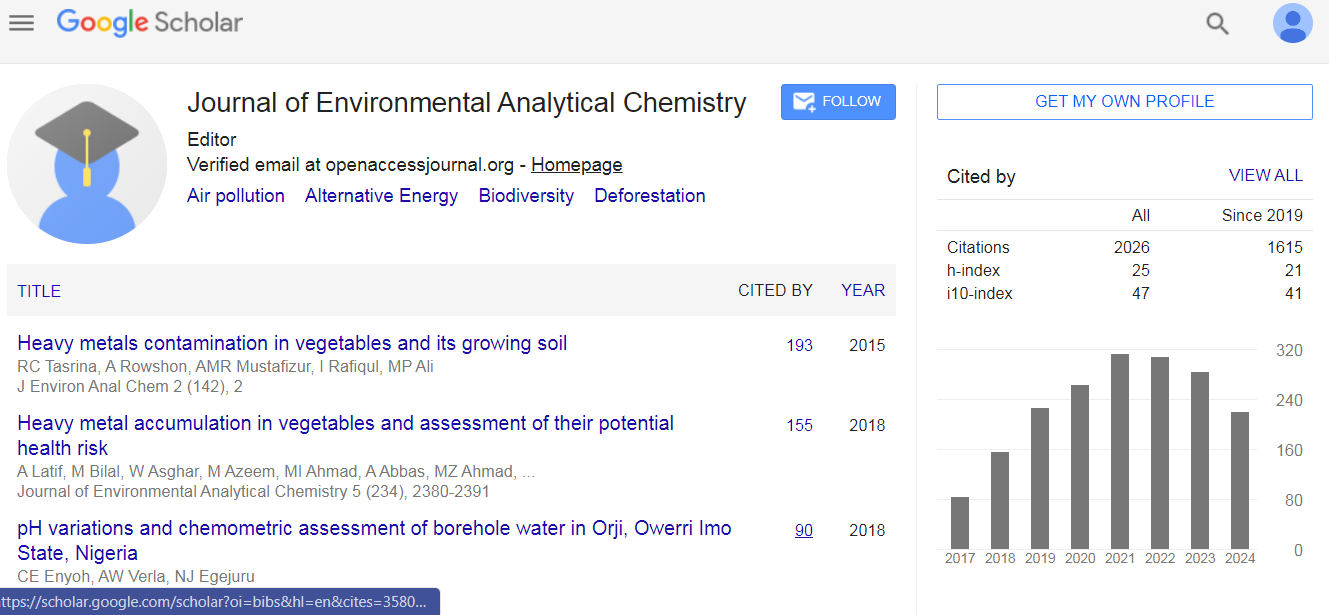
Journal of Environmental Analytical Chemistry received 1781 citations as per Google Scholar report