Commentary - (2025) Volume 13, Issue 3
Received: 01-Jun-2025, Manuscript No. JCMG-26-185537;
Editor assigned: 03-Jun-2025, Pre QC No. P-185537;
Reviewed: 17-Jun-2025, QC No. Q-185537;
Revised: 23-Jun-2025, Manuscript No. R-185537;
Published:
30-Jun-2025
, DOI: 10.37421/2472-128X.2025.13.340
Citation: Okoye, Samuel. ”Cancer Genomics: Unlocking Precision Medicine Through DNA.” J Clin Med Genomics 13 (2025):340.
Copyright: © 2025 Okoye S. This is an open-access article distributed under the terms of the Creative Commons Attribution License, which permits unrestricted use, distribution and reproduction in any medium, provided the original author and source are credited.
Cancer genomics is fundamentally transforming our comprehension of tumor development through the meticulous dissection of intricate DNA alterations that drive oncogenesis. Advanced sequencing technologies empower researchers to precisely identify critical mutations, epigenetic modifications, and patterns of genomic instability unique to various cancer types. This profound knowledge is instrumental in pinpointing driver mutations, elucidating tumor evolution, and architecting targeted therapeutic interventions. The broader 'omics' revolution, encompassing genomics, transcriptomics, and proteomics, offers an exhaustive view of the molecular landscape of cancer, thereby paving the path for precision medicine approaches that customize treatments based on an individual's specific tumor profile [1].
Unraveling the clonal architecture within tumors is of paramount importance for understanding their inherent heterogeneity and their capacity to develop resistance to therapeutic interventions. Genomic sequencing methodologies facilitate the reconstruction of tumor evolutionary histories, vividly illustrating the emergence and competitive dynamics of distinct cellular populations. This intrinsic clonal diversity exerts a significant influence on treatment efficacy and the likelihood of disease recurrence. Cutting-edge studies that utilize longitudinal sampling techniques in conjunction with sophisticated computational analyses are progressively illuminating the dynamic nature of clonal evolution, thereby informing the development of advanced strategies aimed at targeting dominant clones and proactively preventing the emergence of therapy-resistant subclones [2].
The impact of non-coding genetic variants on gene regulation within the context of cancer represents a rapidly expanding and increasingly significant area of research. Beyond the well-studied protein-coding mutations, alterations occurring within regulatory elements such as enhancers and promoters can exert profound influences on oncogene expression levels and the initiation of tumor formation. Comprehensive genomic and epigenomic profiling techniques are indispensable for the accurate identification of these non-coding drivers of cancer. A thorough understanding of how these variants modulate gene expression patterns is critically important for the discovery and development of novel diagnostic markers and therapeutic targets that extend beyond the scope of conventional gene mutation analysis [3].
Liquid biopsies, which ingeniously leverage circulating tumor DNA (ctDNA) present in biological fluids, offer a minimally invasive yet powerful avenue for interrogating the genomic landscape of tumors. These sophisticated analyses possess the capability to detect cancer at its earliest stages, meticulously monitor the patient's response to ongoing treatment, and identify emerging resistance mechanisms in real-time. The sensitivity and specificity associated with ctDNA detection are continuously being refined and enhanced, solidifying liquid biopsies as a highly potent tool for the personalized management of cancer. This transformative technology holds immense promise for widespread clinical adoption, fundamentally reshaping the paradigms of cancer diagnosis and patient management [4].
The tumor microenvironment (TME), a complex and dynamic ecosystem, plays a critical role in cancer progression and the efficacy of treatment responses. The genomic and transcriptomic characteristics of the TME are under increasing investigation. The intricate interactions occurring between tumor cells and surrounding stromal cells, immune cells, and the extracellular matrix are demonstrably shaped by underlying genetic alterations. Gaining a comprehensive understanding of the TME's molecular composition has the potential to reveal novel therapeutic vulnerabilities and provide valuable predictive insights into patient prognoses. The implementation of integrated multi-omics approaches is therefore vital for achieving a comprehensive and nuanced characterization of the TME [5].
Germline genetic variations, inherited from parents, contribute significantly to an individual's inherent susceptibility to developing cancer. Genome-wide association studies (GWAS) have been instrumental in identifying a multitude of common and rare genetic variants that are consistently associated with an elevated risk of cancer. The strategic integration of both germline and somatic genomic data offers a more complete and holistic picture of cancer etiology, which can subsequently inform more accurate risk assessments and guide the development of effective prevention strategies. Comprehending the complex interplay between inherited predispositions and acquired somatic mutations is a cornerstone of personalized cancer risk management [6].
Epigenetic modifications, including but not limited to DNA methylation and histone modifications, are critically important in the development of cancer by influencing gene expression patterns without altering the fundamental DNA sequence. The rapid advancements in genomic technologies are enabling the detailed mapping and characterization of these epigenetic landscapes. Aberrant regulation of epigenetic processes can lead to the aberrant activation of oncogenes or the silencing of crucial tumor suppressor genes, thereby establishing them as significant therapeutic targets. Furthermore, the inherent reversibility of many epigenetic changes presents a particularly promising avenue for the development of innovative and potentially curative treatment strategies [7].
Genomic instability is recognized as a fundamental hallmark of cancer, characterized by a significantly elevated rate of mutations and chromosomal abnormalities. Distinct forms of genomic instability, such as microsatellite instability (MSI) and chromosomal instability (CIN), are often associated with specific cancer subtypes and possess prognostic implications. A deeper understanding of the underlying mechanisms that drive genomic instability can unveil critical cellular vulnerabilities that may be effectively exploited therapeutically, particularly in cases involving deficiencies in DNA repair pathways [8].
Single-cell genomics represents a powerful technological innovation that allows for the detailed resolution of cellular heterogeneity within tumors. By performing genomic analysis on individual cells, researchers are empowered to identify rare and potentially critical cell populations, meticulously track cellular developmental trajectories, and gain profound insights into the genetic underpinnings of drug resistance at an exceptionally fine-grained level. This cutting-edge approach is absolutely essential for fostering a deeper and more comprehensive understanding of tumor evolution and for the subsequent development of more efficacious and precisely targeted therapies [9].
The integration of diverse multi-omics data, encompassing genomics, transcriptomics, proteomics, and epigenomics, is actively revolutionizing our fundamental understanding of cancer biology. Through the synergistic combination of these distinct datasets, researchers are better positioned to construct more comprehensive and sophisticated models of tumor behavior, identify novel and highly specific biomarkers, and discover more effective and potentially curative therapeutic strategies. This integrative, multi-faceted approach is unequivocally key to advancing the field of precision oncology and ultimately improving patient outcomes on a global scale [10].
Cancer genomics is at the forefront of revolutionizing our understanding of tumor development by meticulously dissecting the complex DNA alterations that drive the disease process. Utilizing advanced sequencing technologies, researchers can now accurately identify key mutations, epigenetic changes, and genomic instability patterns that are specific to different cancer types. This wealth of knowledge is indispensable for accurately pinpointing driver mutations, gaining insights into tumor evolution, and formulating effective targeted therapies. The broader 'omics' revolution, including genomics, transcriptomics, and proteomics, provides a comprehensive molecular view of cancer, paving the way for precision medicine that tailors treatments to an individual's unique tumor profile [1].
Ascertaining the clonal architecture of tumors is crucial for comprehending their inherent heterogeneity and their capacity to resist therapeutic interventions. Genomic sequencing enables the reconstruction of tumor evolutionary histories, revealing how distinct cell populations emerge and compete within the tumor ecosystem. This inherent clonal diversity significantly impacts treatment responses and the likelihood of disease recurrence. Employing longitudinal sampling and sophisticated computational analyses, researchers are shedding light on the dynamic nature of clonal evolution, informing strategies to target dominant clones and prevent the emergence of resistant subclones [2].
The influence of non-coding variants on gene regulation in cancer is a rapidly advancing field of study. Beyond mutations in protein-coding regions, alterations in regulatory elements like enhancers and promoters can profoundly affect oncogene expression and tumor initiation. Genomic and epigenomic profiling are essential for identifying these non-coding drivers of cancer. Understanding how these variants affect gene expression patterns is critical for developing novel diagnostic markers and therapeutic targets that extend beyond traditional gene mutation analysis [3].
Liquid biopsies, which utilize circulating tumor DNA (ctDNA), provide a minimally invasive method for examining tumor genomics. These analyses can detect cancer in its early stages, monitor treatment response, and identify resistance mechanisms in real-time. The sensitivity and specificity of ctDNA detection are continuously improving, making liquid biopsies a powerful tool for personalized cancer management. This technology holds immense promise for widespread clinical application, transforming cancer diagnosis and management [4].
The tumor microenvironment (TME) plays a critical role in cancer progression and treatment response, and its genomic and transcriptomic landscape is increasingly being investigated. Interactions between tumor cells and stromal cells, immune cells, and the extracellular matrix are influenced by genetic alterations. Understanding the TME's molecular composition can reveal new therapeutic vulnerabilities and predict patient outcomes. Integrated multi-omics approaches are vital for comprehensively characterizing the TME [5].
Germline genetic variations contribute to an individual's susceptibility to cancer. Genome-wide association studies (GWAS) have identified numerous common and rare variants associated with increased cancer risk. Integrating germline and somatic genomic data provides a more complete picture of cancer etiology and can inform risk assessment and prevention strategies. Understanding the interplay between inherited predispositions and acquired mutations is key to personalized cancer risk management [6].
Epigenetic modifications, such as DNA methylation and histone modifications, play a crucial role in cancer development by altering gene expression without changing the underlying DNA sequence. Genomic technologies are enabling detailed mapping of these epigenetic landscapes. Dysregulation of epigenetic processes can lead to oncogene activation or tumor suppressor gene silencing, making them important therapeutic targets. The reversibility of epigenetic changes offers a promising avenue for novel treatment strategies [7].
Genomic instability is a hallmark of cancer, characterized by an increased rate of mutations and chromosomal abnormalities. Different types of genomic instability, such as microsatellite instability (MSI) and chromosomal instability (CIN), are associated with distinct cancer subtypes and prognoses. Understanding the mechanisms driving genomic instability can reveal vulnerabilities that can be exploited therapeutically, particularly in the context of DNA repair deficiencies [8].
Single-cell genomics is a powerful technology for resolving cellular heterogeneity within tumors. By analyzing the genomes of individual cells, researchers can identify rare cell populations, track developmental trajectories, and understand the genetic basis of drug resistance at a fine-grained level. This approach is essential for a deeper understanding of tumor evolution and for developing more effective precision therapies [9].
The integration of multi-omics data, including genomics, transcriptomics, proteomics, and epigenomics, is transforming our understanding of cancer. By combining these datasets, researchers can build more comprehensive models of tumor biology, identify novel biomarkers, and discover more effective therapeutic strategies. This integrative approach is key to advancing precision oncology and improving patient outcomes [10].
Cancer genomics is revolutionizing tumor understanding through DNA alteration analysis using advanced sequencing. This identifies mutations, epigenetic changes, and instability, crucial for targeted therapies and precision medicine. Understanding clonal evolution is vital for managing tumor heterogeneity and treatment resistance. Non-coding variants and their impact on gene regulation are also key areas of research. Liquid biopsies offer a non-invasive way to detect cancer and monitor treatment. The tumor microenvironment's genomic and transcriptomic landscape is increasingly explored. Germline variations contribute to cancer susceptibility, and integrating germline and somatic data improves risk assessment. Epigenetic modifications and genomic instability are critical hallmarks with therapeutic implications. Single-cell genomics provides high-resolution insights into tumor heterogeneity, and multi-omics integration offers a comprehensive view for advancing cancer research and patient care.
None
None
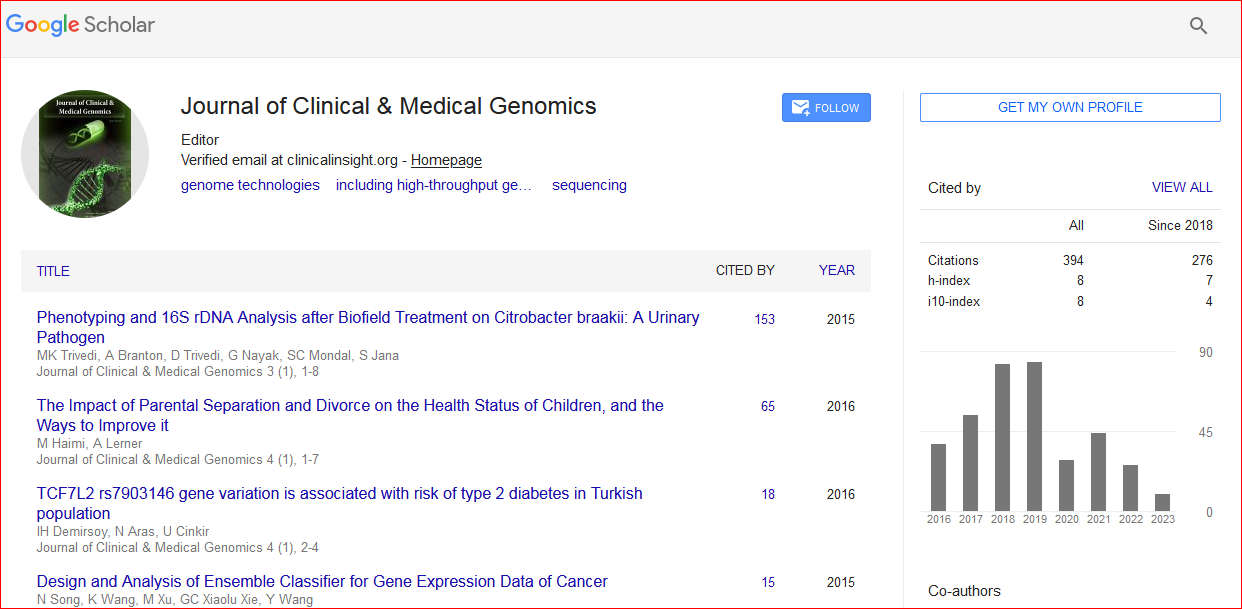
Journal of Clinical & Medical Genomics received 391 citations as per Google Scholar report