Brief Report - (2025) Volume 11, Issue 5
Received: 02-Oct-2025, Manuscript No. jpnp-25-175522;
Editor assigned: 06-Oct-2025, Pre QC No. P-175522;
Reviewed: 20-Oct-2025, QC No. Q-175522;
Revised: 23-Oct-2025, Manuscript No. R-175522;
Published:
30-Oct-2025
, DOI: 10.37421/2472-0992.2025.11.383
Citation: Ionescu, Andrei. ”Cañahua: Resilient Nutrition for Global Food Security.” J Pharmacogn Nat Prod 11 (2025):383.
Copyright: © 2025 Ionescu A. This is an open-access article distributed under the terms of the Creative Commons Attribution License, which permits unrestricted use, distribution and reproduction in any medium, provided the original author and source are credited.
Cañahua (Chenopodium pallidicaule Aellen) is an ancient Andean crop that has recently garnered significant scientific attention due to its exceptional nutritional value, adaptability, and potential contributions to global food security. Originating from the Andean highlands, this pseudo-cereal is well-suited for harsh environmental conditions, making it a promising candidate for sustainable agriculture in vulnerable regions.One key area of research focuses on the detailed characterization of cañahua's nutritional and phytochemical composition. For instance, a study thoroughly analyzed two cañahua ecotypes from Bolivia, revealing significant differences in their protein, fat, fiber, and mineral content. Crucially, this research also highlighted high levels of phenolic compounds and notable antioxidant activity, underscoring its potential as a functional food [1].
Further emphasizing its broad utility, a comprehensive review has detailed cañahua's extensive potential for both global food security and various health benefits. This work systematically discusses the crop's rich nutritional profile, which includes substantial amounts of protein, essential amino acids, dietary fiber, and a wide array of minerals and phenolic compounds. Such a composition firmly establishes cañahua as a valuable alternative crop, capable of enriching diverse diets worldwide [2].
From an agronomic perspective, the viability of cañahua cultivation in new environments has been a crucial area of inquiry. One study specifically evaluated its production potential in the semiarid regions of Jujuy Province, Argentina. The findings from this research indicated its strong suitability for agricultural diversification, particularly in marginal areas, demonstrating promising yields and a commendable adaptability to challenging environmental conditions prevalent in such regions [3].
Advancements in molecular biology have also shed light on cañahua's resilience mechanisms. A significant genome-wide analysis was conducted on the WRKY gene family in cañihua. This study successfully identified specific genes that are likely involved in the crop's responses to abiotic stresses. Understanding these genes is fundamentally important for developing new varieties that are inherently more resilient to environmental challenges, thereby significantly enhancing the crop's overall adaptability [4].
A broader review consolidated knowledge on cañahua, covering its key agronomic aspects, its distinct nutritional and functional properties, and the progress in biotechnological advancements. This review particularly stresses the inherent resilience of the crop, its exceptionally high nutritional value, and the promising avenues for genetic improvement. These combined factors are critical for maximizing its multifaceted benefits, especially in the context of global food security [5].
The specific health-promoting components within cañahua have also been meticulously investigated. Research focused on characterizing the protein fraction present in cañahua grains, uncovering its remarkable positive effects in reducing cellular oxidative stress and inflammation. These compelling findings strongly suggest that cañahua proteins could serve as highly valuable functional ingredients, contributing to the development of health-promoting foods [6].
Genomic research continues to provide deeper insights into this remarkable crop. A paper offered crucial genomic insights into cañahua, emphasizing its rich genetic diversity and its inherent potential for enhancing food security. A thorough understanding of its genome is pivotal for guiding the breeding of new varieties that possess enhanced resilience and superior nutritional profiles, which are indispensable for adapting to the exigencies of climate change [7].
Another comprehensive review meticulously detailed the genetic resources, the profound nutritional value, and the diverse utilization patterns of cañihua, reaffirming its status as an ancient Andean crop. This work powerfully underscores the vital importance of preserving its extensive genetic diversity and actively promoting its cultivation. The goal is to fully leverage its exceptional nutritional qualities for widespread human consumption, ensuring its benefits reach a broader population [8].
The bioactive components responsible for cañahua's health benefits have been further elucidated. A specific study precisely characterized the phenolic compounds and their associated antioxidant activity found within cañahua grains. This research clearly revealed a rich and diverse profile of bioactive compounds. The results strongly indicate that cañahua could indeed function as a highly valuable and natural source of antioxidants, finding significant applications in both the food and pharmaceutical industries [9].
Finally, a synthesizing review brought together the current body of knowledge regarding cañahua's genetic diversity, its profound nutritional value, and its array of potential health benefits. It prominently highlighted cañahua's esteemed status as a nutrient-dense pseudo-cereal and a profoundly promising resource for advancing human health and bolstering food security, especially within regions that are particularly vulnerable [10].
Collectively, these studies affirm cañahua's position not only as a resilient crop with significant nutritional advantages but also as a subject of extensive research aimed at enhancing its cultivation and maximizing its benefits for sustainable food systems globally.
Cañahua (Chenopodium pallidicaule Aellen) is an ancient Andean pseudo-cereal that has drawn considerable scientific attention due to its robust nutritional profile, inherent resilience, and potential to address contemporary food security challenges. Extensive research has meticulously characterized the nutritional and phytochemical composition of diverse cañahua ecotypes, consistently demonstrating significant levels of essential macronutrients like protein, fat, and fiber, alongside vital minerals [1]. Beyond these basic nutrients, cañahua is remarkably rich in various phenolic compounds and exhibits potent antioxidant activity, firmly establishing its status as a functional food with protective properties [1, 9]. These crucial findings are further reinforced by comprehensive reviews that highlight cañahua's role as a nutrient-dense crop, abundant in high-quality protein, a full spectrum of essential amino acids, dietary fiber, and a broad range of minerals and beneficial phenolic compounds. This makes it an exceptionally valuable alternative crop, capable of enriching diverse diets globally and significantly contributing to sustainable global food security initiatives [2, 10]. Detailed analyses of cañihua's genetic resources and profound nutritional value have been presented, powerfully underscoring the critical importance of preserving its biodiversity and actively promoting its widespread cultivation for human consumption [8].
From an agronomic perspective, cañahua distinguishes itself through its remarkable adaptability, particularly thriving in challenging environmental conditions often found in marginal agricultural areas. Seminal studies have specifically evaluated its production potential in semiarid regions, such as the Jujuy Province in Argentina, confirming its distinct suitability for agricultural diversification. This research indicates that cañahua can provide promising yields even where other conventional crops struggle, thereby offering a viable option for farmers in resource-constrained environments [3]. The crop's inherent resilience and ability to thrive under adverse conditions are frequently highlighted, with reviews comprehensively covering its agronomic aspects and exploring the vast potential for strategic genetic improvement aimed at maximizing its myriad benefits for agricultural sustainability [5].
Significant advancements in genomic research are providing increasingly critical insights into cañahua's intrinsic resilience and its considerable potential for targeted enhancement. A notable genome-wide analysis specifically investigated the WRKY gene family in cañihua, a group of transcription factors known to play pivotal roles in plant stress responses. This groundbreaking study successfully identified specific genes within this family that are likely involved in the crop's robust responses to various abiotic stresses, such as drought, salinity, and extreme temperatures. This understanding is profoundly crucial for developing new cañahua varieties that are inherently more resilient to intensifying environmental challenges posed by climate change [4]. Further genomic insights continue to underscore cañahua's rich genetic diversity and its indispensable role in fortifying food security. A deep and comprehensive understanding of its complex genome is paramount for guiding the strategic breeding of new varieties that possess not only enhanced resilience but also superior nutritional profiles, which are absolutely necessary for successful adaptation to rapidly changing global climatic conditions [7]. This ongoing biotechnological progress is thus absolutely essential for fully leveraging cañahua's comprehensive attributes [5].
The health benefits derived from the consumption of cañahua grains constitute another significant and burgeoning area of scientific investigation. Detailed characterization of the protein fraction present in cañahua grains has unequivocally demonstrated its pronounced positive effects in actively reducing cellular oxidative stress and mitigating inflammation [6]. These compelling findings strongly suggest that cañahua proteins could serve as exceptionally valuable functional ingredients for the strategic development of a new generation of health-promoting foods, nutraceuticals, and dietary supplements [6]. Moreover, the rich and diverse profile of phenolic compounds, coupled with their potent antioxidant activity found within cañahua grains, distinctly indicates its immense potential as a highly efficacious natural source of antioxidants for wide-ranging applications in both the burgeoning food and pharmaceutical industries [9]. Collectively, these scientifically validated functional properties significantly contribute to cañahua's esteemed status as a profoundly promising resource for substantially improving overall human health and well-being [10].
In essence, the cumulative body of research provides a comprehensive and compelling narrative, firmly establishing cañahua as a vital crop with multifaceted importance. Its unique genetic resources, exceptional and well-documented nutritional value, and scientifically demonstrated health benefits collectively position it as a critical component for effectively addressing pervasive global food security issues and proactively promoting enhanced well-being, particularly within regions that are environmentally vulnerable and economically disadvantaged [2, 8, 10]. Therefore, sustained and concerted efforts in both understanding and cultivating cañahua are absolutely paramount to fully harness its unique and powerful attributes for achieving sustainable agricultural development and ensuring widespread dietary improvement across the globe.
Cañahua (Chenopodium pallidicaule Aellen) is an ancient Andean crop gaining significant attention for its substantial contributions to global food security and health. Comprehensive research highlights its exceptional nutritional profile, including elevated levels of protein, essential amino acids, dietary fiber, and various minerals [1, 2]. Moreover, it is rich in potent phytochemicals, particularly phenolic compounds, which contribute to its strong antioxidant activity and functional food potential [1, 9]. The protein fraction from cañahua grains has demonstrated remarkable effects in reducing cellular oxidative stress and inflammation, suggesting its utility as a valuable functional ingredient [6]. Agronomic evaluations underscore cañahua's adaptability, showing promising yields even in semiarid regions and proving suitable for agricultural diversification in challenging environments [3, 5]. Genomic studies provide crucial insights into its genetic diversity and identify genes vital for abiotic stress responses, paving the way for developing more resilient varieties [4, 7]. Collectively, these findings emphasize cañahua's resilience, nutritional density, and the potential for biotechnological advancements to maximize its benefits for human health and food systems, particularly in vulnerable areas [5, 8, 10].
None
None
Vilma HA, Juan G, Virginia V. "Characterization of the Nutritional and Phytochemical Composition of Two Cañahua (Chenopodium pallidicaule Aellen) Ecotypes Grown in Bolivia".Foods 12 (2023):2548.
Indexed at, Google Scholar, Crossref
Christian SS, Norma MR, Susan DS. "Canihua (Chenopodium pallidicaule): An ancient Andean crop with high potential for food security and health benefits".Food Sci Nutr 11 (2023):2603-2615.
Indexed at, Google Scholar, Crossref
Valeria PZ, MarÃa VJ, Laura GT. "Evaluation of Cañahua (Chenopodium pallidicaule Aellen) Production as a Potential Crop for Semiarid Regions of Jujuy Province, Argentina".Agronomy 12 (2022):2874.
Indexed at, Google Scholar, Crossref
Xiaohan X, Yun S, Xiaoguang H. "Genome-wide analysis of the WRKY gene family in cañihua (Chenopodium pallidicaule Aellen) and its expression patterns under abiotic stress".BMC Plant Biol 23 (2023):367.
Indexed at, Google Scholar, Crossref
Efrain AM, Christian SS, Edgar DC. "Cañahua (Chenopodium pallidicaule Aellen): Agronomic Aspects, Nutritional and Functional Properties, and Biotechnological Advances".Agronomy 12 (2022):2577.
Indexed at, Google Scholar, Crossref
Valeria MZ, Christian SS, Norma MR. "Characterization of the Protein Fraction of Cañahua (Chenopodium pallidicaule Aellen) Grains and Its Effects on Cellular Oxidative Stress and Inflammation".Molecules 27 (2022):6606.
Indexed at, Google Scholar, Crossref
Janira DR, Luis NF, Christian SS. "Genomic Insights into Andean Native Crops: Cañahua (Chenopodium pallidicaule Aellen) and Its Potential for Food Security".Plants (Basel) 10 (2021):2269.
Indexed at, Google Scholar, Crossref
Efrain AM, Christian SS, Edgar DC. "The ancient Andean crop cañihua (Chenopodium pallidicaule Aellen): Genetic resources, nutritional value, and utilization".J Ethn Foods 8 (2021):19.
Indexed at, Google Scholar, Crossref
Valeria MZ, Christian SS, Edgar DC. "Phenolic compounds and antioxidant activity in cañahua (Chenopodium pallidicaule Aellen) grains".J Food Sci Technol 58 (2021):3866-3874.
Indexed at, Google Scholar, Crossref
Christian SS, Efrain AM, Norma MR. "A Review of the Genetic Diversity, Nutrition, and Potential Health Benefits of Cañahua (Chenopodium pallidicaule Aellen)".Foods 9 (2020):1845.
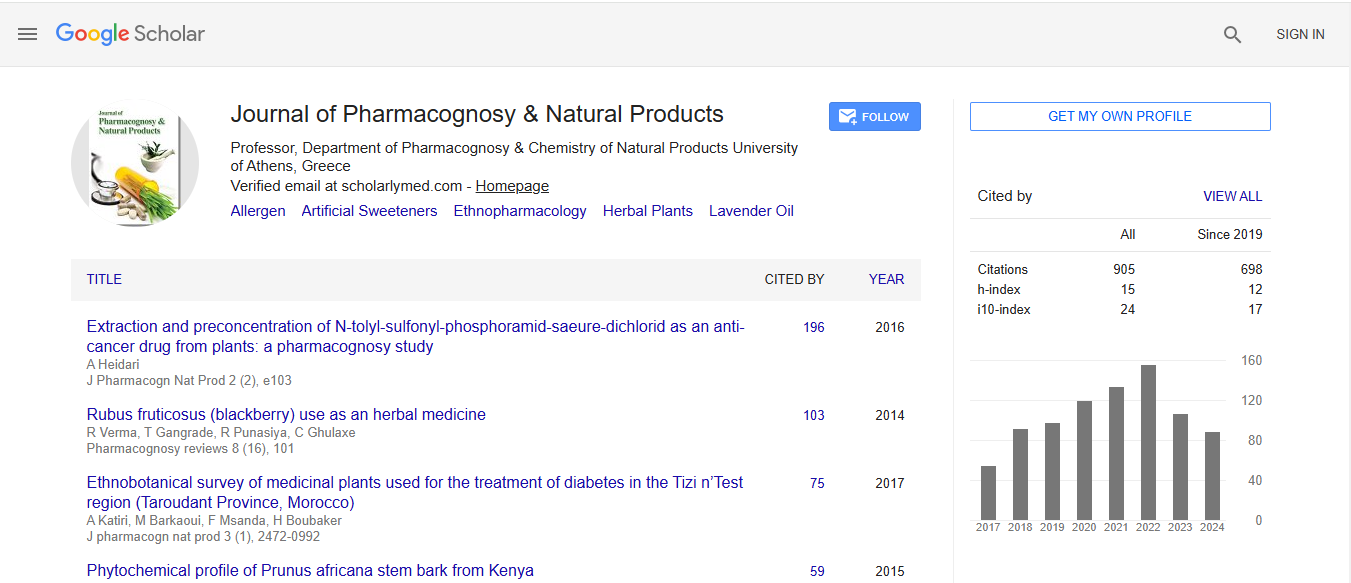
Journal of Pharmacognosy & Natural Products received 606 citations as per Google Scholar report