Opinion - (2025) Volume 12, Issue 4
Received: 01-Aug-2025, Manuscript No. reac-26-185848;
Editor assigned: 04-Aug-2025, Pre QC No. P-185848;
Reviewed: 18-Aug-2025, QC No. Q-185848;
Revised: 22-Aug-2025, Manuscript No. R-185848;
Published:
29-Aug-2025
, DOI: 10.37421/2380-2391.2025.12.439
Citation: Kowalski, Tomasz. ”Calibration Strategies for Reliable Environmental Monitoring.” J Environ Anal Chem 12 (2025):439.
Copyright: © 2025 Kowalski T. This is an open-access article distributed under the terms of the Creative Commons Attribution License, which permits unrestricted use, distribution and reproduction in any medium, provided the original author and source are credited.
Accurate environmental monitoring is foundational for informed decision-making and effective policy implementation across various domains. The integrity of environmental data hinges critically on the reliability and precision of the measurement instruments used. Consequently, rigorous calibration of sensors and analytical equipment is an indispensable step in the environmental monitoring process. This article aims to synthesize key insights and methodologies from recent research concerning the calibration of diverse environmental sensing technologies. The first study reviewed emphasizes the importance of meticulous calibration strategies for sensor networks employed in assessing both air and water quality, highlighting the necessity of certified reference materials, inter-laboratory comparisons, and field-based techniques to mitigate systematic errors and guarantee data credibility. Without proper calibration, environmental data can indeed be misleading, with potentially severe consequences for regulatory actions and public health initiatives [1].
The second publication delves into the critical role of traceable calibration in ensuring the quality of trace gas measurements for atmospheric monitoring, exploring advanced calibration methods for instruments designed to detect volatile organic compounds and greenhouse gases, and stressing the importance of traceability to national metrology institutes for achieving intercomparable data [2].
Following this, a study addresses the inherent variability of water quality parameters by investigating in-situ calibration techniques for optical sensors utilized in aquatic environments, proposing cost-effective, field-deployable calibration protocols to maintain data integrity [3].
The fourth article examines the calibration procedures for satellite-based sensors used in monitoring land cover changes and vegetation health, discussing the application of spectral libraries and ground-truthing to validate remote sensing data and emphasizing the need for standardized calibration protocols [4].
The fifth research paper focuses on the calibration challenges and solutions for low-cost sensors deployed in ubiquitous environmental monitoring networks, presenting strategies for distributed calibration and highlighting the trade-offs between cost, accuracy, and sensor lifespan [5].
The sixth study is dedicated to ensuring the accuracy of heavy metal detection in environmental samples, reviewing calibration methods for techniques such as Atomic Absorption Spectrometry and Inductively Coupled Plasma Mass Spectrometry, and discussing the importance of matrix matching and certified reference materials [6].
The seventh work examines the calibration of field equipment used in ecological surveys, such as soil moisture sensors, pH meters, and conductivity meters, addressing the impact of environmental conditions and proposing field-based calibration protocols to account for these variations [7].
The eighth paper concentrates on the calibration of dissolved gas sensors for monitoring oxygen and carbon dioxide in industrial wastewater, discussing challenges posed by complex matrices and fluctuating temperatures, and presenting a systematic approach to multi-point calibration [8].
The ninth article reviews calibration strategies for optical and gravimetric methods used to measure particulate matter concentrations, highlighting the importance of using well-characterized reference materials and intercomparison studies to ensure the reliability of these measurements [9].
Finally, the tenth study explores the adaptive calibration of electrochemical sensors for detecting polycyclic aromatic hydrocarbons in urban air, proposing a novel calibration approach that incorporates real-time correction algorithms to maintain accuracy in dynamic urban environments [10].
The overarching theme across these studies is the paramount importance of calibration in achieving accurate and reliable environmental data. Whether dealing with air and water quality, atmospheric trace gases, remote sensing, low-cost sensors, heavy metal analysis, ecological monitoring, dissolved gases, particulate matter, or specific pollutants like PAHs, the principles of calibration remain consistent. These include the use of certified reference materials, traceable standards, inter-laboratory comparisons, and appropriate field-based or in-situ techniques. The research collectively underscores that without proper calibration, environmental monitoring efforts risk generating misleading information, which can have detrimental effects on regulatory compliance, risk assessment, and public health. Therefore, a continuous focus on developing and implementing robust calibration protocols is essential for advancing the field of environmental science and ensuring the validity of environmental data used for policy and scientific understanding. This synthesis serves as a comprehensive overview of the current landscape of calibration strategies and their critical role in environmental monitoring applications.
The rigorous calibration of environmental monitoring instruments is a non-negotiable prerequisite for obtaining accurate and trustworthy data. In the realm of air and water quality assessment, the first study emphasizes the implementation of essential calibration strategies for sensor networks, advocating for the use of certified reference materials, inter-laboratory comparisons, and field-based calibration techniques to effectively minimize systematic errors and enhance data reliability. The authors stress that without appropriate calibration, environmental data can become fundamentally misleading, thereby compromising regulatory decisions and impacting public health initiatives. The techniques discussed, such as single-point, multi-point, and dynamic calibration, along with strategies for drift compensation in long-term monitoring, are vital for maintaining data integrity [1].
The second paper meticulously examines the critical role of traceable calibration in assuring the quality of trace gas measurements essential for atmospheric monitoring. It delves into advanced calibration methodologies for instruments dedicated to detecting volatile organic compounds (VOCs) and greenhouse gases. The research highlights the inherent challenges associated with calibrating complex analytical systems and subsequently presents practical solutions, including the utilization of high-purity gas standards and sophisticated gas mixing systems. A key takeaway from this work is the paramount importance of ensuring traceability to national metrology institutes, which provides a crucial foundation for enabling intercomparable data across diverse research groups and geographical locations [2].
Addressing the inherent variability observed in water quality parameters, the third study focuses on investigating in-situ calibration techniques specifically designed for optical sensors deployed in aquatic environments. The research concentrates on key parameters such as turbidity, dissolved oxygen, and pH. A significant finding of this study is the discernible impact of biofouling and sensor drift on measurement accuracy. To counter these issues, the authors propose the implementation of cost-effective, field-deployable calibration protocols. They strongly advocate for the adoption of regular re-calibration procedures utilizing portable standards, alongside the integration of automated sensor cleaning mechanisms, as essential strategies for preserving data integrity over extended monitoring periods [3].
The fourth article investigates the calibration and validation procedures for satellite-based sensors that are integral to monitoring land cover changes and vegetation health. The reliability of remote sensing data for environmental assessment is fundamentally dependent on effective ground-truthing and meticulous calibration processes. This research discusses the practical application of spectral libraries and comparative analyses with field spectroradiometer measurements to rigorously validate satellite data. A central emphasis of the work is placed on the critical need for standardized calibration protocols to ensure the consistency and comparability of environmental data derived from an array of different satellite platforms [4].
The fifth research endeavor centers on the specific calibration challenges and the proposed solutions for low-cost sensors that are increasingly being deployed in ubiquitous environmental monitoring networks. The authors meticulously explore the performance characteristics of both electrochemical and optical sensors, with a particular focus on their application in measuring air pollutants such as PM2.5 and NO2. They introduce and discuss strategies for distributed calibration, which importantly include the innovative use of mobile reference instruments and collaborative calibration approaches among interconnected network nodes. The study effectively highlights the inherent trade-offs that exist between cost, achieved accuracy, and the operational lifespan of these sensors, underscoring the critical importance of robust calibration schemes to effectively overcome their inherent limitations [5].
The sixth publication is dedicated to ensuring the utmost accuracy in the detection of heavy metals within environmental samples, a task of paramount importance for environmental protection and remediation efforts. This article provides a comprehensive review of the calibration methods applicable to advanced analytical techniques such as Atomic Absorption Spectrometry (AAS) and Inductively Coupled Plasma Mass Spectrometry (ICP-MS). It meticulously discusses the critical importance of matrix matching, the strategic use of certified reference materials (CRMs) that possess complex matrices, and the development of sophisticated multi-element calibration standards. The authors strongly emphasize that the successful implementation of proper calibration procedures is absolutely essential for conducting reliable risk assessments and executing effective remediation strategies [6].
The seventh study focuses on the practical application of field calibration protocols for essential ecological monitoring equipment. The precision and reliability of ecological sampling and subsequent monitoring efforts are fundamentally reliant on the accurate calibration of field equipment. This research thoroughly examines the calibration procedures for critical instruments such as soil moisture sensors, pH meters, and conductivity meters that are commonly employed in ecological surveys. It also adeptly addresses the significant impact that varying environmental conditions can have on sensor performance, proposing robust field-based calibration protocols specifically designed to effectively account for these environmental variations. The research unequivocally highlights the absolute necessity of performing regular recalibrations and employing portable calibration standards to ensure the comparability and scientific validity of data collected across diverse sites and various sampling events [7].
The eighth paper narrows its focus to the calibration of dissolved gas sensors, which are crucial for monitoring oxygen and carbon dioxide levels within industrial wastewater. The study acknowledges and discusses the significant challenges that are often posed by complex matrices and frequently fluctuating temperatures within these environments. The authors systematically present a well-defined approach to multi-point calibration, utilizing precisely prepared certified gas mixtures, and also conduct an investigation into the long-term stability characteristics of the sensors. The study strongly emphasizes the critical importance of rigorously validating sensor performance by comparing it against the measurements obtained from laboratory-grade reference instruments to ensure strict compliance with relevant environmental regulations [8].
The ninth article provides a review of calibration strategies specifically tailored for both optical and gravimetric methods used in the accurate quantification of particulate matter (PM) concentrations, a crucial aspect of air quality assessment. The study discusses the inherent challenges associated with PM measurements, particularly those related to particle size distribution, varying composition, and potential sampling artifacts. The authors strongly highlight the indispensable importance of utilizing well-characterized reference materials and conducting comprehensive intercomparison studies as key measures to guarantee the overall reliability and accuracy of particulate matter measurements [9].
Finally, the tenth study delves into the adaptive calibration of electrochemical sensors designed for the detection of polycyclic aromatic hydrocarbons (PAHs) in urban air environments. The research examines the significant impact that co-pollutants and prevailing environmental conditions can have on the response characteristics of these sensors. To address these complexities, the authors propose a novel calibration approach that ingeniously incorporates real-time correction algorithms derived from multivariate data analysis. The work unequivocally underscores the critical need for adaptive calibration strategies that can effectively maintain measurement accuracy within the inherently dynamic and complex conditions of urban environments [10].
This collection of research synthesizes critical calibration strategies for a wide array of environmental monitoring applications. Key themes include the essential use of certified reference materials, traceable standards, and inter-laboratory comparisons to ensure data accuracy and reliability in assessing air and water quality, atmospheric gases, and heavy metals. Studies address the unique challenges posed by various sensor types, from advanced analytical instruments to low-cost sensors and remote sensing platforms. Techniques discussed range from single-point and multi-point calibrations to in-situ and adaptive calibration methods designed to compensate for environmental variability, sensor drift, and matrix effects. The research collectively emphasizes that without robust and appropriate calibration, environmental data can be misleading, impacting regulatory decisions, risk assessments, and public health initiatives. Therefore, consistent development and application of effective calibration protocols are vital for the integrity of environmental monitoring.
None
None
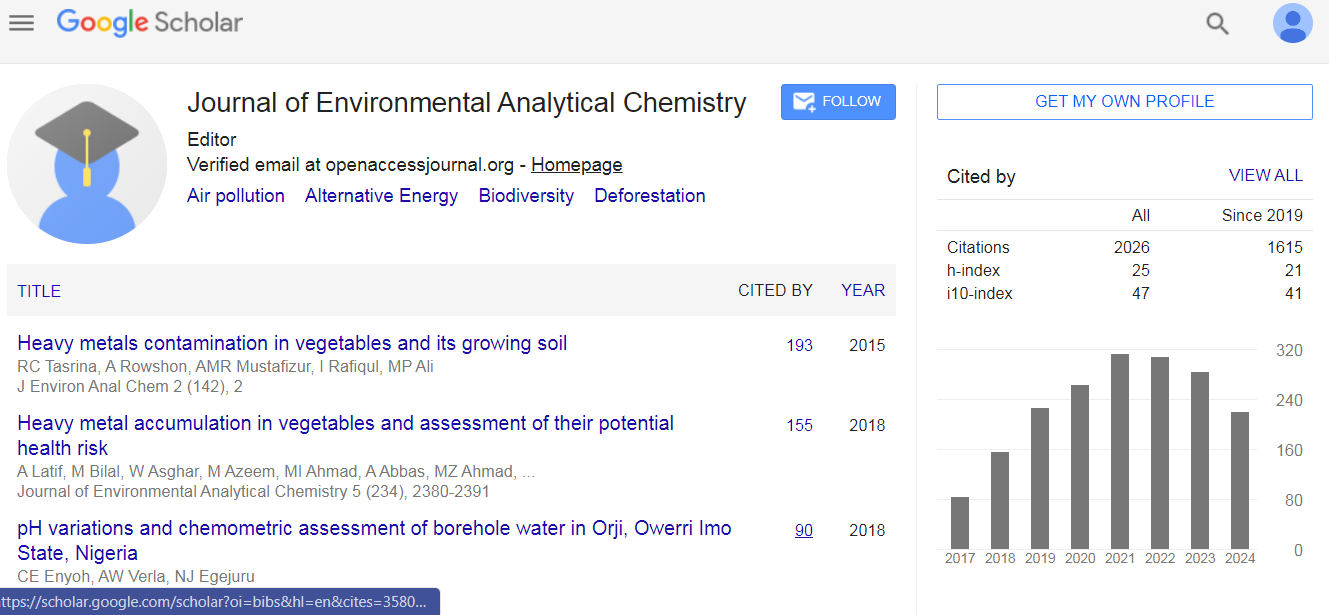
Journal of Environmental Analytical Chemistry received 1781 citations as per Google Scholar report