Perspective - (2025) Volume 16, Issue 4
Received: 01-Jul-2025, Manuscript No. bej-26-182465;
Editor assigned: 03-Jul-2025, Pre QC No. P-182465;
Reviewed: 17-Jul-2025, QC No. Q-182465;
Revised: 22-Jul-2025, Manuscript No. R-182465;
Published:
29-Jul-2025
, DOI: 10.37421/2161-6219.2025.16.568
Citation: Al-Mansoori, Omar. ”Business’s Role in Economic
Growth and Innovation.” Bus Econ J 16 (2025):568.
Copyright: © 2025 Al-Mansoori O. This is an open-access article distributed under the terms of the Creative Commons Attribution License, which permits unrestricted use,
distribution and reproduction in any medium, provided the original author and source are credited.
Business organizations are fundamental pillars of modern economies, their strategic decisions and operational frameworks profoundly shaping national and global economic trajectories. The intricate interplay between corporate actions and macroeconomic outcomes necessitates a comprehensive understanding of the diverse factors that contribute to firm performance and, by extension, economic growth. High-performing enterprises often exhibit robust governance structures, demonstrating an inherent ability to navigate evolving market dynamics and capitalize on emerging opportunities. Their commitment to innovation, coupled with strategic investments in both human capital and technological advancements, serves as a powerful engine for job creation and productivity enhancement, ultimately bolstering the gross domestic product of nations.
Conversely, organizations that struggle with inefficiency or deficient management can inadvertently impede economic progress. This can manifest through the misallocation of vital resources, a dampening effect on healthy competition, and a general slowdown in the pace of economic advancement and overall prosperity. The critical role of innovation within the corporate sphere cannot be overstated; it stands as a principal catalyst for sustained economic expansion. Businesses that actively cultivate environments conducive to research and development, readily embrace cutting-edge technologies, and successfully introduce novel products or services to the marketplace frequently surpass their competitors in performance. This internal dynamism not only drives individual firm success but also stimulates broader economic activity, thereby enhancing a nation's export capabilities and solidifying its position in the global economic arena. Such a focus on innovation is therefore directly correlated with a more robust and competitive national economy. Operational efficiency stands as a foundational element in how businesses exert influence over economic performance metrics. The meticulous streamlining of internal processes, the astute optimization of complex supply chains, and the judicious management of organizational resources collectively empower firms to produce goods and services at reduced costs. This cost reduction can translate into more accessible pricing for consumers, thereby increasing purchasing power, and simultaneously generate higher profits, which can then be reinvested into further growth and development. Such improvements in productivity invariably contribute positively to the aggregate economic indicators of a nation. Human capital development within the organizational context is intrinsically interwoven with positive economic outcomes. When businesses prioritize and invest in comprehensive employee training programs, facilitate continuous skill enhancement, and actively promote the well-being of their workforce, they cultivate a more skilled, adaptable, and motivated labor pool. This enhanced human capital directly fuels innovation, boosts overall productivity, and strengthens a firm's competitive standing in the marketplace. Consequently, these localized positive effects ripple outward, creating a beneficial cascade that positively impacts the broader economy. The strategic orientation adopted by business organizations, encompassing their chosen market focus and the competitive strategies they employ, plays a pivotal role in shaping their economic performance and, by extension, the economic landscape. Firms that embrace proactive, market-driving strategies are often better positioned to achieve superior growth trajectories and enhanced profitability. Their forward-thinking approach allows them to contribute more substantially to the economic ecosystem compared to organizations that adopt more passive or reactive stances, which may limit their potential for significant economic impact. Access to adequate financial resources and the existence of efficient capital markets are indispensable for enabling businesses to undertake essential investments, pursue expansion initiatives, and foster innovation. These financial mechanisms directly influence economic performance by ensuring that capital is channeled effectively towards productive ventures. A well-functioning financial system, therefore, acts as a crucial facilitator of economic growth and stability, allowing businesses to realize their full potential and contribute to a thriving economy. An organization's capacity for adaptability, particularly in response to rapid technological advancements and significant market shifts, is paramount for its sustained economic contribution. Businesses that possess the agility to pivot their strategies and readily embrace change are demonstrably more likely to achieve long-term survival and prosperity. Their ability to navigate dynamic environments ensures the continued generation of employment opportunities and the creation of economic value, even amidst uncertainty and transformation. While the direct, short-term financial implications of ethical business practices and corporate social responsibility (CSR) initiatives may not always be immediately apparent, these factors exert a significant indirect influence on economic performance. By cultivating a positive corporate reputation, attracting top-tier talent, and fostering genuine consumer trust, organizations build a foundation for long-term sustainability. These intangible assets are crucial for enduring economic success and contribute to a more resilient and trustworthy economic system. The dynamic interplay of competition among business organizations serves as a powerful stimulant for both innovation and efficiency, ultimately yielding substantial benefits for the broader economy. As firms vigorously strive to capture and expand their market share, they are incentivized to introduce superior products, offer more competitive pricing, and deliver enhanced customer services. This competitive drive leads to a higher overall level of economic welfare and improved outcomes for consumers. Effective management practices are critically vital for the successful translation of organizational resources into tangible economic performance. Organizations that benefit from strong leadership, possess clearly defined strategic objectives, and demonstrate efficient execution capabilities are inherently more likely to achieve their desired goals. Such success translates into the creation of valuable employment opportunities and a more significant overall contribution to national economic prosperity and development. Business organizations are central to economic activity, their strategic choices and operational efficiencies directly influencing economic performance. Key factors include robust governance, market adaptability, and investment in human capital and technology, which foster job creation and productivity growth. Conversely, inefficient organizations can hinder progress through resource misallocation and stifled competition. The literature explores these dynamics through various lenses, highlighting the multifaceted relationship between corporate behavior and macroeconomic outcomes. This paper synthesines these findings to provide a comprehensive overview of how businesses impact economic performance, drawing upon empirical investigations and theoretical frameworks to illuminate the intricate connections at play. The focus remains on understanding the mechanisms through which organizations contribute to or detract from economic vitality, providing insights for policymakers and business leaders alike. Innovation is a significant driver of economic growth. Companies that prioritize research and development, adopt new technologies, and introduce novel products tend to outperform competitors and stimulate economic activity. This leads to increased export potential and a more competitive national economy. These innovations often stem from a corporate culture that values creativity and embraces change, allowing businesses to stay ahead in a rapidly evolving global market. The investment in new ideas and technologies is therefore crucial for long-term economic sustainability. Operational efficiency is a cornerstone of how businesses influence economic performance. Streamlining processes, optimizing supply chains, and effectively managing resources allow firms to produce goods and services at lower costs, potentially leading to lower prices for consumers and higher profits for reinvestment. This enhanced productivity contributes positively to national economic metrics, demonstrating the direct link between internal organizational effectiveness and broader economic well-being. Efficient operations are thus a key determinant of a firm's contribution to economic growth. Human capital development within organizations is intrinsically linked to economic outcomes. Investing in employee training, skill development, and well-being leads to a more skilled and motivated workforce, which can drive innovation, improve productivity, and enhance a firm's competitive edge. This positive effect cascades through the economy, highlighting the importance of nurturing talent as a strategic imperative for both individual firms and the national economy as a whole. The growth of human capital is a direct contributor to economic prosperity. The strategic orientation of business organizations, including their market focus and competitive strategies, plays a crucial role in shaping economic performance. Firms that adopt proactive and market-driving strategies often achieve superior growth and profitability, contributing more significantly to the economic landscape than those with passive approaches. This proactive stance ensures that businesses are not merely reacting to market changes but are actively shaping them to their advantage. Access to finance and efficient capital markets allows businesses to invest, expand, and innovate, directly influencing economic performance. Well-functioning financial systems enable the allocation of capital to productive ventures, fostering economic growth and stability. The availability of capital is thus a prerequisite for businesses to engage in the activities that drive economic advancement and create sustainable value. Organizational adaptability to technological advancements and market shifts is critical for sustained economic contribution. Businesses that can pivot and embrace change are more likely to survive and thrive, generating employment and economic value in dynamic environments. This agility allows organizations to remain relevant and competitive in the face of constant change. The ethical practices and corporate social responsibility (CSR) of business organizations can indirectly influence economic performance by enhancing reputation, attracting talent, and building consumer trust. While not always directly measurable in short-term profits, these factors contribute to long-term economic sustainability and a positive societal impact. Competition among business organizations stimulates innovation and efficiency, ultimately benefiting the broader economy. Firms striving to gain market share often introduce better products, lower prices, and improved services, leading to higher overall economic welfare. This competitive dynamic ensures that businesses are constantly striving for improvement. Effective management practices are vital for translating organizational resources into economic performance. Organizations with strong leadership, clear strategic goals, and efficient execution capabilities are more likely to achieve success, creating jobs and contributing to economic prosperity. Strong management is the engine that drives organizational success and economic contribution.Business organizations significantly impact economic performance through their strategic decisions, operational efficiency, and innovation capabilities. High-performing firms often exhibit strong governance, adapt to market changes effectively, and invest in human capital and technology. This, in turn, fosters job creation, increases productivity, and contributes to overall GDP growth. Conversely, inefficient or poorly managed organizations can hinder economic progress by misallocating resources and stifling competition [1].
Innovation within business organizations is a key driver of economic growth. Companies that foster a culture of research and development, embrace new technologies, and bring novel products or services to market tend to outperform their competitors and stimulate broader economic activity. This can lead to increased export potential and a more competitive national economy [2].
Operational efficiency is a cornerstone of how businesses influence economic performance. Streamlining processes, optimizing supply chains, and effectively managing resources allow firms to produce goods and services at lower costs, potentially leading to lower prices for consumers and higher profits for reinvestment. This enhanced productivity contributes positively to national economic metrics [3].
Human capital development within organizations is intrinsically linked to economic outcomes. Investing in employee training, skill development, and well-being leads to a more skilled and motivated workforce, which can drive innovation, improve productivity, and enhance a firm's competitive edge. This positive effect cascades through the economy [4].
The strategic orientation of business organizations, including their market focus and competitive strategies, plays a crucial role in shaping economic performance. Firms that adopt proactive and market-driving strategies often achieve superior growth and profitability, contributing more significantly to the economic landscape than those with passive approaches [5].
Access to finance and efficient capital markets allows businesses to invest, expand, and innovate, directly influencing economic performance. Well-functioning financial systems enable the allocation of capital to productive ventures, fostering economic growth and stability [6].
Organizational adaptability to technological advancements and market shifts is critical for sustained economic contribution. Businesses that can pivot and embrace change are more likely to survive and thrive, generating employment and economic value in dynamic environments [7].
The ethical practices and corporate social responsibility (CSR) of business organizations can indirectly influence economic performance by enhancing reputation, attracting talent, and building consumer trust. While not always directly measurable in short-term profits, these factors contribute to long-term economic sustainability [8].
Competition among business organizations stimulates innovation and efficiency, ultimately benefiting the broader economy. Firms striving to gain market share often introduce better products, lower prices, and improved services, leading to higher overall economic welfare [9].
Effective management practices are vital for translating organizational resources into economic performance. Organizations with strong leadership, clear strategic goals, and efficient execution capabilities are more likely to achieve success, creating jobs and contributing to economic prosperity [10].
Business organizations are pivotal to economic performance through strategic decisions, operational efficiency, and innovation. High-performing firms leverage strong governance, market adaptability, and investments in human capital and technology to drive job creation and productivity, boosting GDP. Conversely, inefficient firms can impede economic progress by misallocating resources and limiting competition. Innovation is a key growth driver, leading to competitive advantages and increased export potential. Operational efficiency lowers costs and enhances productivity. Human capital development fosters a skilled workforce, boosting innovation and competitiveness. Strategic orientation and access to finance are crucial for growth and investment. Adaptability to change ensures long-term economic contribution, while ethical practices and CSR build trust and sustainability. Competition spurs innovation and efficiency, benefiting consumers and the economy overall. Effective management translates resources into success, creating jobs and prosperity.
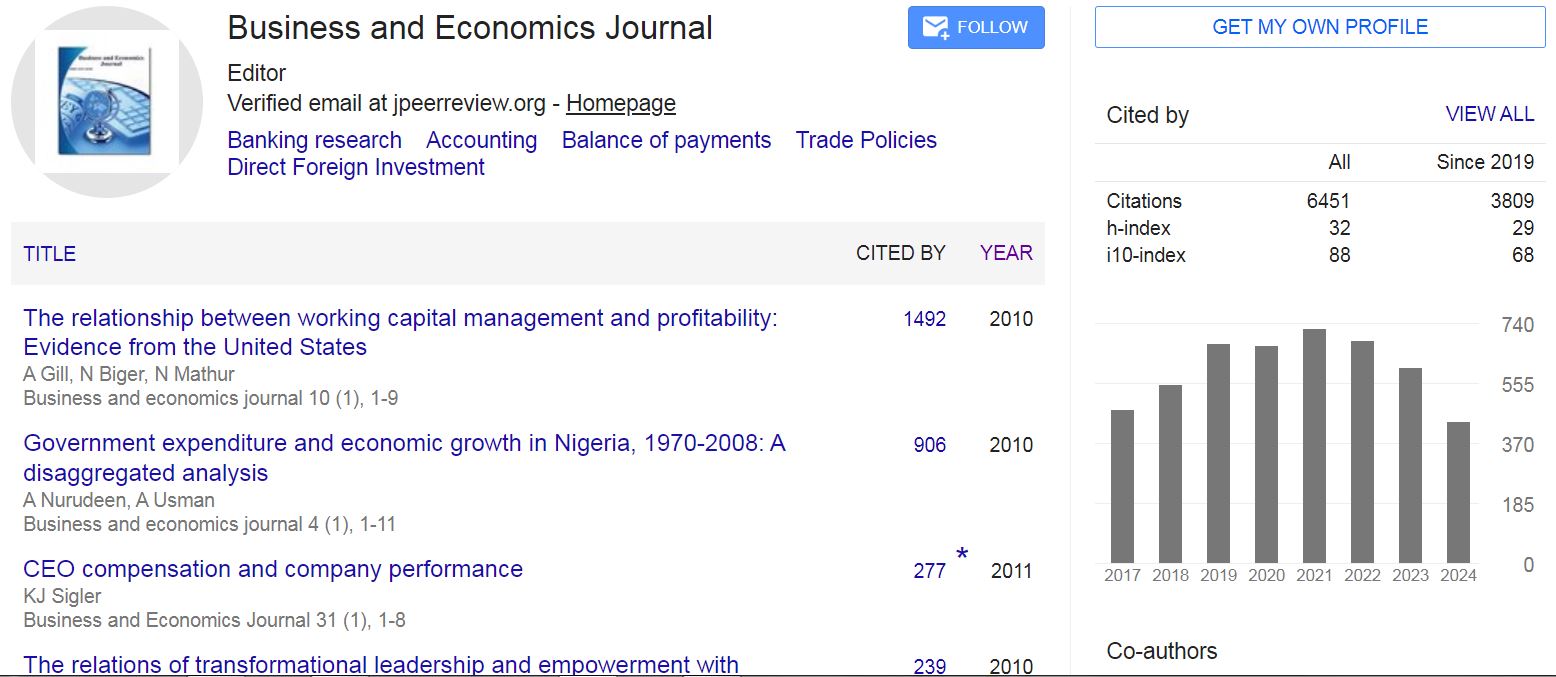
Business and Economics Journal received 6451 citations as per Google Scholar report