Opinion - (2025) Volume 16, Issue 3
Received: 01-May-2025, Manuscript No. bej-26-182424;
Editor assigned: 05-May-2025, Pre QC No. P-182424;
Reviewed: 19-May-2025, QC No. Q-182424;
Revised: 22-May-2025, Manuscript No. R-182424;
Published:
29-May-2025
, DOI: 10.37421/2161-6219.2025.16.556
Citation: Schmidt, Isabella. ”Business Practices’ Impact on National
Economies.” Bus Econ J 16 (2025):556.
Copyright: © 2025 Schmidt I. This is an open-access article distributed under the terms of the Creative Commons Attribution License, which permits unrestricted use,
distribution and reproduction in any medium, provided the original author and source are credited.
The intricate relationship between diverse business practices and the trajectory of national economies has been a subject of considerable academic inquiry. Understanding how various corporate strategies influence economic indicators such as growth, employment, and income distribution is crucial for policymakers and business leaders alike. Innovations in business operations, coupled with a commitment to corporate social responsibility (CSR), can steer economies toward sustained prosperity, though the specific outcomes are often nuanced, varying by industry and regulatory frameworks [1].
The pervasive wave of digitalization has profoundly reshaped economies, particularly concerning productivity and labor markets. While digital transformation offers avenues for efficiency and the creation of novel job roles, it simultaneously presents challenges related to workforce skills and potential job displacement, necessitating strategic policy interventions to ensure equitable benefit distribution [2].
Furthermore, the adoption of sustainable business practices is increasingly recognized for its positive correlation with national economic competitiveness and environmental stewardship. Green technologies and resource efficiency not only bolster export potential but also contribute to a more resilient economic model, often facilitated by supportive national policies that encourage broader implementation [3].
The influx of foreign direct investment (FDI) also plays a significant role, with the business practices of multinational corporations (MNCs) impacting host economies through knowledge transfer, local sourcing, and adherence to labor and environmental standards. Effective policy frameworks are paramount in harnessing the positive spillover effects of FDI [4].
A firm's investment in research and development (R&D) intensity serves as a potent driver for national innovation ecosystems and economic growth. Such corporate commitments foster product and process innovation, enhance human capital, and generate high-value employment, with government support acting as a multiplier for these national benefits [5].
The financial practices of corporations, encompassing capital structure and dividend policies, have a discernible impact on macroeconomic stability and investment. Prudent financial management contributes to long-term economic health, whereas excessive risk-taking can introduce systemic vulnerabilities, underscoring the need for financial regulation aligned with national economic objectives [6].
Participation in global value chains (GVCs) can significantly influence the economic development of emerging economies. Integration into GVCs, driven by lead firm practices, can spur technology upgrading, boost exports, and create jobs, though strategies to enhance domestic value addition are essential to mitigate market dependence [7].
Mergers and acquisitions (M&A) also leave their mark on national economies, affecting market structure, consumer prices, and employment. The extent to which M&A fosters economic dynamism is often contingent on regulatory oversight and the strategic integration capabilities of the involved firms [8].
Corporate governance structures and their alignment with national regulations are critical for a firm's capacity to innovate, manage risk, and contribute to economic stability. Robust governance frameworks, adhering to legal and ethical standards, are fundamental for sustainable economic development and public trust [9].
Finally, the entrepreneurial spirit and business practices of small and medium-sized enterprises (SMEs) are vital for national economic dynamism. A thriving SME sector fuels job creation, spurs innovation, and diversifies economies, with supportive policy environments and access to finance being key enablers of their contribution to national economic goals [10].
The diverse landscape of business practices significantly influences national economic performance, with innovation adoption, corporate social responsibility, and supply chain management acting as key determinants of economic growth, employment, and income distribution. While certain practices foster sustainability and broad-based prosperity, others can intensify inequalities or introduce economic fragilities, with the ultimate impact being multifaceted and contingent on industry specifics, regulatory environments, and implementation scale [1].
The process of digitalization within businesses profoundly affects national economies, particularly in terms of productivity and labor markets. Digital transformation can unlock substantial efficiency gains and generate new job categories, but it also poses challenges related to skill gaps and potential job displacement, emphasizing the need for proactive policy interventions to ensure that the benefits are widely shared [2].
Moreover, the integration of sustainable business practices into a nation's economic framework demonstrates a positive correlation with enhanced economic competitiveness and a reduced environmental footprint. Firms embracing green technologies often achieve competitive advantages, leading to improved export potential and decreased reliance on finite resources, with national policies playing a crucial role in promoting broader adoption for a more resilient economic model [3].
The role of foreign direct investment (FDI) in host economies is closely tied to the business practices of multinational corporations (MNCs). While FDI can be a catalyst for economic development, its net effect is influenced by the extent of knowledge transfer, local sourcing engagement, and adherence to national labor and environmental standards by MNCs, highlighting the critical role of policy frameworks in maximizing positive spillover effects [4].
The intensity of corporate investment in research and development (R&D) is a significant contributor to national innovation ecosystems and overall economic growth. A strong corporate commitment to R&D not only drives innovation in products and processes but also contributes to the accumulation of human capital and the creation of high-value jobs, with government support further amplifying these national-level benefits [5].
Furthermore, the financial practices of large corporations, including their decisions on capital structure and dividend policies, have a direct impact on macroeconomic stability and investment levels. Prudent financial management contributes to long-term economic health, whereas excessive risk-taking or a focus on short-term profit maximization can lead to systemic vulnerabilities, underscoring the importance of financial regulation in aligning corporate behavior with national economic objectives [6].
The participation of firms in global value chains (GVCs) can significantly shape the economic development of emerging economies. Integration into GVCs, often initiated by the business practices of lead firms, can lead to technological upgrading, increased exports, and job creation. However, it also presents potential risks of market dependence, necessitating strategies to bolster domestic value addition [7].
Mergers and acquisitions (M&A) within a national context have discernible economic consequences, influencing market concentration, consumer prices, and employment levels. The efficacy of M&A in fostering economic dynamism is often dependent on the strength of regulatory oversight and the strategic integration capabilities of the firms involved [8].
Corporate governance structures and their adherence to national regulations are vital for a firm's innovative capacity, risk management approach, and its contribution to overall economic stability. Robust governance frameworks that align with national legal and ethical standards are essential for cultivating sustainable economic development and maintaining public trust [9].
Finally, the economic contributions of entrepreneurship and the business practices of small and medium-sized enterprises (SMEs) are fundamental to national economies. A dynamic SME sector is instrumental in job creation, fostering innovation, and promoting economic diversification, with supportive policy environments and accessible finance being key facilitators for their impactful role in achieving national economic objectives [10].
This collection of research explores the multifaceted impact of diverse business practices on national economies. Key themes include how innovation adoption, digitalization, and sustainable practices drive economic growth and productivity, while also presenting challenges such as skill gaps and inequality. The influence of foreign direct investment, corporate R&D, financial management, global value chain participation, mergers and acquisitions, corporate governance, and the role of SMEs are also examined. The studies collectively highlight the critical interplay between corporate strategies, regulatory environments, and policy interventions in shaping economic outcomes, fostering competitiveness, and ensuring sustainable development.
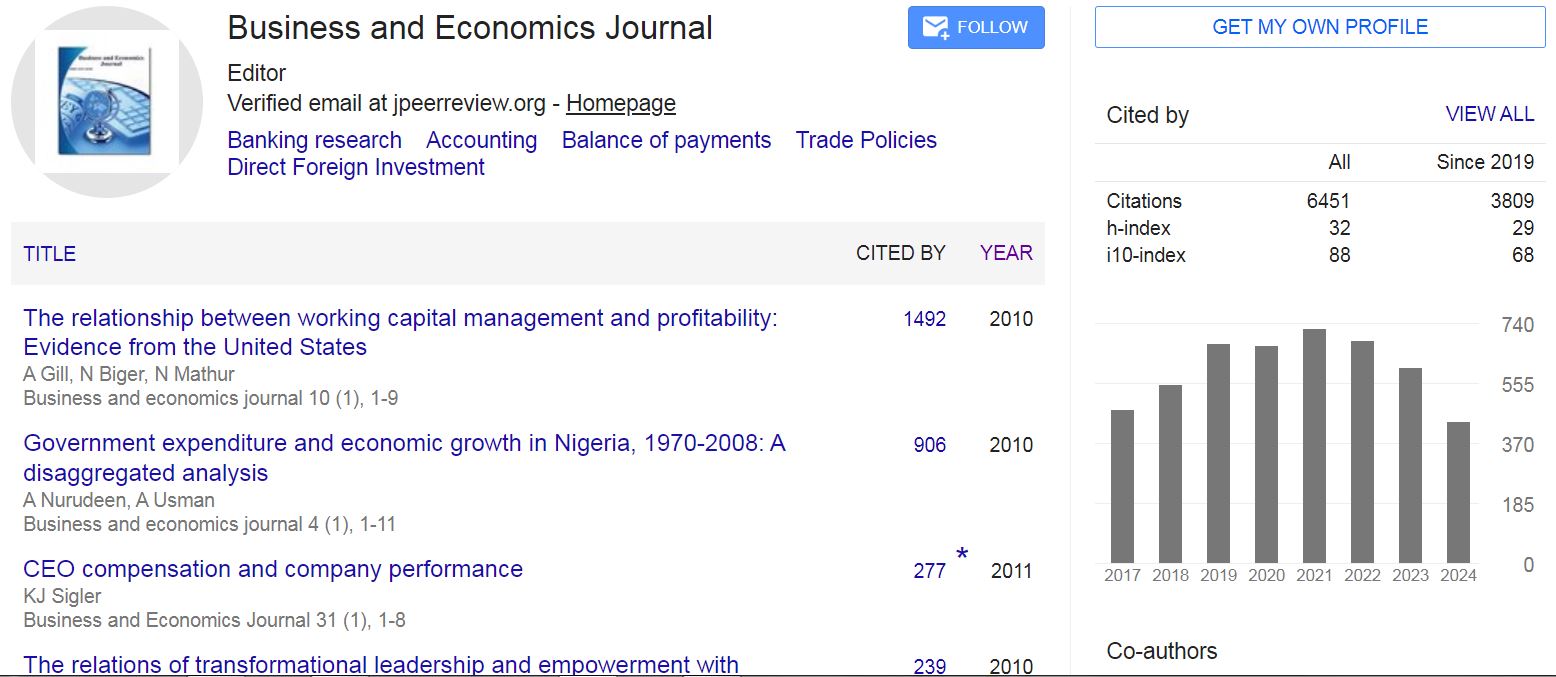
Business and Economics Journal received 6451 citations as per Google Scholar report