Commentary - (2025) Volume 16, Issue 6
Received: 01-Nov-2025, Manuscript No. bej-26-182555;
Editor assigned: 03-Nov-2025, Pre QC No. P-182555;
Reviewed: 17-Nov-2025, QC No. Q-182555;
Revised: 22-Nov-2025, Manuscript No. R-182555;
Published:
29-Nov-2025
, DOI: 10.37421/2161-6219.2025.16.585
Citation: Popov, Boris. ”Business Investment: Fueling Economic
Growth and Prosperity.” Bus Econ J 16 (2025):585.
Copyright: © 2025 Popov B. This is an open-access article distributed under the terms of the Creative Commons Attribution License, which permits unrestricted use, distribution
and reproduction in any medium, provided the original author and source are credited.
The profound link between business investment and economic growth forms the bedrock of sustained prosperity. Increased capital expenditure by firms acts as a catalyst, propelling productivity and innovation while simultaneously fostering job creation, thereby driving the expansion of Gross Domestic Product. A stable economic environment, coupled with supportive government policies, is paramount in encouraging such vital investments. The evidence suggests that policies designed to mitigate investment risks and enhance financial accessibility are indispensable for achieving long-term economic well-being [1].
Understanding the varied responses of business investment to prevailing economic conditions is crucial. Research indicates that the specific type of investment, whether in research and development or physical capital, alongside distinct firm characteristics, significantly shapes their contribution to overall economic growth. Notably, firms with robust financial standing and those operating in innovative sectors tend to invest more actively during economic downturns, acting as a stable engine for continued growth [2].
The intricate role of financial markets in mediating the relationship between business investment and economic growth cannot be overstated. Efficient credit and equity markets are essential for the effective channeling of savings into productive avenues, thereby amplifying the positive repercussions on economic output and employment. This financial intermediation is key to translating investment into tangible economic gains [3].
Economic and political uncertainty presents a significant impediment to business investment decisions, consequently impacting economic growth. Studies reveal that elevated levels of uncertainty lead to a marked reduction in investment, acting as a considerable drag on GDP growth. Therefore, establishing clear and stable policy frameworks is essential for cultivating a predictable environment that encourages investment [4].
Technological progress plays a pivotal role in the dynamic interplay between business investment and economic growth. Investments in novel technologies not only enhance productivity but also serve to stimulate further investment, establishing a virtuous cycle of innovation and expansion. Fostering an environment that is conducive to the adoption of new technologies is therefore critically important [5].
Foreign direct investment (FDI) exerts a significant influence on domestic business investment and, by extension, economic growth. FDI can act as a complement to domestic investment by injecting capital, advanced technology, and valuable managerial expertise, which collectively lead to higher productivity and accelerated growth rates. The impact of FDI, however, is contingent upon its quality and nature [6].
Government policies are instrumental in shaping the trajectory of business investment and, consequently, economic growth. Fiscal incentives, regulatory reforms, and strategic investments in infrastructure can significantly bolster private sector investment, thereby promoting broader economic expansion. The consistency and efficacy of these policies are paramount to their success [7].
The mechanisms of corporate governance profoundly affect business investment and economic growth. Strong governance, characterized by transparency and accountability, is consistently associated with higher levels of business investment and more robust economic expansion. Conversely, weak governance can act as a deterrent to investment and impede overall economic progress [8].
Human capital serves as a critical mediator in the nexus between business investment and economic growth. Investments in education and skills serve to enhance the productivity of both capital and labor, leading to improved returns on business investments and, ultimately, accelerating economic growth. A well-skilled workforce is a fundamental enabler of innovation and productivity advancements [9].
Infrastructure investment plays a vital role in influencing business investment and subsequent economic growth. Well-developed infrastructure networks, encompassing transportation, communication, and energy, reduce operational costs for businesses, improve efficiency, and stimulate private sector investment, thus fostering comprehensive economic development [10].
The intricate connection between business investment and the pace of economic growth is a subject of extensive research, highlighting how elevated capital expenditure by firms directly fuels enhancements in productivity and innovation. This, in turn, stimulates job creation, ultimately contributing to the expansion of Gross Domestic Product (GDP). Central to this dynamic is the establishment of a stable economic climate and the implementation of supportive government policies, which are critical for incentivizing businesses to undertake significant investments. The findings from various studies underscore the importance of policies aimed at reducing investment-related risks and improving access to necessary financing as crucial elements for sustaining long-term economic prosperity [1].
A deeper examination of business investment responses reveals a significant heterogeneity influenced by prevailing economic conditions. This variation is notably tied to the specific type of investment undertaken, differentiating between, for instance, research and development (R&D) initiatives and investments in physical capital, as well as the unique characteristics of individual firms. These factors collectively shape their respective contributions to economic growth. Importantly, firms possessing stronger financial foundations and those situated within innovative sectors are observed to exhibit a tendency to invest more counter-cyclically, thereby providing a more stable and resilient engine for economic growth [2].
Financial markets play an indispensable role as intermediaries in the complex relationship between business investment and economic growth. The efficiency and effectiveness of well-functioning credit and equity markets are essential for the successful channeling of savings into productive investments. This process is vital for amplifying the positive impact of such investments on overall economic output and the creation of employment opportunities, thereby fostering a more dynamic economy [3].
Elevated levels of uncertainty, whether stemming from economic volatility or political instability, have a demonstrably negative effect on business investment decisions, consequently exerting a dampening influence on economic growth. Research consistently indicates that heightened uncertainty leads to a significant contraction in investment activity, creating a substantial drag on GDP growth. Therefore, the establishment and maintenance of clear, stable, and predictable policy frameworks are of paramount importance for fostering a conducive environment for investment [4].
Technological advancement is a key driver influencing business investment and its subsequent impact on economic growth. Investments directed towards new technologies not only serve to boost productivity levels but also act as a catalyst for further investment, thereby creating a self-reinforcing cycle of innovation and sustained growth. Consequently, the cultivation of an environment that actively promotes and facilitates technological adoption is of utmost importance [5].
Foreign direct investment (FDI) can significantly influence the dynamics of domestic business investment and, consequently, impact overall economic growth. FDI offers valuable contributions by introducing capital, advanced technology, and sophisticated managerial expertise into the host economy. These elements collectively contribute to enhanced productivity and higher growth rates. However, the ultimate impact of FDI is significantly determined by its qualitative aspects and specific nature [6].
Government policies are a critical determinant in fostering business investment and driving economic growth. Through the strategic implementation of fiscal incentives, the enactment of conducive regulatory reforms, and significant investments in public infrastructure, governments can powerfully encourage private sector investment. This, in turn, leads to broader economic expansion. The study emphasizes the crucial importance of ensuring policy consistency and demonstrating tangible effectiveness to achieve desired outcomes [7].
The quality of corporate governance has a notable impact on business investment decisions and their contribution to economic growth. Business enterprises that adhere to strong corporate governance mechanisms, characterized by principles of transparency and accountability, tend to attract higher levels of business investment. This robust investment environment, in turn, contributes to more substantial economic growth. Conversely, instances of poor governance can act as a significant deterrent to investment and hinder overall economic progress [8].
Human capital plays a pivotal role as a mediator in the complex relationship between business investment and economic growth. Investments in education and the development of skills enhance the overall productivity of both capital and labor. This leads to improved returns on business investments and, ultimately, accelerates the pace of economic growth. A highly skilled and educated workforce is identified as a key enabler for innovation and significant productivity gains [9].
The impact of infrastructure investment on business investment and its subsequent effect on economic growth is substantial. Well-developed infrastructure, encompassing essential sectors such as transportation, communication, and energy, serves to reduce operational costs for businesses, thereby enhancing overall efficiency. This improved efficiency stimulates greater private sector investment, which in turn promotes broader economic growth and development across the economy [10].
This collection of research explores the multifaceted relationship between business investment and economic growth. Key findings indicate that increased capital expenditure drives productivity, innovation, and job creation, ultimately boosting GDP. A stable economic environment and supportive government policies are crucial for encouraging investment. The type of investment, firm characteristics, and the functioning of financial markets significantly influence growth. Economic and political uncertainty act as deterrents, while technological advancements and infrastructure development stimulate investment. Foreign direct investment can complement domestic efforts, and strong corporate governance is linked to higher investment. Human capital enhancement further amplifies the positive effects of business investment on economic expansion. Policies focused on reducing investment risks, improving financial access, and fostering innovation are vital for sustained prosperity.
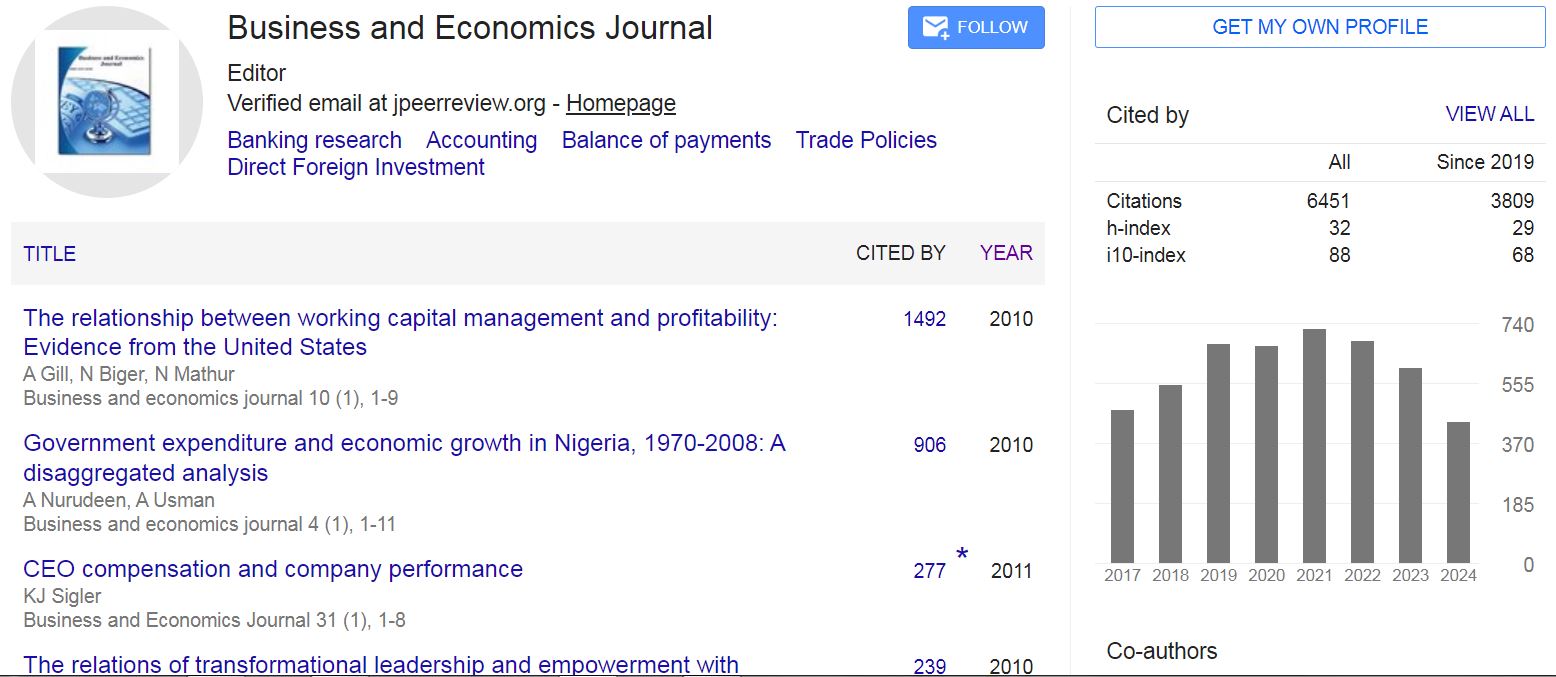
Business and Economics Journal received 6451 citations as per Google Scholar report