Commentary - (2025) Volume 16, Issue 4
Received: 01-Jul-2025, Manuscript No. bej-26-182452;
Editor assigned: 03-Jul-2025, Pre QC No. P-182452;
Reviewed: 17-Jul-2025, QC No. Q-182452;
Revised: 22-Jul-2025, Manuscript No. R-182452;
Published:
29-Jul-2025
, DOI: 10.37421/2161-6219.2025.16.564
Citation: Ahmed, Hassan. ”Business, Innovation, and Economic
Development Drivers.” Bus Econ J 16 (2025):564.
Copyright: © 2025 Ahmed H. This is an open-access article distributed under the terms of the Creative Commons Attribution License, which permits unrestricted use,
distribution and reproduction in any medium, provided the original author and source are credited.
The intricate relationship between business activities and economic development is a cornerstone of modern economic discourse, with a vast body of research exploring its various facets. The fundamental understanding is that robust business sectors are essential for national prosperity, driving growth through a multitude of channels. Entrepreneurship, innovation, and investment are consistently identified as key drivers that lead to job creation, enhanced productivity, and a tangible increase in Gross Domestic Product (GDP) [1].
Small and medium-sized enterprises (SMEs) play a particularly pivotal role, especially in emerging markets, by diversifying economies and fostering local employment opportunities. While their contributions are significant, SMEs often grapple with challenges such as limited access to finance and markets, necessitating targeted policy interventions to maximize their economic impact [2].
Foreign direct investment (FDI) is another critical element in the economic development equation, acting as a catalyst for technology transfer, capital formation, and job creation. However, it is imperative for host economies to implement strategic policies to harness the full benefits of FDI while mitigating any potential negative externalities [3].
Innovation is universally recognized as a powerful engine for economic development. Cultivating an environment that encourages innovation, supports research and development (R&D), and facilitates the commercialization of new technologies is crucial for achieving sustained economic growth and maintaining global competitiveness [4].
Corporate social responsibility (CSR) is increasingly viewed not just as an ethical imperative but as a strategic business advantage. Companies that embrace responsible practices can enhance their reputation, attract top talent, and contribute to more sustainable economic outcomes, aligning business success with societal well-being [5].
Entrepreneurship education and dedicated support programs are instrumental in stimulating business activity and fostering economic development. By equipping individuals with essential entrepreneurial skills and providing mentorship, these initiatives can cultivate a more dynamic business landscape and spur innovation [6].
Global supply chains and participation in global value chains (GVCs) significantly influence business activities and their broader economic impact. Engaging in GVCs can boost productivity, improve market access, and drive economic growth, although potential challenges associated with such integration must also be acknowledged [7].
The digital economy and the widespread adoption of new technologies are transforming business activities and, consequently, economic development. Digital transformation enhances efficiency, enables novel business models, and fuels innovation, all contributing to improved economic performance [8].
Sustainable business practices are paramount for ensuring long-term economic development. By integrating environmental and social considerations into core business operations, companies can build resilience, gain a competitive edge, and pave the way for a more sustainable economic future [9].
Financial inclusion, characterized by improved access to financial services for individuals and businesses, is a powerful lever for economic development. It stimulates investment, encourages entrepreneurship, and fosters overall economic growth, particularly in communities that have historically been underserved by financial institutions [10].
The foundational role of business activities in driving economic development is extensively documented, with research consistently highlighting entrepreneurship, innovation, and investment as paramount engines of progress. These elements collectively contribute to job creation, bolster productivity, and foster overall GDP growth, underscoring the importance of a conducive regulatory environment and accessible capital for business expansion [1].
Small and medium-sized enterprises (SMEs) are recognized as critical contributors to economic development, especially in emerging markets, by enabling economic diversification and generating local employment. Despite their importance, SMEs frequently encounter obstacles related to accessing finance and markets, which necessitates the implementation of targeted policy measures to amplify their contribution to national economies [2].
Foreign direct investment (FDI) is another significant factor influencing economic development, primarily through its effects on technology transfer, capital formation, and job creation. The analysis indicates that strategic policy frameworks are essential for maximizing the advantages derived from FDI while simultaneously mitigating any potential adverse effects on host economies [3].
The impact of innovation on business activities and its subsequent effect on economic development are profound. Fostering an innovative culture, providing robust support for research and development, and streamlining the commercialization of new technologies are vital for achieving enduring economic growth and maintaining a competitive edge [4].
Corporate social responsibility (CSR) is emerging as a crucial aspect of business operations, impacting economic development in multifaceted ways. Businesses committed to responsible practices can not only enhance their public image and attract skilled personnel but also contribute to more sustainable economic outcomes [5].
Entrepreneurship education and the provision of support programs are vital for stimulating business creation and advancing economic development. By equipping individuals with the necessary entrepreneurial skills and offering mentorship opportunities, these initiatives cultivate a more vibrant business ecosystem and promote innovation [6].
The influence of global supply chains and participation in global value chains (GVCs) on business activities and economic development is substantial. Involvement in GVCs can lead to enhanced productivity, expanded market access, and overall economic growth, though it is important to address the associated challenges [7].
The digital economy and the integration of advanced technologies into business operations are profoundly reshaping economic development. Digital transformation optimizes efficiency, facilitates the creation of new business models, and drives innovation, leading to improved economic performance and growth [8].
Sustainable business practices are increasingly recognized as essential for long-term economic development. By embedding environmental and social considerations into their operational strategies, businesses can achieve greater resilience, secure a competitive advantage, and contribute to a more sustainable economic trajectory [9].
Financial inclusion, which involves improving access to financial services for both individuals and businesses, plays a crucial role in stimulating economic development. Enhanced financial access can catalyze investment, foster entrepreneurship, and promote broader economic growth, particularly within marginalized communities [10].
This collection of research examines the multifaceted relationship between business activities and economic development. It highlights how entrepreneurship, innovation, and investment are key drivers of job creation and GDP growth. The studies emphasize the significant role of Small and Medium-sized Enterprises (SMEs) in diversifying economies and creating local employment, while also noting challenges in access to finance and markets. Foreign Direct Investment (FDI) is explored for its contributions to technology transfer and capital formation. The importance of fostering innovation, supporting R&D, and commercializing new technologies is underscored for sustained growth. Corporate Social Responsibility (CSR) is presented as a factor that enhances reputation and leads to sustainable economic outcomes. Entrepreneurship education and support programs are identified as vital for stimulating business creation. The impact of global supply chains and digital transformation on business efficiency and economic growth is analyzed. Finally, the role of financial inclusion in stimulating investment and entrepreneurship, especially in underserved communities, is discussed as a catalyst for economic development. Sustainable business practices are also noted for their contribution to long-term economic resilience and competitiveness.
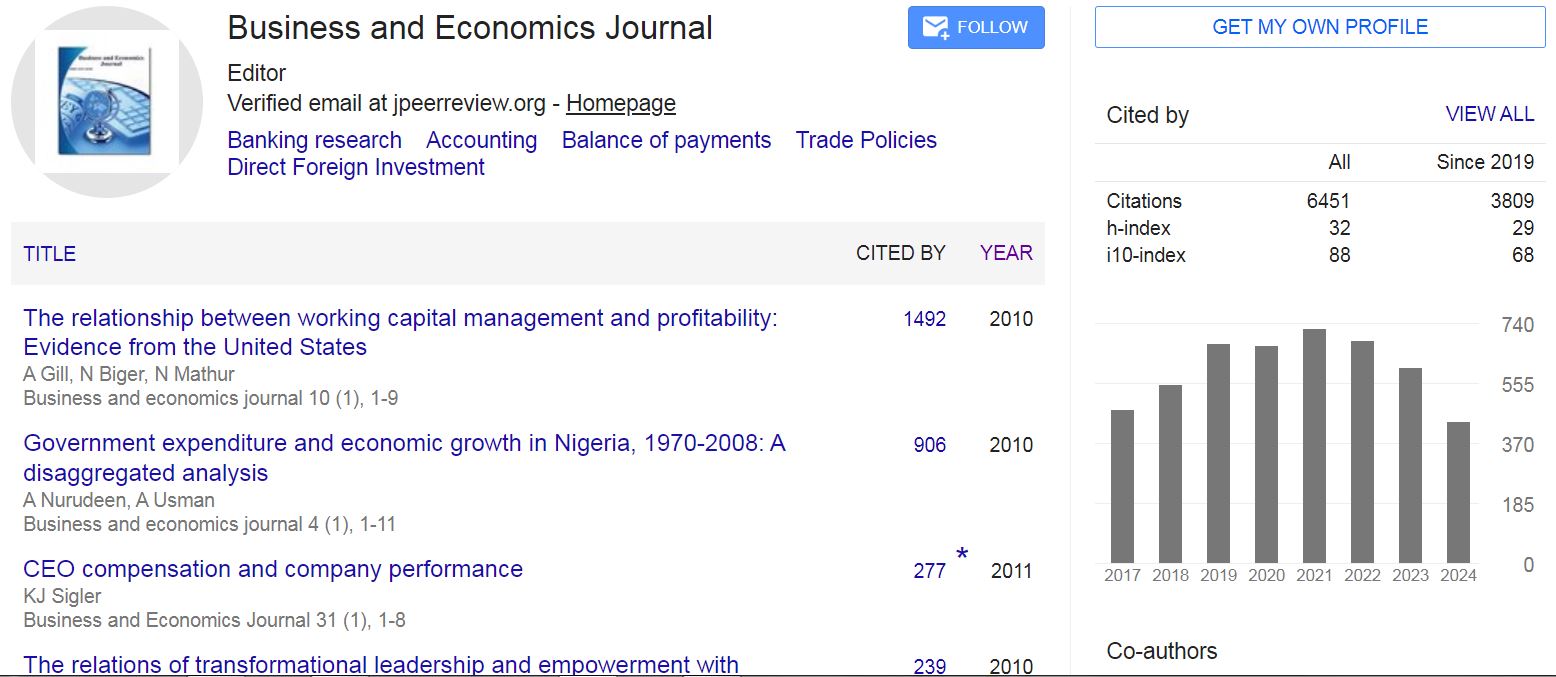
Business and Economics Journal received 6451 citations as per Google Scholar report