Brief Report - (2025) Volume 16, Issue 3
Received: 01-May-2025, Manuscript No. bej-26-182413;
Editor assigned: 05-May-2025, Pre QC No. P-182413;
Reviewed: 19-May-2025, QC No. Q-182413;
Revised: 22-May-2025, Manuscript No. R-182413;
Published:
29-May-2025
, DOI: 10.37421/2161-6219.2025.16.552
Citation: Duffy, Fiona. ”Business Drivers of Economic Growth:
A Multifaceted View.” Bus Econ J 16 (2025):552.
Copyright: © 2025 Duffy F. This is an open-access article distributed under the terms of the Creative Commons Attribution License, which permits unrestricted use, distribution
and reproduction in any medium, provided the original author and source are credited.
The dynamic interplay between business activities and national economic expansion forms the bedrock of contemporary economic discourse and policy formulation. Understanding this relationship is crucial for fostering sustainable growth and prosperity. This exploration delves into the multifaceted ways in which business endeavors contribute to the broader economic landscape. The intricate relationship between business activities and economic growth is a central theme in economic literature, highlighting how innovation, investment, and productivity within firms are direct drivers of national economic expansion [1].
Moreover, the strategic integration of corporate social responsibility (CSR) into business operations has emerged as a significant factor influencing economic trajectories. Genuine commitment to sustainability and ethical practices not only enhances brand reputation and customer loyalty but also fosters innovation and operational efficiency, leading to sustained growth [2].
The pervasive influence of digitalization and technological adoption within businesses is fundamentally reshaping economic growth patterns. This transformation is evidenced by increased productivity, expanded market access, and the creation of novel business models, all contributing to overall economic dynamism [3].
In many economies, particularly developing ones, small and medium-sized enterprises (SMEs) play a pivotal role as engines of economic growth. Their agility, capacity for job creation, and contribution to local innovation underscore their importance [4].
Foreign direct investment (FDI) inflows present another critical avenue through which economic growth can be stimulated. The business sector acts as a crucial mediator in this process, facilitating technology transfer, capital formation, and enhanced competition when the domestic environment is conducive [5].
Financial innovation is a powerful catalyst for business growth, and consequently, for aggregate economic growth. Improved access to diverse financial instruments and services can significantly lower the cost of capital for firms, thereby spurring investment and expansion [6].
Effective supply chain management is increasingly recognized for its contribution to business competitiveness and overall economic growth. Streamlined and resilient supply chains reduce costs, improve efficiency, and enable businesses to respond more effectively to market demands [7].
Human capital development, encompassing skills and education, is intrinsically linked to business innovation and economic growth. A skilled workforce is fundamental for adopting new technologies, driving innovation, and increasing overall productivity [8].
Market structure and the level of competition within industries profoundly impact business performance and subsequently affect economic growth. Competitive markets incentivize efficiency, innovation, and the delivery of lower prices, benefiting both consumers and businesses [9].
Finally, government policy and regulation play a critical role in shaping the business environment and, by extension, its impact on economic growth. Effective policies related to property rights, contract enforcement, and industrial support are instrumental in fostering business investment and innovation, thereby promoting sustainable and inclusive economic growth [10].
The foundational drivers of economic growth are deeply rooted in the performance and evolution of the business sector. As detailed in the Journal of Economic Dynamics and Control, innovation, investment, and productivity within firms are not merely indicators of corporate success but are direct contributors to national economic expansion. The presence of supportive business environments, accessible financing, and a well-developed human capital base further amplifies this effect, creating a virtuous cycle where business achievements translate into widespread economic prosperity [1].
Beyond traditional economic metrics, the integration of corporate social responsibility (CSR) into business strategies has become a significant determinant of economic growth. Studies published in the Journal of Cleaner Production indicate that when CSR is aligned with core business operations, it fosters brand reputation, customer loyalty, innovation, and operational efficiency, all of which contribute to sustained economic advancement. CSR is thus viewed not as an expenditure, but as a strategic investment for long-term economic benefits [2].
The ongoing digital transformation is profoundly altering the landscape of economic growth, with businesses at the forefront of this change. Research in Technological Forecasting and Social Change highlights how digitalization leads to enhanced productivity, broader market access, and the emergence of new business models. Companies that embrace digital transformation are better equipped to adapt to market shifts, thereby contributing more substantially to economic dynamism [3].
In the context of emerging economies, the role of small and medium-sized enterprises (SMEs) as catalysts for economic growth is particularly pronounced. As explored in Small Business Economics, these enterprises demonstrate remarkable agility, possess a strong capacity for job creation, and are instrumental in fostering local innovation. Targeted support mechanisms for SMEs, such as access to credit and markets, are vital for unlocking their full potential as economic growth drivers [4].
Foreign direct investment (FDI) is another key contributor to economic growth, with the domestic business sector acting as a crucial intermediary. The World Economy reports that FDI can spur growth through technology transfer, capital formation, and increased competition, provided that the local business environment is receptive. Regulatory frameworks and the absorptive capacity of local firms are critical for maximizing the positive impacts of FDI [5].
Financial innovation plays a pivotal role in enabling business growth and, consequently, overall economic development. The Journal of Banking & Finance discusses how diverse financial instruments and services can reduce the cost of capital for businesses, stimulating investment and expansion. Dynamic and inclusive financial markets are essential for facilitating business activities that drive economic progress [6].
The efficiency and resilience of supply chains are increasingly recognized as significant factors in business competitiveness and economic growth. The International Journal of Production Economics emphasizes that streamlined supply chains reduce costs, improve operational efficiency, and enhance a business's ability to meet market demands, leading to substantial productivity gains across various industries [7].
Human capital, defined by the skills and education of the workforce, is intrinsically linked to business innovation and economic growth. Studies in Labour Economics show that a skilled labor force is fundamental for adopting new technologies, fostering innovation, and boosting productivity. Investments in education and vocational training are therefore critical for nurturing a dynamic economy capable of sustained growth [8].
Market competition is a powerful incentive for business performance and economic growth. The Journal of Industrial Economics suggests that competitive markets drive efficiency, innovation, and lower prices, benefiting consumers and businesses alike. Policies that promote fair competition and reduce market barriers are essential for realizing the growth potential of both the business sector and the broader economy [9].
Government policy and regulation serve as crucial enablers or impediments to business growth and economic development. The European Economic Review highlights how well-designed policies related to property rights, contract enforcement, and industrial support can foster business investment and innovation. A balanced regulatory framework is instrumental in promoting sustainable and inclusive economic growth [10].
This collection of research explores the interconnectedness of business activities and economic growth from various perspectives. Innovation, investment, and productivity within firms are identified as direct drivers of national economic expansion, supported by conducive business environments and human capital development. The strategic integration of corporate social responsibility contributes to sustained growth through enhanced reputation and efficiency. Digital transformation amplifies productivity and market access. Small and medium-sized enterprises are crucial for job creation and local innovation, particularly in developing economies. Foreign direct investment stimulates growth via technology transfer and capital formation, mediated by the domestic business environment. Financial innovation lowers capital costs, spurring business investment. Efficient supply chains enhance competitiveness and productivity. A skilled workforce is vital for innovation and productivity. Market competition drives efficiency and innovation. Finally, government policy and regulation shape the business environment, influencing investment and sustainable growth.
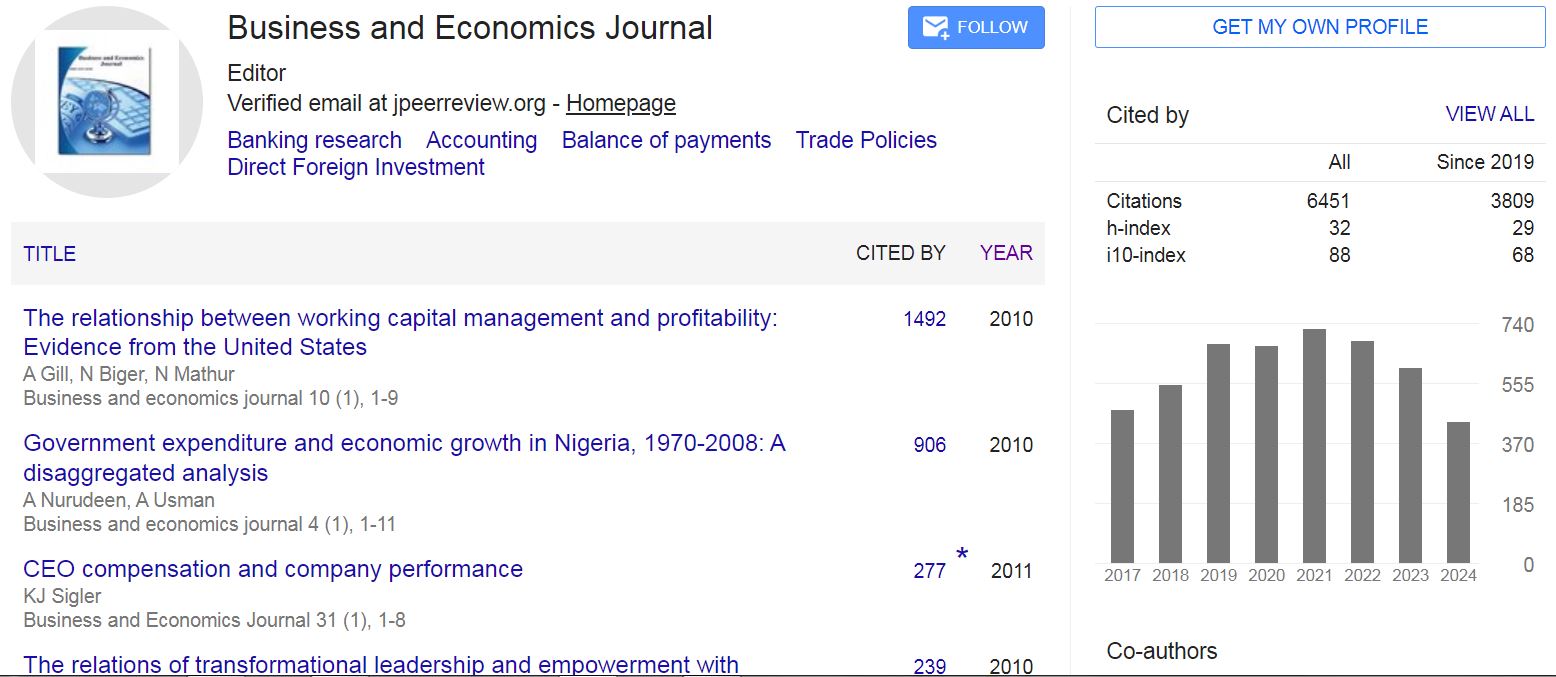
Business and Economics Journal received 6451 citations as per Google Scholar report