Perspective - (2025) Volume 16, Issue 4
Received: 01-Jul-2025, Manuscript No. bej-26-182469;
Editor assigned: 03-Jul-2025, Pre QC No. P-182469;
Reviewed: 17-Jul-2025, QC No. Q-182469;
Revised: 22-Jul-2025, Manuscript No. R-182469;
Published:
29-Jul-2025
, DOI: 10.37421/2161-6219.2025.16.569
Citation: Duval, Isabelle. ”Business Contributions To Economic
Development: A Multifaceted Analysis.” Bus Econ J 16 (2025):569.
Copyright: © 2025 Duval I. This is an open-access article distributed under the terms of the Creative Commons Attribution License, which permits unrestricted use, distribution
and reproduction in any medium, provided the original author and source are credited.
The fundamental role of business enterprises in driving economic development is widely acknowledged across diverse economic landscapes. These entities are instrumental in generating wealth, creating employment opportunities, and fostering innovation, which are all crucial for improving living standards and achieving sustainable growth [1].
The significant contribution of small and medium-sized enterprises (SMEs) to economic development is particularly noteworthy. SMEs are recognized as major drivers of employment, innovation, and regional economic resilience, making them vital components of any diversified economy [2].
Foreign direct investment (FDI) plays a pivotal role in economic development by facilitating business expansion and the transfer of technology. Inflows of FDI can stimulate domestic industries, enhance productivity, and lead to significant job creation, especially when coupled with appropriate policy frameworks [3].
Innovation and technological advancement within businesses are critical drivers of economic development. A dynamic business sector, characterized by robust research and development (R&D) activities and the adoption of new technologies, is essential for increasing competitiveness and ensuring long-term economic growth [4].
Corporate social responsibility (CSR) is increasingly recognized for its contribution to sustainable economic development. Businesses that embrace responsible practices not only contribute to economic growth but also to social well-being and environmental protection, enhancing their reputation and fostering long-term resilience [5].
Entrepreneurship is a powerful engine for economic development, creating new markets, generating employment, and fostering innovation. Understanding the factors that encourage entrepreneurial activity, such as access to finance and supportive institutional frameworks, is key to unlocking economic transformation [6].
Business investment acts as a direct catalyst for economic growth. Increased private sector investment in capital, technology, and human resources leads to higher productivity, increased output, and ultimately, sustained economic development [7].
Globalization has profound implications for business and economic development, opening new markets and opportunities that can lead to economic growth and improved living standards. However, it also presents challenges and risks that require careful management for both businesses and national economies [8].
Reforms within the business sector are essential for promoting economic development. Policies designed to improve the business environment, including deregulation and enhanced contract enforcement, can effectively stimulate investment, boost productivity, and drive economic growth [9].
The financial sector's role is critical in enabling business growth and economic development. Access to finance, financial innovation, and overall financial stability are paramount for firms to invest, expand, and contribute to a dynamic business landscape and sustained economic progress [10].
Business enterprises are fundamental to economic development, acting as engines of wealth generation and drivers of improved living standards through innovation and job creation. Their symbiotic relationship with supportive economic policies fosters entrepreneurship and sustainable growth on a global scale [1].
Small and medium-sized enterprises (SMEs) are essential contributors to economic development, significantly driving employment, fostering innovation, and enhancing regional economic resilience. Their growth is further bolstered by targeted policy interventions that impact overall economic progress in diversified economies [2].
Foreign direct investment (FDI) significantly enhances economic development by promoting business expansion and facilitating technological transfer. FDI inflows stimulate domestic industries, improve productivity, and create valuable employment opportunities, particularly when supported by conducive policy environments and absorptive capacities in host economies [3].
Innovation and technological advancement within businesses are cornerstones of economic development. A vibrant business sector that prioritizes R&D and adopts new technologies is crucial for elevating competitiveness and ensuring sustained economic growth, with policy implications for cultivating such an environment [4].
Corporate social responsibility (CSR) plays a vital role in achieving sustainable economic development. Businesses that integrate responsible practices contribute not only to economic prosperity but also to social well-being and environmental stewardship, thereby enhancing their reputation and securing long-term economic resilience [5].
Entrepreneurship is a key determinant of economic development, as entrepreneurial ventures forge new markets, generate substantial employment, and catalyze innovation, leading to significant economic transformation. Factors like access to finance and robust institutional frameworks are critical enablers of this entrepreneurial activity [6].
Business investment serves as a potent catalyst for economic growth. Elevated levels of private sector investment in capital, technology, and human resources directly correlate with increased productivity, higher output, and overall economic advancement, though challenges in sustaining such investment, especially in developing economies, persist [7].
Globalization has reshaped business operations and economic development by opening new markets and opportunities, thereby fostering economic growth and improving living standards globally. Nevertheless, it also introduces complex challenges and risks for businesses and national economies that necessitate strategic navigation [8].
Reforms aimed at enhancing the business sector are pivotal for driving economic development. Policies such as deregulation, privatization, and improved contract enforcement can effectively stimulate investment, boost productivity, and consequently accelerate economic growth, offering valuable lessons for policymakers seeking effective reform strategies [9].
The financial sector is indispensable for economic development by enabling business growth. The accessibility of finance for firms, the advancement of financial innovation to facilitate investment, and the maintenance of financial stability are crucial for sustained economic progress and a thriving business landscape [10].
This collection of research underscores the multifaceted contributions of businesses to economic development. Enterprises are identified as fundamental drivers of wealth, employment, and innovation, with particular emphasis placed on the vital role of SMEs. Foreign direct investment is shown to stimulate domestic industries and productivity. Innovation and technological advancements are crucial for competitiveness, while corporate social responsibility contributes to sustainable growth. Entrepreneurship fuels economic transformation by creating markets and jobs. Business investment directly correlates with economic growth, and globalization presents both opportunities and challenges. Reforms in the business sector are essential for stimulating investment and productivity. Finally, a robust financial sector is critical for enabling business growth and overall economic progress. The interconnectedness of these factors highlights the dynamic nature of economic development.
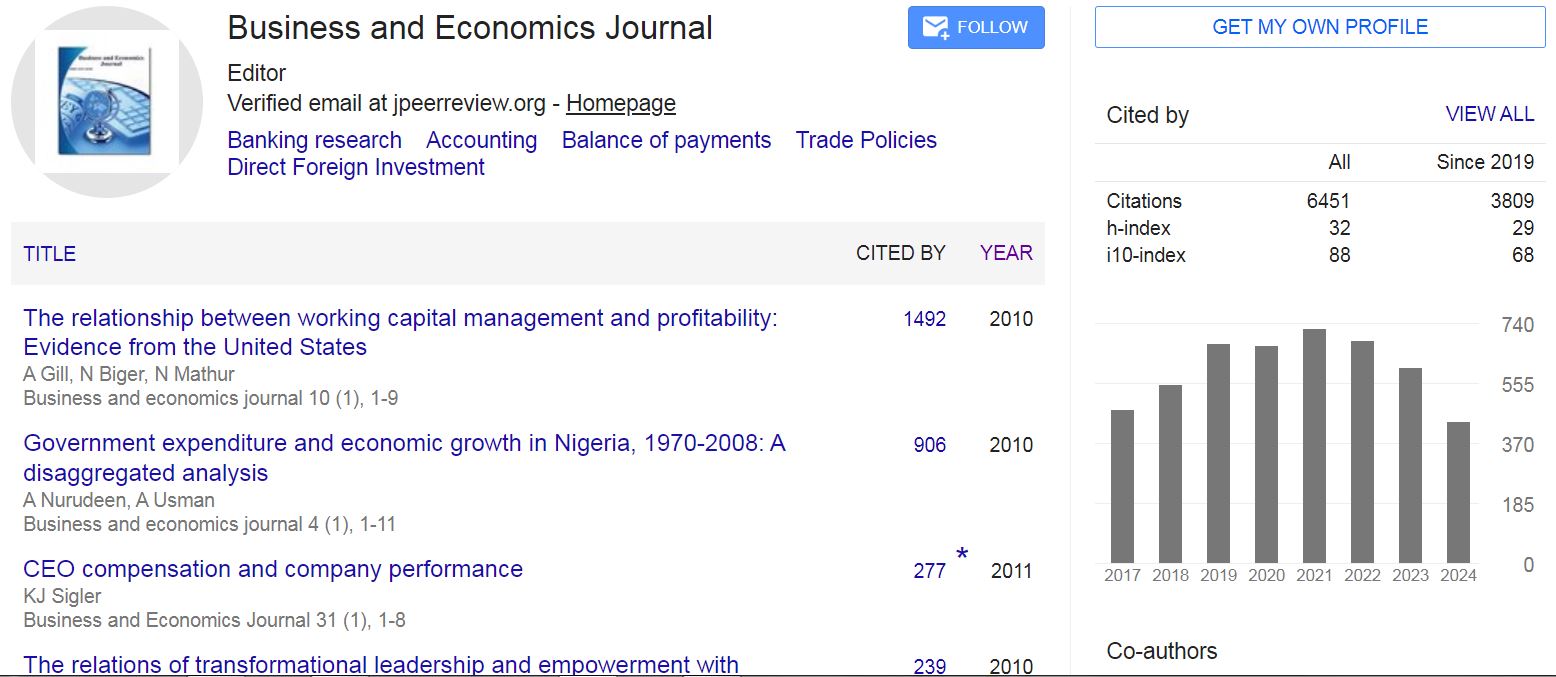
Business and Economics Journal received 6451 citations as per Google Scholar report