Short Communication - (2025) Volume 11, Issue 5
Received: 01-Oct-2025, Manuscript No. elj-25-174935;
Editor assigned: 03-Oct-2025, Pre QC No. P-174935;
Reviewed: 17-Oct-2025, QC No. Q-174935;
Revised: 22-Oct-2025, Manuscript No. R-174935;
Published:
29-Oct-2025
, DOI: 10.37421/2472-0895.2025.11.341
Citation: Harris, Isabella. ”Breakthroughs in Brain Tumor Care Bring Hope.” Epilepsy J 11 (2025):341.
Copyright: © 2025 Harris I. This is an open-access article distributed under the terms of the Creative Commons Attribution License, which permits unrestricted use, distribution and reproduction in any medium, provided the original author and source are credited.
The landscape of brain tumor research and treatment is continually evolving, driven by significant advancements across diagnostic and therapeutic modalities. Recent studies shed light on innovative approaches that promise to improve patient outcomes and overcome long-standing challenges in neuro-oncology. A crucial area of progress lies in diagnosis, where new technologies are refining how tumors are detected and characterized. For instance, Artificial Intelligence (AI) is transforming brain tumor diagnosis. AI algorithms are now critical in analyzing medical images like MRI and CT scans, greatly improving the detection, segmentation, and classification of tumors. This leads to significantly enhanced diagnostic accuracy and efficiency in clinical settings [4].
Complementing imaging advances, liquid biopsy emerges as a promising non-invasive tool for both diagnosis and ongoing monitoring of brain tumors. While researchers acknowledge current technical hurdles in isolating brain tumor-derived biomarkers from bodily fluids such as blood and cerebrospinal fluid, the future prospects for integrating this method into routine clinical practice for better patient management are substantial [5].
Beyond diagnosis, therapeutic strategies are also undergoing rapid evolution, offering new hope for patients with brain tumors. Immunotherapy, for example, has seen remarkable breakthroughs. Scientists are exploring various sophisticated approaches including checkpoint inhibitors, CAR T-cell therapy, and oncolytic viruses. These methods hold considerable promise, but their effectiveness can be limited by the complex immunosuppressive microenvironment often found in brain tumors, prompting continued research into enhancing their therapeutic efficacy [3].
Specifically for aggressive tumors like glioblastoma, the focus is increasingly on highly specific interventions. The intricate role of tumor-associated macrophages (TAMs) in glioblastoma is under intense scrutiny. These TAMs are known to promote tumor growth and contribute to resistance against existing therapies. Experts are evaluating current and emerging strategies that specifically target these cells, recognizing both the substantial clinical opportunities and the inherent challenges in developing effective TAM-modulating treatments [1].
Targeted therapies represent another cornerstone of glioblastoma treatment, tracing an evolution from earlier attempts to modern molecularly driven interventions. These therapies are designed to specifically block signaling pathways vital for tumor proliferation and survival. Researchers are continually assessing their past successes and failures, while also exploring the future potential of combination strategies to effectively counteract tumor resistance mechanisms [7].
Additionally, gene therapy for glioblastoma is gaining traction. This field is delving into the current status and future outlook of various gene delivery systems and therapeutic genes. The goal is to inhibit tumor growth, induce apoptosis, or boost the sensitivity of cancer cells to conventional treatments. Significant progress has been made, but overcoming remaining hurdles is essential for their successful clinical translation [10].
Advancements in neurosurgical and radiation oncology further underscore the multidisciplinary approach to brain tumor management. Modern neurosurgical techniques are becoming increasingly refined, incorporating innovations that elevate precision and patient safety. These include awake craniotomy, sophisticated intraoperative imaging, and advanced neuro-navigation systems. Such technological developments are instrumental in maximizing tumor resection while simultaneously minimizing neurological deficits, thereby improving patient outcomes [8].
Similarly, radiation therapy for brain tumors has experienced substantial developments. Cutting-edge techniques like proton therapy, stereotactic radiosurgery (SRS), and hypofractionated radiotherapy are being employed. These methods meticulously deliver highly conformal radiation doses directly to tumors, deliberately sparing healthy brain tissue. This precision not only enhances local tumor control but also significantly reduces treatment-related toxicity, a critical factor in maintaining patient quality of life [9].
Addressing the unique challenges of pediatric brain tumors is also a key area of focus. Ongoing clinical trials in this domain are highlighting both the advancements and challenges specific to precision medicine for children. Genomic profiling and tailored targeted therapies are proving increasingly vital in improving outcomes for young patients battling these complex cancers. This evolving understanding is reshaping the entire landscape of pediatric neuro-oncology [2].
Furthermore, understanding prognostic factors in pediatric brain tumors is paramount. A comprehensive scoping review has synthesized existing evidence to identify crucial biological, clinical, and treatment-related variables that significantly influence patient outcomes. This research emphasizes the inherent diversity of these tumors in children and the pressing need for individualized risk stratification. Such personalized approaches are essential for guiding therapeutic decisions effectively and ultimately improving survival rates in this vulnerable patient population [6].
Significant progress in brain tumor diagnosis now leverages Artificial Intelligence (AI) to enhance precision and efficiency. AI algorithms are adept at analyzing complex imaging data from MRI and CT scans, providing crucial support in identifying, segmenting, and classifying tumors with remarkable accuracy. This integration of AI into clinical settings not only streamlines the diagnostic process but also offers a more reliable initial assessment, paving the way for earlier and more targeted interventions [4]. Coupled with these imaging advancements, liquid biopsy is emerging as a powerful, non-invasive diagnostic and monitoring tool. This method focuses on detecting subtle brain tumor-derived biomarkers within bodily fluids, such as blood and cerebrospinal fluid. While the technical hurdles in isolating and identifying these specific biomarkers remain a challenge, the potential for liquid biopsy to revolutionize patient management by providing real-time insights without invasive procedures is immense, suggesting a future where it integrates seamlessly into routine clinical practice [5].
The therapeutic landscape for brain tumors is rapidly expanding, with immunotherapy at the forefront of recent breakthroughs. New strategies like checkpoint inhibitors, CAR T-cell therapy, and oncolytic viruses are being investigated for their ability to harness the body's immune system against cancer. These approaches hold great promise, yet their efficacy is often challenged by the unique immunosuppressive microenvironment characteristic of brain tumors. Overcoming this barrier is a key focus, with ongoing research dedicated to optimizing these therapies to achieve greater and more lasting therapeutic benefits [3]. For aggressive forms such as glioblastoma, understanding and targeting the tumor microenvironment is critical. Tumor-associated macrophages (TAMs), for instance, play a complex and detrimental role by actively promoting tumor growth and fostering resistance to treatment. Researchers are intensely evaluating current and novel strategies to modulate TAMs, identifying significant clinical opportunities while also navigating the considerable challenges in developing effective TAM-specific treatments [1].
Glioblastoma, known for its formidable resistance, is also seeing an evolution in targeted therapies. These treatments have progressed from initial, broad-spectrum approaches to highly specific molecular interventions. The goal is to precisely block critical signaling pathways that drive tumor growth and ensure its survival. Continuous assessment of past successes and failures guides the development of future strategies, particularly emphasizing combination therapies designed to overcome the tumor's inherent ability to develop resistance [7]. Furthermore, gene therapy offers a compelling avenue for glioblastoma treatment. Current and prospective gene therapy approaches involve diverse gene delivery systems and therapeutic genes aimed at multiple goals: inhibiting tumor proliferation, inducing programmed cell death (apoptosis), or enhancing the sensitivity of cancer cells to existing conventional treatments. While significant advancements have been achieved, successful clinical translation of these sophisticated gene therapies requires addressing lingering scientific and logistical hurdles [10].
Innovations in conventional treatment modalities, specifically neurosurgery and radiation oncology, continue to refine patient care. Neurosurgical techniques have seen remarkable advancements, embracing technologies like awake craniotomy, state-of-the-art intraoperative imaging, and precise neuro-navigation systems. These innovations are designed to augment surgical precision, thereby maximizing the extent of tumor resection while simultaneously minimizing potential neurological deficits for patients. The integration of these advanced tools significantly improves both the safety and effectiveness of surgical interventions [8]. Similarly, radiation therapy for brain tumors has evolved dramatically. Modern techniques, including proton therapy, stereotactic radiosurgery (SRS), and hypofractionated radiotherapy, allow for exceptionally conformal dose delivery. This means that high doses of radiation can be precisely targeted to the tumor while meticulously sparing surrounding healthy brain tissue. The result is improved local tumor control and a marked reduction in treatment-related toxicity, which greatly benefits the patientâ??s overall quality of life [9].
The field of pediatric neuro-oncology is also making strides, albeit with its own set of unique challenges. Clinical trials for pediatric brain tumors are increasingly focusing on precision medicine, which involves detailed genomic profiling and the application of targeted therapies. These tailored treatments are beginning to fundamentally reshape the prognosis and management for children facing these particularly challenging cancers, signaling a shift towards more personalized and effective interventions [2]. Furthermore, a thorough understanding of prognostic factors is essential for guiding treatment decisions in pediatric cases. A comprehensive scoping review has systematically gathered and analyzed existing evidence to identify key biological, clinical, and treatment-related variables that impact patient outcomes. This highlights the inherent diversity among pediatric brain tumors and underscores the critical need for individualized risk stratification. Such personalized assessment is vital for making informed therapeutic choices and ultimately improving the survival rates for young patients [6].
Recent advancements in brain tumor research span across diagnosis, treatment, and patient management, offering renewed hope. On the diagnostic front, Artificial Intelligence (AI) is transforming image analysis, significantly improving tumor detection, segmentation, and classification for enhanced accuracy and efficiency. Liquid biopsy also presents a promising non-invasive tool for diagnosis and monitoring, though technical challenges in biomarker detection persist. Therapeutically, immunotherapy has seen breakthroughs with checkpoint inhibitors, CAR T-cell therapy, and oncolytic viruses, despite the challenges posed by the immunosuppressive microenvironment of brain tumors. For glioblastoma, specific strategies target tumor-associated macrophages (TAMs) to overcome tumor growth and treatment resistance. Targeted therapies for glioblastoma are evolving towards molecularly driven approaches, with gene therapy also offering prospects for inhibiting tumor growth and enhancing treatment sensitivity. Neurosurgical techniques have advanced with awake craniotomy, intraoperative imaging, and neuro-navigation, leading to improved precision and maximal tumor resection with minimized neurological deficits. Radiation therapy incorporates proton therapy and stereotactic radiosurgery (SRS) for highly conformal doses, enhancing local control and reducing toxicity. In pediatric brain tumors, precision medicine through genomic profiling and targeted therapies is reshaping outcomes, complemented by research into prognostic factors for individualized risk stratification. These collective efforts underscore a comprehensive approach to tackling the complexities of brain tumors.
None
None
Indexed at, Google Scholar, Crossref
Indexed at, Google Scholar, Crossref
Indexed at, Google Scholar, Crossref
Indexed at, Google Scholar, Crossref
Indexed at, Google Scholar, Crossref
Indexed at, Google Scholar, Crossref
Indexed at, Google Scholar, Crossref
Indexed at, Google Scholar, Crossref
Indexed at, Google Scholar, Crossref
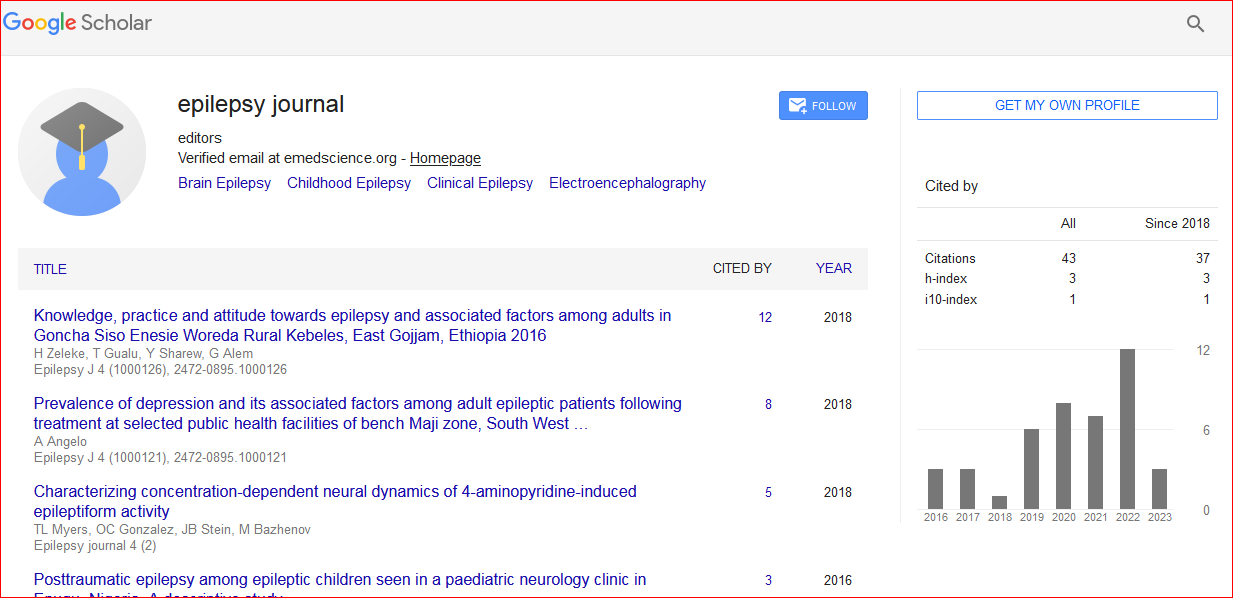
Epilepsy Journal received 41 citations as per Google Scholar report