Perspective - (2025) Volume 14, Issue 2
Received: 02-Apr-2025, Manuscript No. jnc-25-166192;
Editor assigned: 04-Apr-2025, Pre QC No. P-166192;
Reviewed: 16-Apr-2025, QC No. Q-166192;
Revised: 23-Apr-2025, Manuscript No. R-166192;
Published:
30-Apr-2025
, DOI: 10.37421/2167-1168.2025.14.703
Citation: Parmar, Connell. “Breaking the Chain: The Link between Infection Control and Antimicrobial Stewardship.” J Nurs Care 14 (2025): 703.
Copyright: © 2025 Parmar C. This is an open-access article distributed under the terms of the Creative Commons Attribution License, which permits unrestricted use, distribution and reproduction in any medium, provided the original author and source are credited.
Infectious diseases continue to pose a major threat to public health, with Hospital-Acquired Infections (HAIs) and community-associated infections contributing significantly to the global health burden. The emergence of Antimicrobial Resistance (AMR) has further exacerbated these challenges, complicating treatment options and increasing the risk of severe health outcomes. The inappropriate use and overuse of antibiotics and other antimicrobial agents have accelerated the development of resistant strains of bacteria, rendering many once-treatable infections increasingly difficult to manage. As a result, infection control and antimicrobial stewardship have become pivotal components of healthcare strategies aimed at reducing the impact of infectious diseases and combating AMR. While infection control and antimicrobial stewardship are often discussed as distinct strategies, they are deeply interconnected and mutually reinforcing. Infection control involves a range of practices designed to prevent the transmission of infectious agents within healthcare settings. These practices include hand hygiene, the use of personal protective equipment, environmental cleaning and isolation protocols, all of which work to limit the spread of infections. By reducing the occurrence of infections, infection control practices help lower the need for antimicrobial interventions, thus reducing the pressure that drives resistance [2].
On the other hand, antimicrobial stewardship refers to the systematic effort to optimize the use of antimicrobial drugs to ensure their effective application while minimizing overuse and misuse. This involves selecting the appropriate antimicrobial agents, determining the correct dosages and ensuring that the duration of treatment is suitable for the infection. By improving the judicious use of antimicrobials, stewardship programs aim to reduce the development of resistance and preserve the effectiveness of these critical drugs for future generations. The link between infection control and antimicrobial stewardship is crucial. At the same time, antimicrobial stewardship helps reduce the likelihood of resistance by ensuring that antibiotics are used in a targeted, effective manner. Together, these strategies form a robust defense against the spread of infections and the development of resistant pathogens. The integration of infection control and antimicrobial stewardship not only improves patient outcomes but also reduces the overall burden on healthcare systems. Healthcare-associated infections are a leading cause of morbidity and mortality worldwide and these infections often require prolonged antimicrobial treatment, further driving the risk of resistance. By adhering to stringent infection control measures, healthcare facilities can limit the spread of infectious agents, leading to fewer infections and, consequently, a decreased need for antimicrobial treatment [3].
This not only helps reduce the overuse of antibiotics but also protects patients from the potentially harmful side effects of unnecessary medications. Furthermore, reducing the frequency of infections can alleviate pressure on hospital resources, decrease lengths of stay and reduce healthcare costs, making a strong case for a coordinated approach that emphasizes both infection prevention and antimicrobial stewardship. In addition, the collaboration between infection control teams and antimicrobial stewardship programs enhances the overall effectiveness of each strategy. Infection prevention practices are more successful when they are informed by an understanding of local antimicrobial resistance patterns, allowing healthcare providers to implement targeted infection control measures that specifically address the most common or most dangerous pathogens in a given setting. Similarly, antimicrobial stewardship programs are more effective when they collaborate closely with infection control teams to identify and address the root causes of antibiotic resistance within healthcare settings. By sharing data, tracking infection trends and conducting joint educational initiatives, these two strategies can reinforce each other, creating a unified approach that significantly reduces the occurrence of both infections and resistance. This holistic model fosters an environment where infection control and antimicrobial stewardship work synergistically to protect patients and preserve the efficacy of antimicrobials for the future [4].
To further strengthen the integration of infection control and antimicrobial stewardship, ongoing education and training for healthcare professionals is essential. All members of the healthcare team including physicians, nurses, pharmacists and support staff must be equipped with the knowledge and skills to implement evidence-based infection prevention protocols and make informed decisions regarding antimicrobial use. Regular workshops, competency-based training sessions and access to updated clinical guidelines can help ensure that staff remains current with best practices. Technology and data analytics also play a pivotal role in enhancing both infection control and antimicrobial stewardship efforts. Electronic Health Records (EHRs) and Clinical Decision Support Systems (CDSS) can provide real-time alerts for potential antibiotic overuse, drug interactions, or infection outbreaks, allowing clinicians to take prompt, evidence-based action. Surveillance tools can monitor trends in antimicrobial resistance and infection rates, facilitating targeted interventions and more efficient resource allocation. Furthermore, integrating data from microbiology labs, pharmacy records and patient outcomes allows for a comprehensive view of how infections spread and how antimicrobials are used. Ultimately, leveraging technology and analytics creates a more proactive, coordinated response to infectious diseases, ensuring that healthcare systems are better prepared to manage both current and emerging threats [5].
Google Scholar Cross Ref Indexed at
Google Scholar Cross Ref Indexed at
Google Scholar Cross Ref Indexed at
Google Scholar Cross Ref Indexed at
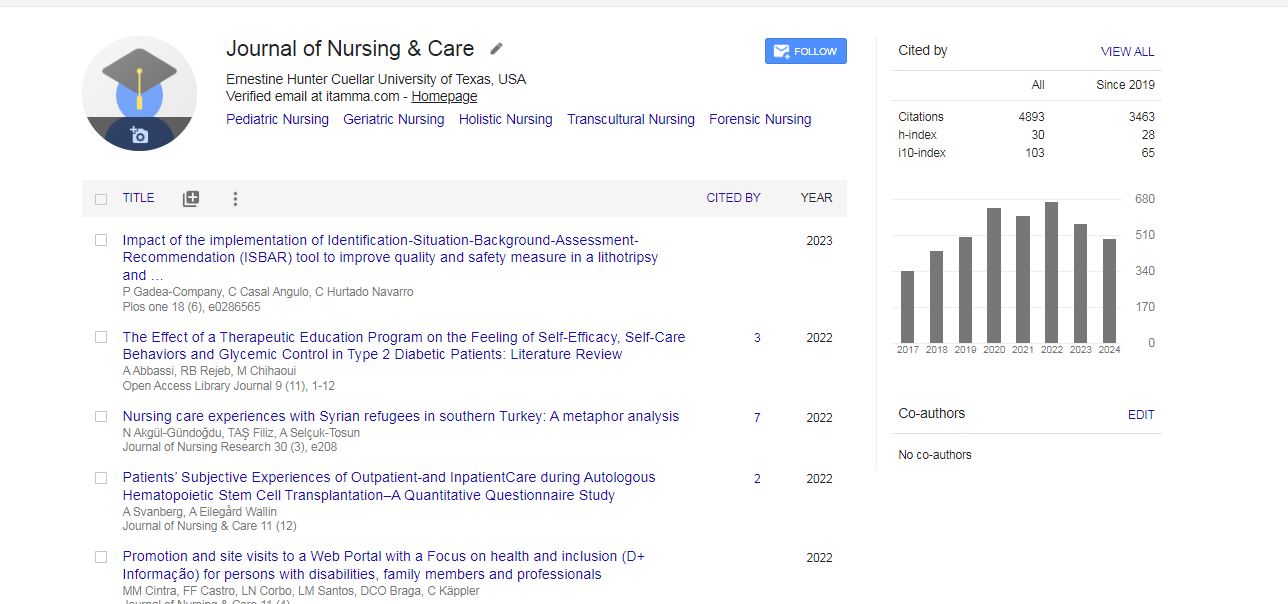
Journal of Nursing & Care received 4230 citations as per Google Scholar report