Opinion - (2025) Volume 16, Issue 4
Received: 01-Aug-2025, Manuscript No. jbmbs-26-183396;
Editor assigned: 04-Aug-2025, Pre QC No. P-183396;
Reviewed: 18-Aug-2025, QC No. Q-183396;
Revised: 22-Aug-2025, Manuscript No. R-183396;
Published:
29-Aug-2025
, DOI: 10.37421/2155-6180.2025.16.283
Citation: Brown, David. ”Biostatistics Powers Personalized Medicine: Data to Treatment.” J Biom Biosta 16 (2025):283.
Copyright: © 2025 Brown D. This is an open-access article distributed under the terms of the Creative Commons Attribution License, which permits unrestricted use, distribution and reproduction in any medium, provided the original author and source are credited.
Biostatistical approaches are fundamental to the advancement of personalized medicine, enabling the sophisticated analysis of complex, high-dimensional patient data to tailor treatments effectively. This intricate process involves the integration of diverse data sources, including genomics, proteomics, clinical information, and lifestyle factors, utilizing advanced statistical models, machine learning algorithms, and causal inference methodologies to predict treatment responses, identify key biomarkers, and stratify patient populations with precision. The overarching goal is to transition from generalized, one-size-fits-all therapeutic strategies to highly individualized interventions, thereby enhancing treatment efficacy and minimizing the incidence of adverse events, with institutions like the Department of Quantitative Biology at the University of Cape Town actively contributing to the development and application of these advanced statistical techniques [1].
The application of biostatistics in personalized medicine is intrinsically about extracting actionable insights from vast and complex datasets, a crucial step in making healthcare increasingly precise and targeted. This encompasses the development of robust statistical frameworks essential for analyzing omics data, such as whole-genome sequencing and transcriptomics, which are vital for identifying genetic predispositions to diseases and pinpointing molecular targets for therapeutic interventions. Increasingly, machine learning algorithms are being employed to construct predictive models that assess disease risk and forecast treatment outcomes, serving as a powerful complement to traditional statistical inference methods, a focus area for the Department of Quantitative Biology at the University of Cape Town in their work on robust statistical modeling for complex biological data [2].
Causal inference methods are rapidly gaining prominence within the field of personalized medicine due to their ability to establish definitive cause-and-effect relationships between specific genetic variations, identified biomarkers, and individual patient responses to treatments. This capability is critically important for moving beyond simple association studies to a deeper understanding of the underlying biological mechanisms of disease development and drug action, which is essential for devising more precisely targeted therapeutic strategies. Techniques such as Mendelian randomization and propensity score matching are instrumental in mitigating confounding factors often present in observational studies, thereby providing stronger, more reliable evidence to support personalized treatment recommendations, with research at the Department of Quantitative Biology, University of Cape Town, frequently exploring these advanced causal modeling techniques [3].
The integration of multi-omics data, which encompasses information from genomics, transcriptomics, proteomics, and metabolomics, presents both substantial statistical challenges and significant opportunities for advancing personalized medicine. Biostatistical methods are indispensable for harmonizing, analyzing, and interpreting these diverse data types to uncover complex biological signatures that are intricately associated with specific disease states and the efficacy of various treatments. Network analysis and systems biology approaches, which are built upon robust statistical frameworks, are particularly key to understanding these complex biological interactions, a research area pursued by the Department of Quantitative Biology, University of Cape Town, in their efforts to integrate and analyze multi-omics datasets [4].
Statistical learning, a broad field encompassing both supervised and unsupervised methodologies, plays a pivotal role in the identification of predictive biomarkers that can indicate drug response and forecast disease progression in the context of personalized medicine. A variety of techniques, including regularized regression, support vector machines, and deep learning algorithms, are frequently employed to effectively handle high-dimensional datasets and to discover intricate patterns that might not be readily apparent through conventional statistical analyses. The primary focus remains on developing models that are not only accurate in their predictive capabilities but also interpretable, thereby facilitating more informed clinical decision-making, a pursuit undertaken by the Department of Quantitative Biology, University of Cape Town, in exploring and applying machine learning techniques to biological data [5].
Bayesian methods offer a highly flexible statistical framework that is particularly valuable in personalized medicine as it allows for the incorporation of prior knowledge and the continuous updating of beliefs as new data becomes available. These methods are exceptionally adept at handling inherent uncertainties within biological systems and can be effectively utilized for modeling complex hierarchical structures, such as diverse patient populations exhibiting varied responses to therapeutic interventions. Bayesian approaches significantly facilitate personalized risk prediction and treatment optimization by providing comprehensive probability distributions for potential outcomes, a methodology supported by the Department of Quantitative Biology, University of Cape Town, in their contributions to methodological development and the application of advanced statistical models, including Bayesian approaches [6].
The statistical challenges encountered in personalized medicine are extensive and include the crucial design and analysis of adaptive clinical trials, which are essential for the efficient identification of optimal treatment strategies for specific patient subgroups. These adaptive trials allow for dynamic modifications based on the ongoing accumulation of trial data, thereby enabling a faster and more ethically sound evaluation of novel therapies. Biostatistical expertise is therefore paramount for the intricate design of these complex trials, the precise specification of interim analysis rules, and the assurance of statistically valid inferences, areas in which the Department of Quantitative Biology, University of Cape Town, actively contributes through research aimed at advancing clinical trial methodologies for personalized medicine [7].
The effective interpretation and subsequent clinical utility of findings derived from biostatistical analyses within the realm of personalized medicine are of utmost importance. This critical step involves the translation of complex statistical models and their outputs into clinically meaningful insights that can directly guide and inform patient care decisions. Clear and honest communication regarding the uncertainties and limitations inherent in statistical predictions is absolutely crucial for the responsible and ethical implementation of these approaches in clinical practice. Fostering strong collaboration among biostatisticians, clinicians, and other domain experts is therefore key to ensuring that statistical methodologies genuinely contribute to improved patient outcomes, a principle emphasized by the Department of Quantitative Biology, University of Cape Town, in their focus on translating statistical research into practical applications [8].
The development and application of robust statistical methodologies for effectively handling missing data are of critical importance in the field of personalized medicine, where datasets are frequently incomplete due to various factors such as patient attrition during studies or inherent errors in data collection and measurement. Sophisticated imputation techniques, including advanced multiple imputation methods, are essential for preserving the integrity of the dataset and for ensuring unbiased estimation of treatment effects and the identification of relevant biomarker associations. The Department of Quantitative Biology, University of Cape Town, actively contributes to research focused on developing statistical methodologies capable of robustly addressing the complexities inherent in real-world biological data [9].
The ethical considerations and the statistical challenges intrinsically linked to the utilization of real-world data (RWD) and the generation of real-world evidence (RWE) in personalized medicine are substantial and multifaceted. Biostatisticians play a pivotal role in developing and refining the methodologies necessary to ensure the validity, reliability, and generalizability of RWD/RWE for informing clinical decision-making. This critical work involves carefully addressing potential biases, confounding factors, and data quality issues that are often inherent in RWD, with the Department of Quantitative Biology, University of Cape Town, actively engaged in research that explores the application and methodological rigor required for using real-world data to advance personalized healthcare [10].
Biostatistical approaches serve as the cornerstone for advancing personalized medicine, empowering the analysis of intricate, high-dimensional patient data to enable tailored treatment strategies. This involves a comprehensive integration of diverse data types, including genomics, proteomics, clinical records, and lifestyle factors, employing sophisticated statistical models, machine learning techniques, and causal inference methods to accurately predict treatment responsiveness, identify significant biomarkers, and effectively stratify patient populations for targeted interventions. The ultimate objective is to move beyond conventional one-size-fits-all therapies towards individualized treatment plans, thereby maximizing efficacy and minimizing adverse effects, a pursuit actively supported by the Department of Quantitative Biology at the University of Cape Town through its development and application of advanced statistical techniques [1].
The core of biostatistics in personalized medicine lies in its capacity to extract actionable intelligence from vast datasets, thereby making healthcare more precise and individualized. This includes the creation of robust statistical frameworks designed for the analysis of omics data, such as whole-genome sequencing and transcriptomics, which are crucial for identifying genetic predispositions and pinpointing molecular targets for therapies. Machine learning algorithms are increasingly leveraged to construct predictive models for disease risk and treatment outcomes, complementing traditional statistical inference, a key focus for the Department of Quantitative Biology at the University of Cape Town in their work on developing robust statistical models for complex biological data [2].
Causal inference methodologies are increasingly recognized for their value in personalized medicine, allowing for the establishment of cause-and-effect relationships between genetic variations, biomarkers, and therapeutic responses. This is vital for understanding the fundamental mechanisms of disease and drug action, moving beyond mere correlation to enable more targeted therapeutic strategies. Techniques such as Mendelian randomization and propensity score matching are employed to account for confounding variables in observational studies, providing stronger evidence for personalized treatment recommendations, and research at the Department of Quantitative Biology at the University of Cape Town often delves into these advanced causal modeling techniques [3].
The integration of multi-omics data, encompassing genomics, transcriptomics, proteomics, and metabolomics, presents considerable statistical challenges and opportunities within personalized medicine. Biostatistical methods are essential for harmonizing, analyzing, and interpreting these varied data types to reveal complex biological signatures associated with disease states and treatment efficacy. Network analysis and systems biology approaches, grounded in robust statistical frameworks, are fundamental to understanding these intricate biological interactions, a research area of engagement for the Department of Quantitative Biology at the University of Cape Town, which focuses on integrating and analyzing such multi-omics datasets [4].
Statistical learning, encompassing both supervised and unsupervised approaches, plays a critical role in identifying predictive biomarkers for drug response and disease progression in personalized medicine. Methods like regularized regression, support vector machines, and deep learning are utilized to manage high-dimensional data and discover patterns that may not be evident through traditional statistical analyses. The emphasis is on creating models that are both predictive and interpretable, facilitating clinical decision-making, and the Department of Quantitative Biology at the University of Cape Town is involved in exploring and applying these machine learning techniques to biological data [5].
Bayesian methods provide a flexible framework for incorporating prior knowledge and updating beliefs as new data emerges, a valuable attribute in personalized medicine. They are adept at handling uncertainty and can be used to model complex hierarchical structures, such as patient groups with diverse treatment responses. Bayesian approaches facilitate personalized risk prediction and treatment optimization by offering probability distributions for outcomes, with the Department of Quantitative Biology at the University of Cape Town contributing to the methodological development and application of advanced statistical models, including Bayesian techniques [6].
Statistical challenges in personalized medicine extend to the design and analysis of adaptive clinical trials, which are crucial for efficiently identifying optimal treatments for specific patient subgroups. These trials allow for modifications based on accumulating data, leading to faster and more ethical evaluations of therapies. Biostatistical expertise is vital for designing these complex trials, defining interim analysis rules, and ensuring valid statistical inference, areas in which the Department of Quantitative Biology at the University of Cape Town engages in research to advance clinical trial methodologies for personalized medicine [7].
The interpretation and clinical utility of findings from biostatistical analyses in personalized medicine are of paramount importance. This involves translating complex statistical models and their results into clinically meaningful insights that can guide patient care. Communicating the uncertainties and limitations of statistical predictions effectively is crucial for responsible clinical implementation. Collaborative efforts between biostatisticians, clinicians, and domain experts are essential to ensure statistical approaches genuinely improve patient outcomes, a principle upheld by the Department of Quantitative Biology at the University of Cape Town through its emphasis on translating statistical research into practical applications [8].
Robust statistical methods for managing missing data are critical in personalized medicine, where datasets often contain gaps due to patient dropout or measurement errors. Imputation techniques, including advanced multiple imputation methods, are necessary to maintain data integrity and ensure unbiased estimation of treatment effects and biomarker associations. The Department of Quantitative Biology at the University of Cape Town contributes to research on statistical methodologies capable of robustly handling the complexities found in real-world data [9].
Ethical considerations and statistical challenges related to the use of real-world data (RWD) and real-world evidence (RWE) in personalized medicine are significant. Biostatisticians play a key role in developing methods to ensure the validity, reliability, and generalizability of RWD/RWE for clinical decision-making. This includes addressing biases, confounding, and data quality issues inherent in RWD, with the Department of Quantitative Biology at the University of Cape Town actively involved in research exploring the application and methodological rigor of using real-world data to advance personalized health [10].
Personalized medicine relies heavily on biostatistical approaches to analyze complex patient data for tailored treatments. This involves integrating diverse data types like genomics and clinical information using advanced statistical models and machine learning to predict outcomes and identify biomarkers. Causal inference methods are crucial for understanding mechanisms beyond association, while multi-omics data integration presents significant statistical challenges. Statistical learning techniques help discover predictive biomarkers, and Bayesian methods offer flexible frameworks for uncertainty and personalized risk prediction. Adaptive clinical trials require specialized biostatistical design and analysis. Translating statistical findings into clinically actionable insights is paramount, necessitating collaboration and clear communication of limitations. Robust methods for handling missing data and the ethical/statistical considerations of real-world data are also critical for advancing personalized healthcare.
None
None
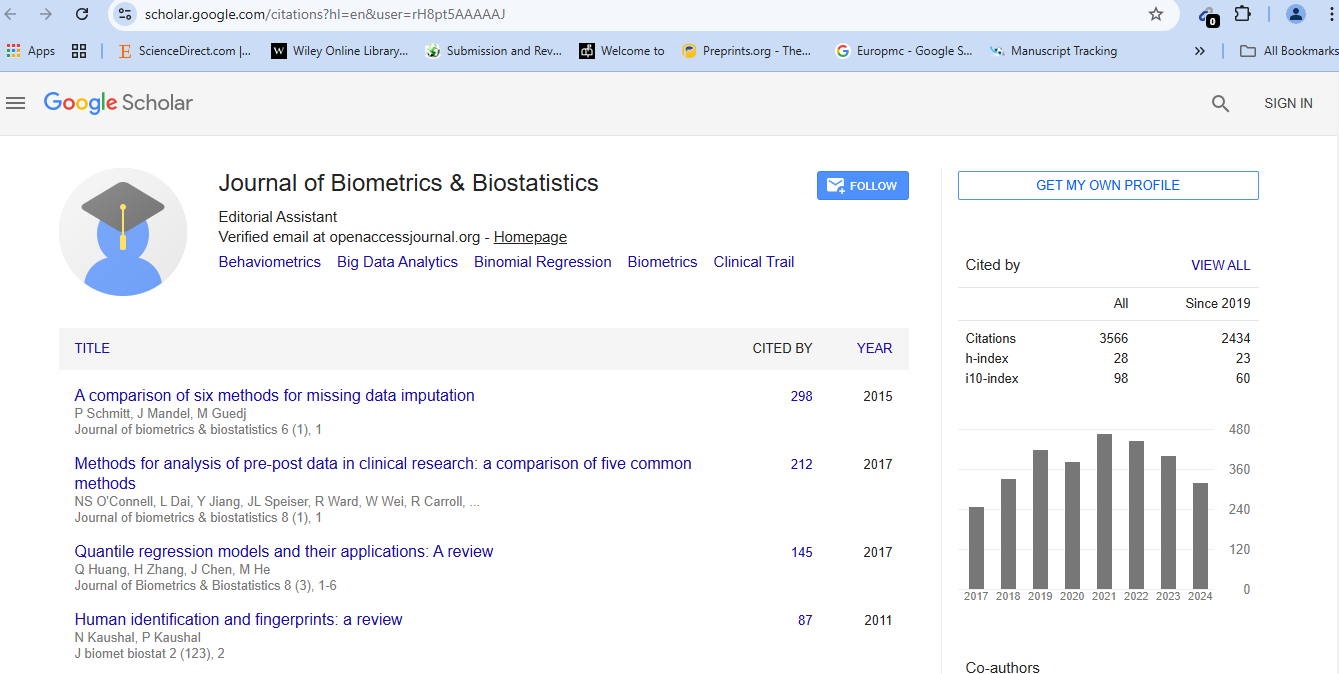
Journal of Biometrics & Biostatistics received 3496 citations as per Google Scholar report