Perspective - (2025) Volume 16, Issue 4
Received: 01-Aug-2025, Manuscript No. jbsbe-26-183311;
Editor assigned: 04-Aug-2025, Pre QC No. P-183311;
Reviewed: 18-Aug-2025, QC No. Q-183311;
Revised: 22-Aug-2025, Manuscript No. R-183311;
Published:
29-Aug-2025
, DOI: 10.37421/2165-6210.2025.16.517
Citation: Novak, Peter. ”Biosensors Revolutionize Drug Discovery and Pharmacokinetics.” J Biosens Bioelectron 16 (2025):517.
Copyright: © 2025 Novak P. This is an open-access article distributed under the terms of the Creative Commons Attribution License, which permits unrestricted use, distribution and reproduction in any medium, provided the original author and source are credited.
Biosensors are emerging as transformative tools in the field of drug discovery, offering unprecedented capabilities for rapid, high-throughput screening of potential drug candidates and facilitating a deeper understanding of drug-target interactions. These advanced platforms are instrumental in identifying promising molecules and characterizing their mechanisms of action, thereby accelerating the initial stages of therapeutic development. In the critical domain of pharmacokinetic (PK) studies, biosensors provide real-time, in vivo monitoring of drug levels and their metabolites. This capability offers invaluable insights into the absorption, distribution, metabolism, and excretion (ADME) profiles of drug candidates, which are essential for assessing their in vivo behavior and efficacy. The ability to track these parameters dynamically is a significant advancement over traditional methods. Electrochemical and optical biosensors, in particular, stand out due to their inherent sensitivity, selectivity, and the potential for significant miniaturization. These characteristics make them highly suitable for integration into sophisticated analytical systems, promising to streamline drug development pipelines and enhance the quality of data generated, leading to more informed decision-making. Advancements in nanomaterials and the development of sophisticated molecular recognition elements are continuously pushing the boundaries of biosensor performance. These innovations are crucial for improving the sensitivity, specificity, and overall applicability of biosensing platforms, enabling the detection of analytes at lower concentrations and in more complex biological environments. Electrochemical biosensors that employ aptamers as their primary recognition elements are proving particularly useful in the early phases of drug discovery. Their proficiency in detecting small molecules and proteins with remarkable specificity and sensitivity enables the rapid screening of vast compound libraries, a bottleneck in traditional discovery processes. The electrochemical readout mechanism is inherently amenable to miniaturization and integration into microfluidic devices. This convergence facilitates the development of high-throughput analytical systems, allowing for parallel analysis of multiple samples and reducing the time and resources required for screening large numbers of potential drug compounds. For pharmacokinetic studies, implantable biosensors represent a significant leap forward, offering unparalleled advantages for real-time drug monitoring within living organisms. These sophisticated devices allow for continuous tracking of drug concentrations, providing dynamic information on ADME parameters that is simply not attainable with intermittent sampling techniques. Optical biosensing techniques, including surface plasmon resonance (SPR) and various fluorescence-based methods, are highly valuable for characterizing the intricate details of drug-target interactions. Their ability to assess binding affinity and kinetics provides critical data for optimizing lead compounds and understanding their therapeutic potential. Microfluidic devices, when integrated with biosensing capabilities, create powerful platforms for miniaturized and automated drug discovery and PK studies. These 'lab-on-a-chip' systems minimize sample and reagent volumes, enable complex assay execution, and offer a controlled environment for experimental workflows, significantly boosting efficiency. The integration of artificial intelligence (AI) and machine learning (ML) with biosensor data is poised to revolutionize drug discovery and PK analysis. AI/ML algorithms can effectively process the complex datasets generated by biosensors, uncovering patterns and predictive insights that can optimize experimental designs and accelerate the identification of viable drug candidates.
Biosensors are revolutionizing drug discovery by enabling rapid, high-throughput screening of drug candidates and facilitating the study of drug-target interactions. These technologies are becoming indispensable in modern pharmaceutical research and development [1].
In pharmacokinetic (PK) studies, biosensors offer real-time, in vivo monitoring of drug levels and their metabolites, providing critical insights into absorption, distribution, metabolism, and excretion (ADME). This real-time data is crucial for understanding drug behavior in a living system [1].
Electrochemical and optical biosensors, in particular, show immense promise for their sensitivity, selectivity, and potential for miniaturization, leading to more efficient and informative drug development pipelines. Their versatility allows for diverse applications in analytical chemistry and drug analysis [1].
Advancements in nanomaterials and molecular recognition elements are further enhancing the performance and applicability of these biosensing platforms. Novel materials and recognition strategies are enabling lower detection limits and improved specificity for various analytes [1].
Electrochemical biosensors utilizing aptamers as recognition elements are demonstrating significant utility in the early stages of drug discovery. Their ability to detect small molecules and proteins with high specificity and sensitivity allows for rapid screening of compound libraries [2].
Furthermore, the electrochemical readout is amenable to miniaturization and integration into microfluidic devices, paving the way for high-throughput analysis. This integration facilitates the development of portable and cost-effective diagnostic tools [2].
For pharmacokinetic studies, implantable biosensors offer unparalleled advantages in real-time drug monitoring within living organisms. These devices can track drug concentrations over extended periods, providing dynamic information on ADME parameters unobtainable with traditional methods [3].
Optical biosensing techniques, such as surface plasmon resonance (SPR) and fluorescence-based methods, are highly valuable for characterizing drug-target interactions with high affinity and kinetics. These label-free or minimally labeled approaches allow for direct observation of binding events [4].
Microfluidic devices integrated with biosensors offer a powerful platform for miniaturized and automated drug discovery and PK studies. These 'lab-on-a-chip' systems enable the handling of small sample volumes and reduced reagent consumption, increasing experimental efficiency [5].
The integration of artificial intelligence (AI) and machine learning (ML) with biosensor data is accelerating drug discovery and PK analysis. AI/ML algorithms can process complex datasets generated by biosensors, identify patterns, and predict drug efficacy and toxicity, enhancing predictive power [8].
Biosensors are significantly advancing drug discovery and pharmacokinetic (PK) studies. They enable rapid, high-throughput screening of drug candidates and detailed analysis of drug-target interactions. In PK, biosensors provide real-time in vivo monitoring of drug levels and metabolites, offering critical insights into ADME properties. Electrochemical and optical biosensors are particularly promising due to their sensitivity, selectivity, and potential for miniaturization. Advancements in nanomaterials and recognition elements further enhance biosensing capabilities. Aptamer-based electrochemical biosensors are valuable for early-stage drug discovery, while implantable biosensors offer continuous in vivo monitoring for PK. Optical techniques excel at characterizing drug-target interactions. Microfluidic platforms integrated with biosensors streamline workflows, and the synergy of AI/ML with biosensor data accelerates analysis and prediction. Wearable biosensors also offer continuous, non-invasive monitoring for personalized drug assessment.
None
None
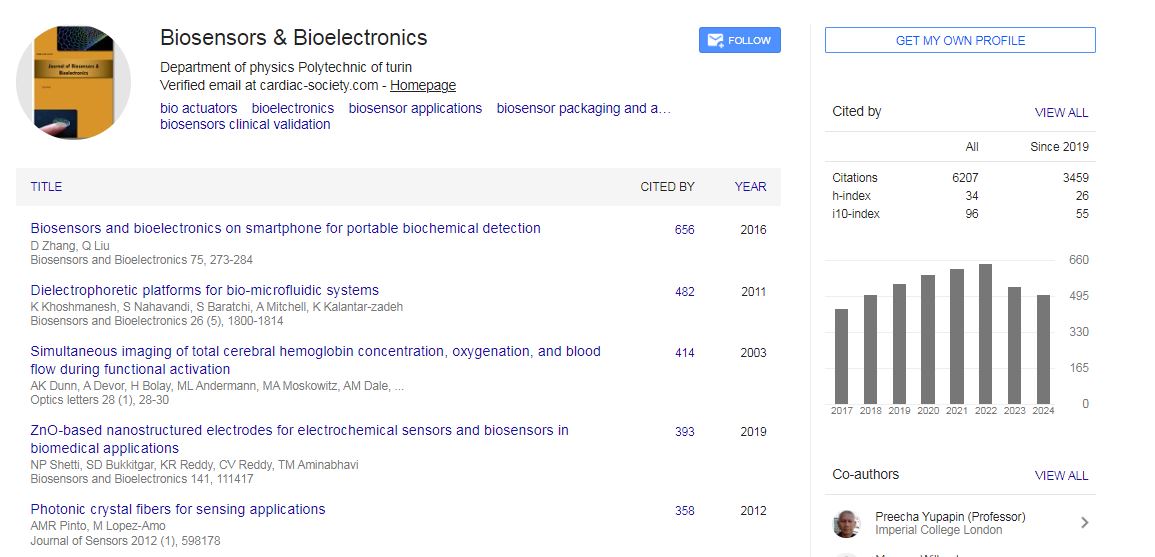
Biosensors & Bioelectronics received 6207 citations as per Google Scholar report