Commentary - (2025) Volume 16, Issue 6
Received: 01-Dec-2025, Manuscript No. jbsbe-26-183330;
Editor assigned: 03-Dec-2025, Pre QC No. P-183330;
Reviewed: 17-Dec-2025, QC No. Q-183330;
Revised: 22-Dec-2025, Manuscript No. R-183330;
Published:
29-Dec-2025
, DOI: 10.37421/2165-6210.2025.16.535
Citation: Al-Khatib, Huda. ”Biosensors: Accelerating Tissue Engineering and Regeneration.” J Biosens Bioelectron 16 (2025):535.
Copyright: © 2025 Al-Khatib H. This is an open-access article distributed under the terms of the Creative Commons Attribution License, which permits unrestricted use, distribution and reproduction in any medium, provided the original author and source are credited.
The field of tissue engineering and regenerative medicine is increasingly relying on advanced monitoring techniques to understand and optimize the complex processes involved in tissue development and regeneration. Biosensors have emerged as critical tools for providing real-time, in-situ data on cellular behavior, metabolic activity, and the surrounding microenvironment, which are essential for effective scaffold design and promoting cellular differentiation and tissue maturation. This progress necessitates integrated biosensing systems capable of tracking multiple parameters simultaneously to gain a deeper understanding of intricate biological events and accelerate the development of functional engineered tissues [1].
Electrochemical biosensors are being developed to offer real-time assessment of key metabolites and inflammatory markers crucial during in-vitro tissue regeneration. These biosensors have the potential to provide continuous monitoring of the tissue microenvironment, enabling immediate feedback for culture optimization. Such devices can significantly reduce the need for laborious and time-consuming off-line analyses, thereby enhancing the efficiency and success rates of regenerative strategies [2].
Advances in microfluidic platforms integrated with biosensing capabilities are revolutionizing the tracking of tissue development. Microfluidic devices are being created that can cultivate engineered tissues while simultaneously monitoring cellular viability, nutrient consumption, and waste production. These systems offer the advantage of mimicking the native tissue environment more closely, providing unprecedented control and real-time data acquisition throughout the cultivation process [3].
Optical biosensors, particularly fluorescence-based methods, are being employed for the non-invasive monitoring of cell proliferation and differentiation in engineered tissues. These techniques allow for the tracking of cell density and marker expression over time without disrupting the tissue constructs. This capability is particularly beneficial for long-term studies and the development of complex, multi-layered tissues where traditional sampling methods are problematic [4].
The integration of biosensors with 3D bioprinting is advancing tissue fabrication by enabling in-line monitoring of the printing process. This ensures cell viability and can even guide the deposition of different cell types based on real-time feedback. The development of closed-loop systems, where biosensor data dynamically adjusts printing parameters, promises more precise and functional engineered tissues [5].
Wearable and implantable biosensors are being explored for in-vivo monitoring of regenerative processes after implantation. These devices aim to continuously track physiological parameters, immune responses, and tissue integration. The goal is to enable early detection of complications and to assess the efficacy of regenerative therapies in a more natural physiological setting, extending monitoring beyond laboratory confines [6].
Developing biosensors for complex tissue environments presents significant challenges and opportunities. Biosensors need to operate effectively within the heterogeneous and dynamic conditions of engineered tissues, accounting for factors such as nutrient gradients, oxygen levels, and pH. Strategies for improving sensor selectivity, sensitivity, and biocompatibility are crucial for accurate and reliable monitoring throughout the regeneration process [7].
Bioelectronic interfaces are being developed to facilitate seamless communication between biological systems and electronic devices for tissue engineering applications. Biosensors integrated into these interfaces provide continuous, real-time data on cellular function and tissue development. This offers critical insights for guiding regenerative strategies and ensuring successful tissue maturation through biocompatible and responsive systems [8].
Nanotechnology is playing a vital role in enhancing biosensing capabilities for tissue engineering. Nanomaterials are being used to improve the sensitivity, specificity, and response time of biosensors designed to monitor cellular processes and the extracellular matrix. Nanostructured sensors can provide more detailed and accurate information about the microenvironment during tissue regeneration, ultimately leading to improved outcomes [9].
The integration of artificial intelligence (AI) with biosensing technologies is transforming the analysis of data generated in tissue engineering and regenerative medicine. AI algorithms can process complex, multi-parameter biosensor data to predict tissue development, identify anomalies, and optimize culture conditions. This synergy accelerates the translation of regenerative medicine therapies from the laboratory to clinical applications [10].
Biosensors are fundamental to advancing tissue engineering by providing real-time, in-situ monitoring of crucial parameters within engineered tissues. They offer unparalleled insights into cellular behavior, metabolic activity, and the microenvironmental conditions, thereby optimizing scaffold design, directing cell differentiation, and facilitating overall tissue maturation. The development of integrated biosensing systems that can simultaneously track multiple parameters is essential for a comprehensive understanding of complex biological events and for accelerating the creation of functional engineered tissues [1].
The application of electrochemical biosensors for the real-time assessment of key metabolites and inflammatory markers during in-vitro tissue regeneration is a significant development. These devices offer continuous monitoring of the tissue microenvironment, providing immediate feedback that can be used to optimize culture conditions. By reducing the reliance on labor-intensive and time-consuming off-line analyses, these biosensors enhance the efficiency and success rates of regenerative therapies [2].
Microfluidic platforms are being revolutionized by the integration of biosensing capabilities, offering new ways to monitor tissue development. These microfluidic devices are capable of cultivating engineered tissues while simultaneously measuring cellular viability, nutrient uptake, and waste production. This approach allows for a closer mimicry of the native tissue environment and provides precise control over real-time data acquisition throughout the tissue cultivation process [3].
Fluorescence-based optical biosensors are employed for non-invasive monitoring of cell proliferation and differentiation in engineered tissues. They enable the tracking of cell density and marker expression over time without perturbing the tissue constructs. This non-invasive nature is highly advantageous for long-term studies and for the development of complex, multi-layered tissues where traditional sampling methods are often disruptive [4].
The integration of biosensors with 3D bioprinting technologies enhances the fabrication of advanced tissue constructs. In-line biosensing monitors the printing process itself, ensuring cell viability and guiding the deposition of different cell types based on real-time feedback. This enables closed-loop systems where biosensor data dynamically adjusts printing parameters, leading to more precise and functional engineered tissues [5].
Wearable and implantable biosensors are being developed for in-vivo monitoring of regenerative processes following tissue implantation. These sensors continuously track physiological parameters, immune responses, and tissue integration, facilitating early detection of complications and assessment of regenerative therapy efficacy in a natural physiological context, moving beyond in-vitro settings [6].
Significant challenges and opportunities exist in developing biosensors capable of functioning within complex tissue environments. These sensors must operate reliably under heterogeneous and dynamic conditions, including varying nutrient gradients, oxygen levels, and pH. Enhancing sensor selectivity, sensitivity, and biocompatibility is paramount for accurate and dependable monitoring throughout the tissue regeneration process [7].
Bioelectronic interfaces are being engineered to establish seamless communication between biological systems and electronic devices for tissue engineering applications. Biosensors integrated into these interfaces deliver continuous, real-time data on cellular function and tissue development, providing essential insights for optimizing regenerative strategies and ensuring successful tissue maturation through biocompatible and responsive designs [8].
Nanotechnology is being leveraged to enhance biosensors for tissue engineering by improving their sensitivity, specificity, and response time. The use of nanomaterials in biosensors allows for more detailed and accurate monitoring of cellular processes and the extracellular matrix. This nanostructured approach provides richer information about the microenvironment during tissue regeneration, leading to superior outcomes [9].
The synergy between artificial intelligence (AI) and biosensing technologies is transforming data analysis in tissue engineering and regenerative medicine. AI algorithms can effectively process complex, multi-parameter data from biosensors to predict tissue development, detect anomalies, and optimize culture conditions, thereby accelerating the clinical translation of regenerative therapies [10].
This collection of research highlights the transformative role of biosensors in tissue engineering and regenerative medicine. Biosensors provide real-time, in-situ monitoring of cellular behavior and microenvironment crucial for optimizing tissue development and maturation. Various types of biosensors, including electrochemical, optical, and microfluidic-integrated systems, are discussed for their applications in tracking metabolites, inflammatory markers, cell proliferation, and differentiation. The integration of biosensors with advanced technologies like 3D bioprinting and AI is enabling closed-loop systems for precise tissue fabrication and data analysis. Furthermore, the development of wearable and implantable biosensors is paving the way for in-vivo monitoring, while nanotechnology enhances sensor performance. Addressing the challenges of complex tissue environments and ensuring biocompatibility are key areas of ongoing research, all contributing to the acceleration of regenerative medicine from laboratory to clinic.
None
None
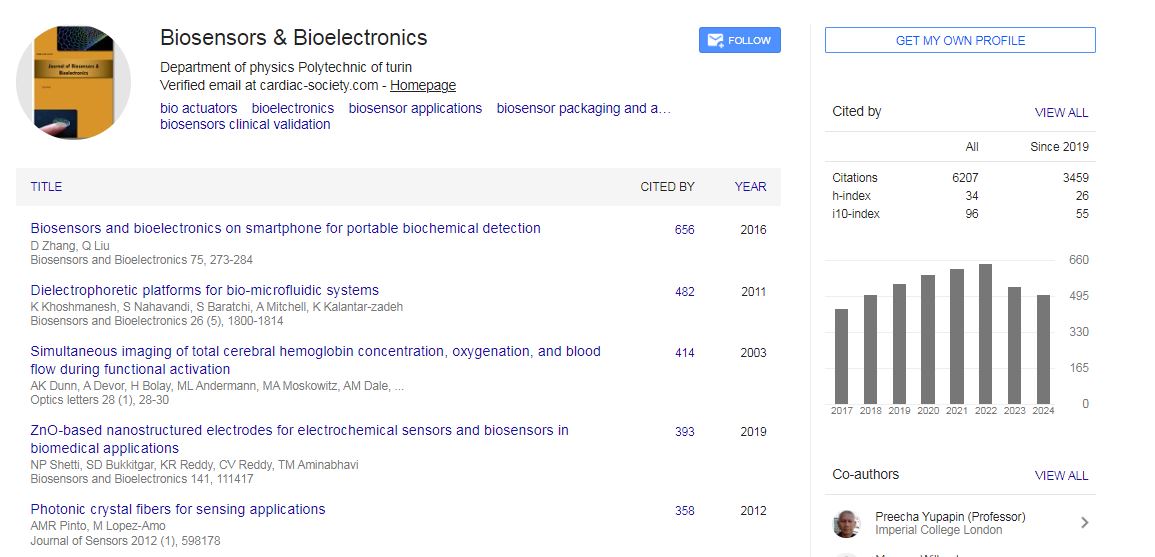
Biosensors & Bioelectronics received 6207 citations as per Google Scholar report