Perspective - (2025) Volume 16, Issue 4
Received: 01-Aug-2025, Manuscript No. jbmbs-26-183402;
Editor assigned: 04-Aug-2025, Pre QC No. P-183402;
Reviewed: 18-Aug-2025, QC No. Q-183402;
Revised: 22-Aug-2025, Manuscript No. R-183402;
Published:
29-Aug-2025
, DOI: 10.37421/2155-6180.2025.16.288
Citation: Novak, Tomas. ”Biometrics: Secure Patient Identification for Telemedicine.” J Biom Biosta 16 (2025):288.
Copyright: © 2025 Novak T. This is an open-access article distributed under the terms of the Creative Commons Attribution License, which permits unrestricted use, distribution and reproduction in any medium, provided the original author and source are credited.
Biometric technologies have emerged as a cornerstone of modern security and identification systems, offering robust solutions for various sectors, including healthcare. Their ability to leverage unique biological or behavioral characteristics provides a high degree of certainty in verifying an individual's identity. In healthcare, this translates to enhanced patient safety, streamlined administrative processes, and improved data security. The digital transformation of healthcare, particularly with the rise of telemedicine, has amplified the need for such advanced authentication methods. Biometrics offer a secure and convenient method for patient identification and authentication in healthcare settings. Their integration into telemedicine platforms enhances data privacy, ensures accurate patient record access, and streamlines remote consultations. This is particularly crucial for sensitive medical information, reducing fraud and improving the overall reliability of digital health services [1].
Different biometric modalities cater to various needs within the healthcare ecosystem. Fingerprint recognition systems, for instance, are widely adopted due to their non-intrusive nature and established reliability. These systems provide a non-intrusive and widely accepted biometric modality for patient identification in hospitals and clinics. Their accuracy and speed contribute to efficient patient throughput and reduce administrative errors. In telemedicine, fingerprint scanning can authenticate users before accessing personal health records or participating in virtual appointments [2].
Facial recognition technology presents another compelling option, especially in contactless scenarios. Facial recognition technology, particularly when combined with liveness detection, offers a contactless method for patient verification in telemedicine. This approach is beneficial for individuals who may have difficulty using traditional authentication methods. Ensuring privacy and mitigating bias are key considerations for its ethical deployment [3].
Beyond fingerprints and faces, more specialized biometrics like iris recognition offer unparalleled accuracy and long-term stability. Iris recognition systems provide a highly accurate and stable biometric trait for long-term patient identification. In the context of telemedicine, these systems can ensure continuous patient verification for chronic care management and remote monitoring, offering a robust security layer [4].
Behavioral biometrics introduce a passive and less intrusive approach to authentication. Behavioral biometrics, such as gait analysis and keystroke dynamics, offer passive authentication methods that are less intrusive than traditional biometrics. For telemedicine, these can be used to continuously monitor user authenticity during a session, enhancing security without requiring active user input [5].
Voice recognition, leveraging the uniqueness of vocal patterns, offers a convenient and accessible biometric solution. Voice recognition, using unique vocal characteristics, can serve as a convenient biometric for patient verification in telemedicine. It's particularly useful for hands-free authentication, improving accessibility for certain patient populations. Challenges include variations in voice due to illness or environmental noise [6].
To further bolster security, multimodal biometric systems combine the strengths of different modalities. Multimodal biometric systems, combining two or more biometric traits (e.g., face and fingerprint), significantly enhance accuracy and security in healthcare applications. This is crucial for high-stakes telemedicine scenarios where robust identity verification is paramount to prevent unauthorized access to sensitive health data [7].
The integration of biometrics extends to the management of electronic health records (EHRs). The integration of biometrics in electronic health records (EHRs) ensures that only authorized personnel can access and modify patient data. This is vital for maintaining the integrity and confidentiality of medical information, especially with the increasing trend of EHR sharing and remote access in telemedicine [8].
Given the sensitive nature of health data, privacy preservation is paramount. Privacy-preserving biometric techniques are essential for telemedicine to comply with data protection regulations like GDPR and HIPAA. Methods such as template protection and secure multi-party computation allow for biometric authentication without storing raw biometric data, safeguarding patient privacy [9].
Ultimately, the successful deployment of biometric systems hinges on user acceptance and usability. The user acceptance and usability of biometric systems in telemedicine are critical for their successful adoption. Factors like ease of use, perceived security, and transparency in data handling significantly influence patient and healthcare provider willingness to employ these technologies [10].
Biometric technologies have become indispensable in modern healthcare, offering a sophisticated approach to patient identification and authentication. Their application in telemedicine is particularly significant, providing enhanced security and convenience for remote healthcare services. Biometric technologies offer a secure and convenient method for patient identification and authentication in healthcare settings. Their integration into telemedicine platforms enhances data privacy, ensures accurate patient record access, and streamlines remote consultations. This is particularly crucial for sensitive medical information, reducing fraud and improving the overall reliability of digital health services [1].
Among the various biometric modalities, fingerprint recognition stands out for its widespread adoption and ease of implementation. Fingerprint recognition systems provide a non-intrusive and widely accepted biometric modality for patient identification in hospitals and clinics. Their accuracy and speed contribute to efficient patient throughput and reduce administrative errors. In telemedicine, fingerprint scanning can authenticate users before accessing personal health records or participating in virtual appointments [2].
Facial recognition offers a contactless and increasingly sophisticated method for patient verification, especially relevant in hygiene-conscious healthcare environments. Facial recognition technology, particularly when combined with liveness detection, offers a contactless method for patient verification in telemedicine. This approach is beneficial for individuals who may have difficulty using traditional authentication methods. Ensuring privacy and mitigating bias are key considerations for its ethical deployment [3].
Iris recognition systems provide an exceptionally high level of accuracy and stability, making them suitable for long-term patient identification and monitoring. Iris recognition systems provide a highly accurate and stable biometric trait for long-term patient identification. In the context of telemedicine, these systems can ensure continuous patient verification for chronic care management and remote monitoring, offering a robust security layer [4].
Behavioral biometrics introduce a novel paradigm by analyzing patterns of user interaction, offering a passive and continuous form of authentication. Behavioral biometrics, such as gait analysis and keystroke dynamics, offer passive authentication methods that are less intrusive than traditional biometrics. For telemedicine, these can be used to continuously monitor user authenticity during a session, enhancing security without requiring active user input [5].
Voice recognition leverages the unique characteristics of an individual's voice for authentication, offering a convenient and accessible option, particularly for hands-free applications. Voice recognition, using unique vocal characteristics, can serve as a convenient biometric for patient verification in telemedicine. It's particularly useful for hands-free authentication, improving accessibility for certain patient populations. Challenges include variations in voice due to illness or environmental noise [6].
Multimodal biometric systems represent a significant advancement in security by combining multiple biometric traits, thereby mitigating the weaknesses of individual modalities and offering enhanced reliability. Multimodal biometric systems, combining two or more biometric traits (e.g., face and fingerprint), significantly enhance accuracy and security in healthcare applications. This is crucial for high-stakes telemedicine scenarios where robust identity verification is paramount to prevent unauthorized access to sensitive health data [7].
The secure management of electronic health records (EHRs) is a critical concern in digital healthcare, and biometrics play a vital role in ensuring data integrity and confidentiality. The integration of biometrics in electronic health records (EHRs) ensures that only authorized personnel can access and modify patient data. This is vital for maintaining the integrity and confidentiality of medical information, especially with the increasing trend of EHR sharing and remote access in telemedicine [8].
Protecting patient privacy is paramount, and advanced biometric techniques are designed to achieve this without compromising security. Privacy-preserving biometric techniques are essential for telemedicine to comply with data protection regulations like GDPR and HIPAA. Methods such as template protection and secure multi-party computation allow for biometric authentication without storing raw biometric data, safeguarding patient privacy [9].
Finally, the practical success of biometric systems in telemedicine is intrinsically linked to their user-friendliness and the trust they inspire among patients and healthcare providers. The user acceptance and usability of biometric systems in telemedicine are critical for their successful adoption. Factors like ease of use, perceived security, and transparency in data handling significantly influence patient and healthcare provider willingness to employ these technologies [10].
Biometric technologies offer secure and convenient patient identification and authentication in healthcare, especially vital for telemedicine. Various modalities like fingerprint, facial, iris, behavioral, and voice recognition provide distinct advantages in accuracy, convenience, and security. Fingerprint recognition is widely adopted for its speed and accuracy, while facial recognition offers contactless verification. Iris recognition provides high long-term stability, and behavioral biometrics offer passive authentication. Voice recognition is convenient for hands-free use, though susceptible to environmental factors. Multimodal systems enhance security by combining multiple traits. Biometrics are crucial for securing electronic health records and ensuring compliance with privacy regulations. User acceptance and usability are key factors for the successful integration of these technologies into telemedicine platforms, ensuring patient privacy and data integrity.
None
None
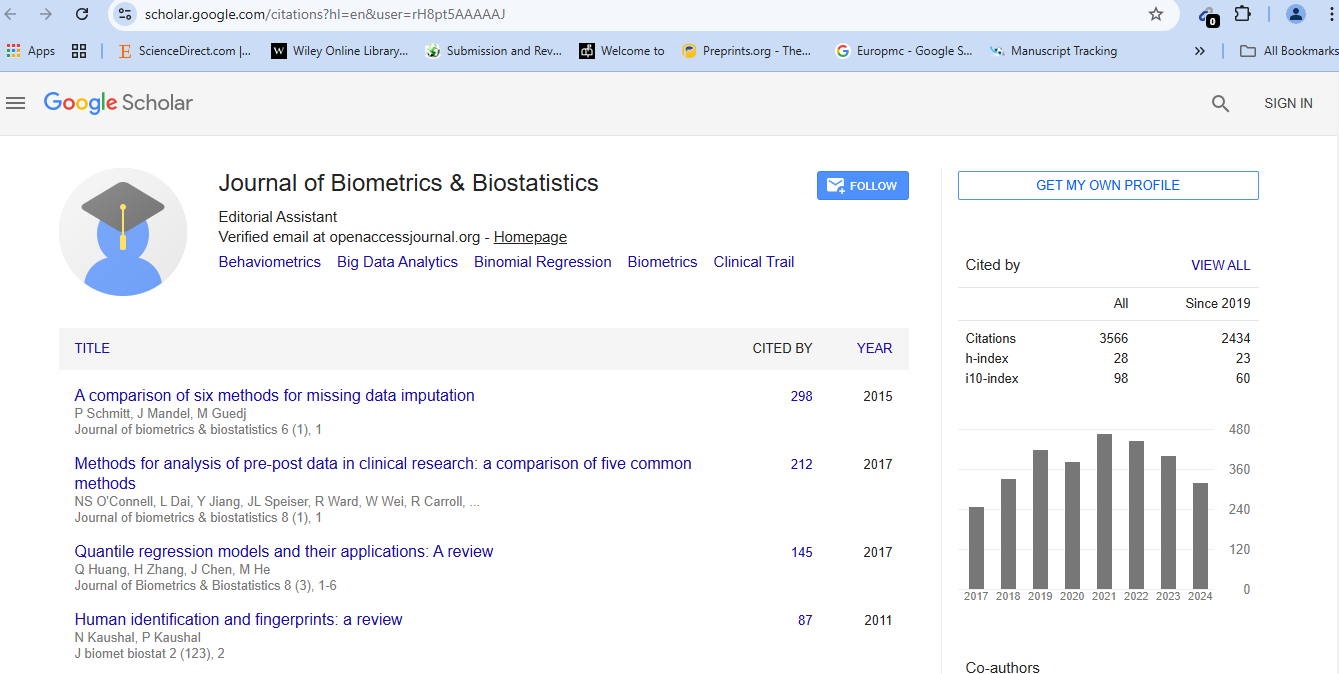
Journal of Biometrics & Biostatistics received 3496 citations as per Google Scholar report