Opinion - (2025) Volume 16, Issue 4
Received: 01-Aug-2025, Manuscript No. jmbd-25-168353;
Editor assigned: 04-Aug-2025, Pre QC No. P-168353;
Reviewed: 14-Aug-2025, QC No. Q-168353;
Revised: 21-Aug-2025, Manuscript No. R-168353;
Published:
28-Aug-2025
, DOI: 10.37421/2155-9929.2025.16.715
Citation: Rahman, Abdul. ”Biomarkers: Fueling Precision Medicine’s Future.” J Mol Biomark Diagn 16 (2025):715.
Copyright: © 2025 Rahman A. This is an open-access article distributed under the terms of the Creative Commons Attribution License, which permits unrestricted use, distribution and reproduction in any medium, provided the original author and source are credited.
Biomarkers are central to the advancement of predictive, preventive, and personalized medicine (3PM). They provide objective measures for assessing disease risk, enabling early detection, and monitoring therapeutic responses. In the realm of prediction, biomarkers identify individuals at elevated risk for specific diseases, thereby facilitating the implementation of targeted interventions [1].
For preventive strategies, these markers can guide lifestyle modifications or the administration of prophylactic treatments. In the context of personalized medicine, biomarkers are instrumental in dictating treatment selection, aiming to optimize efficacy and minimize adverse effects. The advent of 'omics' technologies has profoundly transformed biomarker discovery, leading to the identification of a vast array of molecular signatures for diverse conditions. However, significant challenges persist in the validation, standardization, and clinical implementation of these discoveries [1].
Liquid biopsies represent a paradigm shift in cancer diagnostics and management, leveraging circulating biomarkers such as cell-free DNA (cfDNA) and circulating tumor cells (CTCs). These non-invasive approaches facilitate the early detection of recurrence, enable the monitoring of treatment response, and aid in identifying mechanisms of therapeutic resistance. The application of cfDNA in detecting minimal residual disease (MRD) holds particular promise for informing adjuvant therapy decisions in oncology [2].
Biomarkers are critical for stratifying patients for immunotherapy, a pivotal treatment modality in modern oncology. The prediction of response to immune checkpoint inhibitors (ICIs) is heavily reliant on biomarkers like PD-L1 expression, tumor mutational burden (TMB), and microsatellite instability (MSI). A thorough understanding of these biomarkers empowers clinicians to select appropriate patients, optimize treatment strategies, and enhance outcomes while mitigating unnecessary toxicity [3].
Genomic biomarkers are indispensable for the practice of personalized medicine in oncology. The identification of specific genetic alterations, including mutations in EGFR, BRAF, or KRAS, serves as a guide for selecting targeted therapies for a wide spectrum of cancers. Companion diagnostics, frequently based on these genomic biomarkers, ensure that patients receive treatments precisely tailored to their tumor's molecular profile, thereby improving survival rates and reducing side effects [4].
Proteomic biomarkers are emerging as potent tools for disease diagnosis, prognosis, and therapeutic monitoring across numerous conditions, spanning cardiovascular diseases to neurological disorders. Techniques such as mass spectrometry and antibody-based platforms facilitate the identification and quantification of specific proteins or their modifications, which can serve as early disease indicators or predict treatment outcomes. The integration of proteomic data with other 'omics' layers is poised to deepen our understanding of disease mechanisms and advance biomarker development [5].
Metabolomic biomarkers offer a dynamic reflection of cellular function and metabolic status, rendering them valuable for early disease detection and ongoing monitoring. Alterations in metabolite profiles can manifest before structural or functional changes occur, providing a sensitive window for therapeutic intervention. Their application is expanding in areas such as diabetes, metabolic syndrome, and neurodegenerative diseases, offering non-invasive diagnostic and prognostic possibilities [6].
The development and rigorous validation of robust biomarkers are paramount for their successful translation into clinical practice. Comprehensive analytical validation and clinical utility studies are indispensable to ensure accuracy, reproducibility, and clinical relevance. The regulatory pathways governing biomarker approval are also undergoing evolution to accommodate the rapid advancements in this field, particularly for 'omics'-based diagnostics [7].
Epigenetic biomarkers, including DNA methylation patterns and histone modifications, are increasingly recognized for their potential in early disease detection, prognosis assessment, and treatment stratification. These markers often exhibit stability and can be detected in readily accessible biological samples, such as blood. Their role in predicting cancer risk and response to therapies like chemotherapy is a significant area of ongoing research [8].
The integration of artificial intelligence (AI) and machine learning (ML) is revolutionizing the landscape of biomarker discovery and application. AI algorithms possess the capability to analyze vast and complex datasets generated by 'omics' technologies, thereby identifying novel biomarkers and predicting disease risk or treatment response with enhanced accuracy. This synergistic approach significantly accelerates the translation of research findings into practical clinical tools for personalized medicine [9].
The gut microbiome is emerging as a significant source of biomarkers for a variety of diseases. Dysbiosis, characterized by an imbalance in the gut microbial community, has been associated with conditions such as inflammatory bowel disease, metabolic disorders, and even neurological ailments. Microbial metabolites and host-microbe interactions are actively being explored as potential diagnostic and prognostic markers [10].
Biomarkers are fundamental to the evolution of predictive, preventive, and personalized medicine (3PM), offering objective metrics for disease risk assessment, early detection, and treatment response monitoring. In predictive applications, biomarkers identify individuals at high risk of developing a disease, enabling targeted interventions and preventative measures, such as lifestyle modifications or prophylactic treatments. For personalized medicine, biomarkers are crucial for guiding treatment selection to optimize efficacy and minimize adverse effects. The widespread adoption of 'omics' technologies has dramatically advanced biomarker discovery, revealing numerous molecular signatures for various diseases, although challenges in validation, standardization, and clinical implementation remain [1].
Liquid biopsies, a non-invasive diagnostic approach, utilize circulating biomarkers like cell-free DNA (cfDNA) and circulating tumor cells (CTCs) to transform cancer diagnostics and management. These methods allow for early detection of recurrence, monitoring of treatment response, and identification of resistance mechanisms. Notably, the application of cfDNA for detecting minimal residual disease (MRD) shows significant promise in guiding adjuvant therapy decisions in oncology [2].
In the context of cancer treatment, biomarkers play a critical role in stratifying patients for immunotherapy. The prediction of response to immune checkpoint inhibitors (ICIs) relies heavily on biomarkers such as PD-L1 expression, tumor mutational burden (TMB), and microsatellite instability (MSI). Understanding these predictive markers enables clinicians to select the most appropriate patients, optimize therapeutic strategies, and improve patient outcomes while avoiding unnecessary toxicity [3].
Genomic biomarkers are indispensable in personalized oncology, where identifying specific genetic alterations, such as mutations in EGFR, BRAF, or KRAS, guides the selection of targeted therapies. Companion diagnostics, often developed around these genomic biomarkers, ensure that patients receive treatments tailored to their tumor's unique molecular profile, leading to improved survival and reduced side effects [4].
Proteomic biomarkers are increasingly recognized as powerful tools for disease diagnosis, prognosis, and therapeutic monitoring across diverse conditions, including cardiovascular and neurological diseases. Techniques like mass spectrometry and antibody-based platforms enable the identification and quantification of specific proteins or protein modifications that can serve as early indicators of disease or predict treatment responses. Integrating proteomic data with other 'omics' layers promises deeper insights into disease mechanisms and biomarker development [5].
Metabolomic biomarkers provide a dynamic snapshot of cellular function and metabolic status, proving valuable for early disease detection and monitoring. Changes in metabolite profiles can precede observable structural or functional alterations, offering a sensitive window for intervention. Their utility is expanding in areas like diabetes, metabolic syndrome, and neurodegenerative diseases, presenting non-invasive diagnostic and prognostic possibilities [6].
The successful translation of biomarkers into clinical practice hinges on their robust development and validation. Rigorous analytical validation and clinical utility studies are essential to guarantee accuracy, reproducibility, and clinical relevance. The regulatory frameworks for biomarker approval are also evolving to accommodate the rapid advancements in the field, particularly for 'omics'-based diagnostics [7].
Epigenetic biomarkers, such as DNA methylation and histone modifications, are gaining prominence for their potential in early disease detection, prognosis, and treatment stratification. These markers are often stable and can be detected in easily accessible samples like blood. Their role in predicting cancer risk and response to therapies like chemotherapy is an active area of research [8].
The integration of artificial intelligence (AI) and machine learning (ML) is fundamentally transforming biomarker discovery and application. AI algorithms can analyze extensive and complex datasets from 'omics' technologies to identify novel biomarkers and predict disease risk or treatment response with high accuracy. This synergistic approach accelerates the translation of research findings into clinical tools for personalized medicine [9].
The gut microbiome is emerging as a significant source of biomarkers for various diseases. Dysbiosis, or an imbalance in the gut microbial community, has been linked to conditions such as inflammatory bowel disease, metabolic disorders, and neurological conditions. Microbial metabolites and host-microbe interactions are being explored as potential diagnostic and prognostic markers [10].
Biomarkers are crucial for advancing predictive, preventive, and personalized medicine. They enable early disease risk assessment, detection, and treatment response monitoring. Various 'omics' technologies, including genomics, proteomics, metabolomics, and epigenetics, are driving biomarker discovery across different diseases, from cancer to metabolic disorders. Liquid biopsies offer non-invasive methods for cancer detection and monitoring. Biomarkers also play a vital role in stratifying patients for immunotherapy and guiding targeted therapies in oncology. The integration of AI and machine learning is accelerating biomarker identification and application. Challenges remain in biomarker validation, standardization, and clinical implementation, necessitating robust analytical and clinical utility studies, alongside evolving regulatory pathways. The gut microbiome is also emerging as a source of novel biomarkers.
None
None
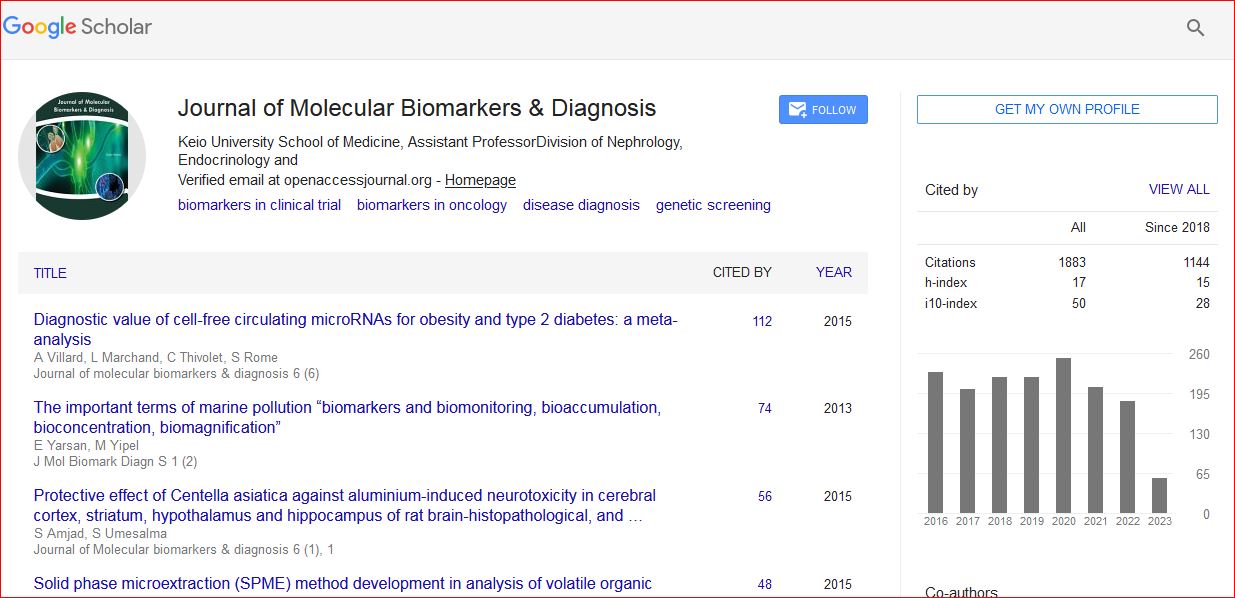
Journal of Molecular Biomarkers & Diagnosis received 2054 citations as per Google Scholar report