Brief Report - (2025) Volume 15, Issue 3
Received: 01-May-2025, Manuscript No. jnt-26-178932;
Editor assigned: 05-May-2025, Pre QC No. P-178932;
Reviewed: 19-May-2025, QC No. Q-178932;
Revised: 22-May-2025, Manuscript No. R-178932;
Published:
29-May-2025
, DOI: 10.37421/2161-0959.2025.15.562
Citation: Petrovic, Sofia. ”Biomarker Guidance: Transforming Chronic Kidney Disease Care.” J Nephrol Ther 15 (2025):562.
Copyright: © 2025 Petrovic S. This is an open-access article distributed under the terms of the Creative Commons Attribution License, which permits unrestricted use, distribution and reproduction in any medium, provided the original author and source are credited.
Biomarker-guided management of chronic kidney disease (CKD) is revolutionizing patient care by enabling earlier detection, risk stratification, and personalized treatment strategies. This approach moves beyond traditional measures like eGFR and albuminuria, incorporating novel biomarkers to provide a more granular understanding of disease progression and therapeutic response. The integration of these biomarkers facilitates proactive interventions, potentially slowing CKD progression, reducing complications, and improving patient outcomes. This shift underscores the importance of a precision medicine framework in nephrology [1].
The identification and validation of new biomarkers are crucial for advancing CKD management. Biomarkers such as KIM-1, NGAL, and ST2 offer insights into specific pathophysiological processes like inflammation and fibrosis, allowing for more targeted interventions. Their application in clinical trials and practice is expanding, supporting the development of therapies aimed at halting or reversing kidney damage [2].
Personalized treatment strategies in CKD are increasingly driven by biomarker profiles. Beyond stratifying risk, biomarkers can predict response to specific therapies, such as SGLT2 inhibitors or ARBs. This tailored approach optimizes treatment efficacy and minimizes adverse effects, leading to better patient outcomes and a more efficient use of healthcare resources [3].
The application of advanced omics technologies, including genomics and proteomics, is uncovering a wealth of new biomarkers for CKD. These technologies allow for a comprehensive understanding of the molecular pathways involved in kidney disease, paving the way for the discovery of novel therapeutic targets and diagnostic tools [4].
Biomarker-guided management extends to predicting the risk of acute kidney injury (AKI) in patients with CKD. Early identification of AKI risk through biomarkers can trigger timely interventions, potentially mitigating kidney damage and preventing progression to more severe kidney disease states [5].
The use of circulating microRNAs as biomarkers in CKD is gaining traction. These small non-coding RNAs can reflect the complex molecular changes occurring in the kidney and offer a non-invasive method for diagnosis, prognosis, and monitoring of treatment response [6].
Implementing biomarker-guided CKD management requires robust clinical validation and integration into existing healthcare workflows. Standardization of assays, interpretation of results, and education of healthcare professionals are essential for widespread adoption and effective clinical decision-making [7].
The economic impact of biomarker-guided CKD management is significant. By enabling earlier intervention and preventing costly complications such as end-stage renal disease requiring dialysis, this approach offers a more cost-effective model of care for CKD patients [8].
Specific biomarkers are being explored to differentiate between various causes of CKD, such as diabetic nephropathy, hypertensive nephrosclerosis, and glomerulonephritis. This diagnostic precision is crucial for selecting the most appropriate treatment tailored to the underlying pathology [9].
The role of the gut microbiome in CKD pathogenesis is a growing area of research, with emerging biomarkers related to microbial metabolites. Targeting these microbial dysbiosis could offer novel therapeutic avenues for CKD management [10].
Biomarker-guided management of chronic kidney disease (CKD) represents a paradigm shift in patient care, moving towards earlier detection, precise risk stratification, and highly personalized therapeutic interventions. This advanced approach transcends conventional metrics such as estimated glomerular filtration rate (eGFR) and albuminuria, instead incorporating novel biomarkers to achieve a more nuanced understanding of disease trajectory and treatment efficacy. The strategic integration of these biomarkers empowers clinicians to implement proactive measures, thereby potentially slowing disease progression, mitigating complications, and ultimately enhancing patient outcomes, underscoring the significance of a precision medicine framework within nephrology [1].
The ongoing discovery and rigorous validation of novel biomarkers are indispensable for the evolution of CKD management strategies. Biomarkers like kidney injury molecule-1 (KIM-1), neutrophil gelatinase-associated lipocalin (NGAL), and soluble ST2 (ST2) provide critical insights into distinct pathophysiological processes, including inflammation and fibrosis, which in turn facilitates the application of more targeted therapeutic interventions. The increasing incorporation of these biomarkers in clinical trials and routine practice supports the development of novel therapies designed to halt or even reverse existing kidney damage [2].
Personalized treatment regimens for CKD are increasingly dictated by comprehensive biomarker profiles. Beyond their utility in risk stratification, biomarkers possess the capability to predict an individual patient's response to specific therapeutic agents, such as sodium-glucose cotransporter-2 (SGLT2) inhibitors or angiotensin receptor blockers (ARBs). This finely tuned, individualized approach serves to maximize therapeutic effectiveness while simultaneously minimizing the occurrence of adverse events, thereby leading to improved patient outcomes and a more judicious allocation of healthcare resources [3].
The advent of advanced omics technologies, encompassing genomics and proteomics, has been instrumental in uncovering an extensive array of new biomarkers relevant to CKD. These sophisticated technologies enable a holistic comprehension of the intricate molecular pathways implicated in the development and progression of kidney disease, thereby clearing a path for the identification of novel therapeutic targets and the development of innovative diagnostic tools [4].
A critical facet of biomarker-guided CKD management is its application in predicting the risk of acute kidney injury (AKI) among patients already diagnosed with CKD. The early identification of AKI risk through sensitive biomarkers can serve as a crucial trigger for the timely implementation of specific interventions, which may effectively mitigate the extent of kidney damage and avert the progression to more severe forms of kidney disease [5].
Circulating microRNAs are emerging as a promising class of biomarkers in the context of CKD. These diminutive non-coding RNA molecules possess the capacity to reflect the complex molecular alterations occurring within the renal tissue. Their identification offers a non-invasive modality for diagnosis, prognostication, and the objective monitoring of therapeutic response, thereby enhancing the precision of CKD management [6].
The successful implementation of biomarker-guided CKD management hinges on rigorous clinical validation and seamless integration into established healthcare workflows. Essential prerequisites for widespread adoption and effective clinical decision-making include the standardization of analytical assays, the precise interpretation of results, and comprehensive educational initiatives targeted at healthcare professionals [7].
The economic implications of adopting biomarker-guided CKD management are substantial. By facilitating early interventions and proactively preventing the occurrence of costly complications, such as end-stage renal disease necessitating dialysis, this management strategy presents a more economically viable model for the comprehensive care of patients afflicted with CKD [8].
Research is actively exploring the potential of specific biomarkers to accurately differentiate among the diverse etiologies of CKD, including conditions like diabetic nephropathy, hypertensive nephrosclerosis, and various forms of glomerulonephritis. This enhanced diagnostic precision is paramount for selecting and administering treatments that are optimally tailored to the underlying pathological process driving the disease [9].
The intricate relationship between the gut microbiome and the pathogenesis of CKD constitutes a rapidly expanding field of scientific inquiry. Emerging biomarkers associated with microbial metabolites are providing new avenues for understanding this connection. The strategic targeting of such microbial dysbiosis holds promise for the development of novel therapeutic strategies aimed at managing CKD [10].
Biomarker-guided management is transforming chronic kidney disease (CKD) care through early detection, risk stratification, and personalized treatments. Novel biomarkers, alongside traditional measures, offer a deeper understanding of disease progression and response to therapy. Biomarkers like KIM-1, NGAL, and ST2 identify specific pathological processes, enabling targeted interventions. Omics technologies are uncovering new biomarkers by analyzing genomic and proteomic data, leading to novel therapeutic targets. Biomarkers also aid in predicting acute kidney injury risk in CKD patients, prompting timely interventions. Circulating microRNAs are emerging as non-invasive diagnostic and prognostic tools. Effective implementation requires clinical validation, standardized assays, and professional education. Biomarker-guided management offers economic benefits by preventing costly complications. Specific biomarkers help differentiate CKD causes, guiding tailored treatments. The gut microbiome's role in CKD is also an area of research, with microbial metabolites serving as potential biomarkers and therapeutic targets.
None
None
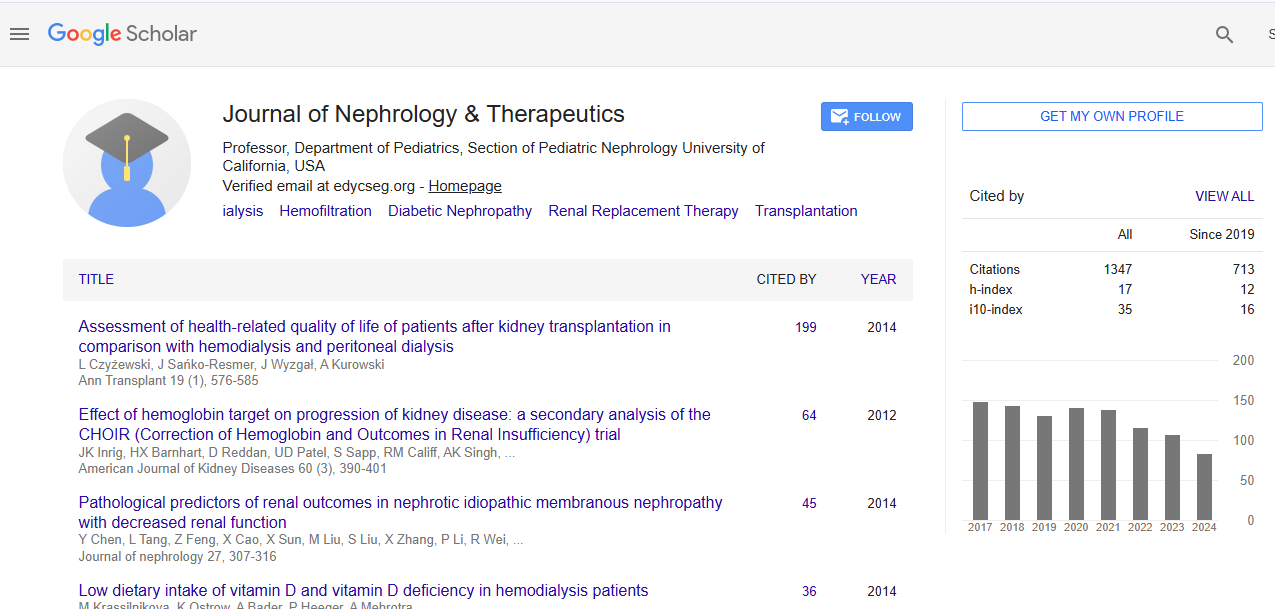
Journal of Nephrology & Therapeutics received 784 citations as per Google Scholar report