Brief Report - (2025) Volume 16, Issue 6
Received: 01-Dec-2025, Manuscript No. jmbd-26-179545;
Editor assigned: 03-Dec-2025, Pre QC No. P-179545;
Reviewed: 15-Dec-2025, QC No. Q-179545;
Revised: 22-Dec-2025, Manuscript No. R-179545;
Published:
29-Dec-2025
, DOI: 10.37421/2155-9929.2025.16.737
Citation: Papadopoulos, George. ”Biomarker Discovery To Clinical Translation: A Holistic Approach.” J Mol Biomark Diagn 16 (2025):737.
Copyright: © 2025 Papadopoulos G. This is an open-access article distributed under the terms of the Creative Commons Attribution License, which permits unrestricted use,
distribution and reproduction in any medium, provided the original author and source are credited.
Molecular biomarkers serve as crucial bridges for translating scientific discoveries into tangible clinical applications. Their identification and validation are essential for developing reliable indicators that can accurately detect, diagnose, and monitor diseases. The integration of diverse 'omics' data, including genomics, proteomics, and metabolomics, is fundamental for creating precise diagnostic tools that offer a wealth of information, but the primary challenge lies in distilling this complex data into actionable clinical insights. This essential bridging effort necessitates robust validation processes, the standardization of methodologies, and close collaboration between basic researchers and practicing clinicians to ensure successful translation [1].
The development of highly reliable assays for detecting these molecular biomarkers is of paramount importance. These assays must demonstrate high sensitivity, specificity, and reproducibility to be clinically useful. Standardization of both pre-analytical and analytical procedures is critical for minimizing variability and ensuring that results obtained in different laboratories and studies are directly comparable. The ultimate aim is to progress from the initial discovery phase to the creation of dependable diagnostic tests that can be seamlessly integrated into routine clinical practice, thereby improving patient care [2].
Genomic biomarkers, especially those derived from next-generation sequencing (NGS) technologies, are revolutionizing the field of oncology. These biomarkers play a vital role in guiding the selection of targeted therapies, predicting patient responses to treatments, and monitoring for minimal residual disease after therapy. A significant challenge in this area is the integration of complex genomic data into clinical decision-making processes, which requires sophisticated bioinformatic pipelines and the expertise of skilled interpreters to ensure accurate and effective application [3].
Proteomic biomarkers offer a complementary perspective to genomic approaches, providing valuable insights into protein expression levels and post-translational modifications. These changes often reflect cellular function and can serve as indicators of various disease states. Advances in mass spectrometry-based proteomics have significantly enhanced the ability to identify candidate biomarkers for a wide range of diseases. Despite these advancements, the validation and successful clinical translation of proteomic findings continue to present complex hurdles that require dedicated research efforts [4].
Liquid biopsies, which include biomarkers such as circulating tumor DNA (ctDNA) and circulating tumor cells (CTCs), represent a significant leap forward in non-invasive diagnostic capabilities. These innovative biomarkers facilitate early cancer detection, enable real-time monitoring of treatment efficacy, and aid in characterizing the heterogeneity of tumors. The clinical utility of liquid biopsies is rapidly expanding, fueled by ongoing technological improvements and a growing understanding of their diagnostic potential [5].
The entire journey from initial biomarker discovery to widespread clinical implementation is characterized by numerous challenges that must be overcome. Rigorous analytical and clinical validation studies are indispensable, followed by the essential process of regulatory approval. Furthermore, the seamless integration of new biomarker tests into existing healthcare workflows is crucial for their practical adoption. This complex process demands extensive interdisciplinary collaboration and significant investment in the necessary infrastructure to support these advanced diagnostic tools [6].
Artificial intelligence (AI) and machine learning (ML) methodologies are increasingly being employed to analyze vast datasets of omics information and to identify novel biomarkers with greater efficiency. These powerful computational tools have the potential to accelerate the biomarker discovery process significantly and to enhance the predictive accuracy of diagnostic models. The integration of AI/ML techniques into biomarker development pipelines is rapidly becoming a key trend in the field of translational diagnostics, promising to unlock new avenues for disease detection and management [7].
A novel concept, the 'digital biomarker,' is also emerging as a significant development in health monitoring. This approach leverages data collected from wearable devices and mobile health applications to track physiological and behavioral parameters. Digital biomarkers can serve as valuable complements to traditional molecular biomarkers, offering a more comprehensive and holistic view of a patient's health status and disease progression, thereby enriching the diagnostic landscape [8].
Ensuring inter-laboratory standardization and rigorous quality control measures are absolutely critical for the reliable and consistent application of molecular biomarkers in clinical settings. The implementation of proficiency testing schemes and the use of shared reference materials are essential steps in guaranteeing that diagnostic results are both accurate and reproducible. These efforts foster greater trust in these emerging technologies among healthcare professionals and patients alike, paving the way for their widespread adoption [9].
The ethical, legal, and societal implications stemming from the widespread adoption of biomarker testing must be carefully considered and addressed. Issues pertaining to data privacy, the process of obtaining informed consent from patients, and ensuring equitable access to novel diagnostic technologies are paramount for responsible implementation and the maintenance of public trust in these advancements [10].
Molecular biomarkers are indispensable for the effective translation of research findings into clinical practice. This process involves the rigorous identification and validation of biological indicators capable of reliably detecting, diagnosing, or monitoring disease states. The synergy of genomic, proteomic, and metabolomic data is fundamental to the development of highly precise diagnostic tools. While the 'omics' revolution provides an expansive landscape of biological information, the significant challenge lies in effectively extracting and synthesizing this data into actionable clinical insights. This crucial bridging endeavor mandates robust validation protocols, standardization of experimental methodologies, and fostering collaborative relationships between basic researchers and clinicians to bridge the gap between discovery and application [1].
The creation of robust and reliable assays for biomarker detection represents a critical step in their clinical utility. Such assays must exhibit high levels of sensitivity, specificity, and reproducibility to be considered dependable. The standardization of all pre-analytical and analytical procedures is of utmost importance to minimize variability and ensure that the results generated are comparable across different laboratories and diverse studies. The overarching objective is to facilitate the transition from initial biomarker discovery to the establishment of dependable diagnostic tests that can be readily implemented within routine clinical practice, thereby advancing patient care [2].
Genomic biomarkers, particularly those identified through next-generation sequencing (NGS) techniques, are profoundly transforming the landscape of oncology. These biomarkers are instrumental in guiding the selection of targeted therapies, predicting a patient's response to specific treatments, and enabling the monitoring of minimal residual disease. A substantial hurdle in this domain involves the intricate process of integrating complex genomic data into clinical decision-making frameworks, a task that necessitates advanced bioinformatic pipelines and expert interpretation to ensure accurate and effective application [3].
Proteomic biomarkers provide a valuable complementary approach to genomic insights, offering a deeper understanding of protein expression patterns and post-translational modifications that reflect cellular functionality and disease status. Significant advancements in mass spectrometry-based proteomics have greatly improved the capacity to identify candidate biomarkers for a broad spectrum of diseases. Nevertheless, the validation and successful clinical translation of proteomic discoveries continue to pose considerable challenges requiring sustained research efforts [4].
Liquid biopsies, encompassing biomarkers such as circulating tumor DNA (ctDNA) and circulating tumor cells (CTCs), signify a major advancement in the realm of non-invasive diagnostics. These innovative biomarkers facilitate the early detection of cancer, allow for real-time assessment of treatment response, and contribute to the characterization of tumor heterogeneity. The clinical relevance of liquid biopsies is experiencing rapid expansion, driven by continuous technological enhancements and a growing comprehension of their diagnostic potential [5].
The pathway from the initial discovery of biomarkers to their widespread clinical implementation is inherently complex and fraught with numerous obstacles. Rigorous analytical and clinical validation studies are indispensable prerequisites, followed by the crucial process of obtaining regulatory approval. Moreover, the successful integration of novel biomarker assays into existing healthcare workflows is vital for their practical utility and adoption. This multifaceted process necessitates extensive interdisciplinary collaboration and substantial investment in the requisite infrastructure to support these advanced diagnostic modalities [6].
Artificial intelligence (AI) and machine learning (ML) techniques are increasingly being leveraged for the analysis of extensive omics datasets, facilitating the identification of novel biomarkers with enhanced efficiency. These sophisticated computational tools possess the capacity to accelerate the biomarker discovery pipeline and improve the predictive accuracy of diagnostic models. The integration of AI/ML methodologies into biomarker development workflows is emerging as a pivotal trend within translational diagnostics, promising to unlock new frontiers in disease detection and management strategies [7].
The concept of 'digital biomarkers' is gaining prominence as a novel approach to health monitoring. This methodology involves utilizing data collected from wearable devices and mobile health applications to track key physiological and behavioral parameters. Digital biomarkers can effectively complement traditional molecular biomarkers, thereby offering a more comprehensive and holistic evaluation of a patient's health status and the progression of their disease, enriching the overall diagnostic picture [8].
Establishing inter-laboratory standardization and implementing stringent quality control measures are paramount for ensuring the reliable and consistent application of molecular biomarkers in clinical practice. The adoption of proficiency testing programs and the utilization of shared reference materials are essential steps in guaranteeing the accuracy and reproducibility of diagnostic results. These initiatives are crucial for fostering confidence in these evolving technologies among healthcare professionals and ultimately for patient benefit [9].
The ethical, legal, and societal ramifications associated with the widespread deployment of biomarker testing warrant careful consideration and proactive management. Critical issues such as data privacy, the intricacies of informed consent, and the imperative of ensuring equitable access to innovative diagnostic tools are fundamental for responsible implementation and the cultivation of public trust in these advanced medical technologies [10].
Molecular biomarkers are critical for translating research into clinical applications, requiring the integration of 'omics' data and robust validation. The development of sensitive, specific, and reproducible assays, along with standardized procedures, is essential for routine clinical use. Genomic biomarkers, particularly from NGS, are transforming oncology by guiding targeted therapies and monitoring disease. Proteomic biomarkers offer complementary insights into cellular function and disease states, though their clinical translation remains challenging. Liquid biopsies, including ctDNA and CTCs, provide non-invasive means for early cancer detection and monitoring. The journey from discovery to implementation involves significant challenges, including validation, regulatory approval, and workflow integration, often requiring interdisciplinary collaboration. AI and machine learning are accelerating biomarker discovery and improving diagnostic models. Digital biomarkers from wearables offer a holistic view of health. Standardization and quality control are vital for assay reliability and reproducibility. Ethical, legal, and societal implications, such as data privacy and equitable access, must be addressed for responsible implementation.
None
None
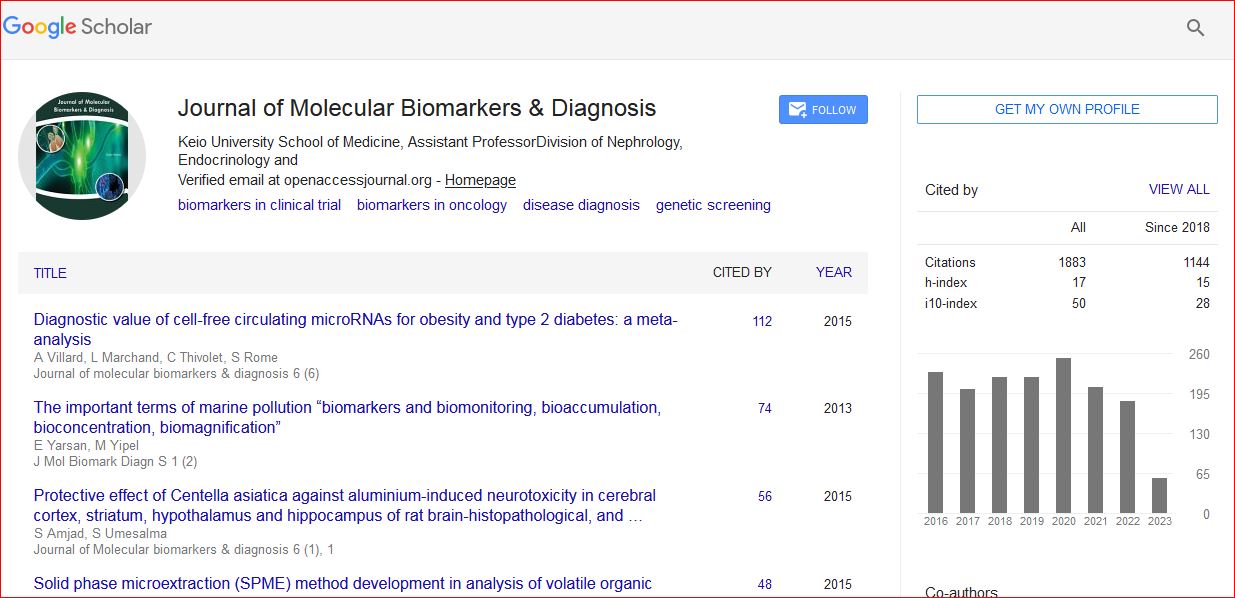
Journal of Molecular Biomarkers & Diagnosis received 2054 citations as per Google Scholar report