Perspective - (2025) Volume 16, Issue 4
Received: 01-Aug-2025, Manuscript No. jbsbe-26-183312;
Editor assigned: 04-Aug-2025, Pre QC No. P-183312;
Reviewed: 18-Aug-2025, QC No. Q-183312;
Revised: 22-Aug-2025, Manuscript No. R-183312;
Published:
29-Aug-2025
, DOI: 10.37421/2165-6210.2025.16.518
Citation: Al-Harbi, Fatima. ”Bioelectronic Sensors Revolutionize Cardiovascular Monitoring.” J Biosens Bioelectron 16 (2025):518.
Copyright: © 2025 Al-Harbi F. This is an open-access article distributed under the terms of the Creative Commons Attribution License, which permits unrestricted use, distribution and reproduction in any medium, provided the original author and source are credited.
The field of bioelectronic sensors for cardiovascular monitoring is rapidly advancing, offering transformative potential for patient care by enabling continuous and personalized assessment of cardiac health. These devices operate on fundamental principles that convert biological signals into electrical outputs, a process enhanced by breakthroughs in materials science, microfabrication, and sophisticated signal processing techniques. This allows for the non-invasive and continuous tracking of critical cardiovascular parameters such as heart rate, blood pressure, and electrocardiogram (ECG) data, leading to improved diagnostic accuracy and earlier intervention capabilities. The integration of these advanced sensors into wearable devices and implantable systems is a key focus, addressing challenges related to accuracy, biocompatibility, and power efficiency to realize their full clinical promise.[1] Significant strides have been made in developing flexible and stretchable bioelectronic sensors specifically designed for seamless integration with the human body for cardiac monitoring applications. These innovations involve novel conductive materials and sophisticated device architectures capable of withstanding the mechanical stresses associated with skin and underlying tissue movement. The ability to reliably track physiological signals like ECG and seismocardiograms (SCG) with high fidelity is crucial for early detection of cardiac arrhythmias and other cardiovascular abnormalities, facilitating long-term, unobtrusive monitoring. The pursuit of such advanced sensor technologies promises to revolutionize cardiovascular disease management by offering continuous and passive health surveillance.[2] Furthermore, the incorporation of nanomaterials has become a pivotal strategy for enhancing the sensitivity and selectivity of bioelectronic sensors used in cardiovascular diagnostics. Tailored nanomaterials are instrumental in improving the electrochemical detection of key biomarkers indicative of cardiac stress or damage, such as troponins and natriuretic peptides. Research in this area focuses on sensor designs suitable for both in-vitro diagnostics and continuous in-vivo monitoring, aiming for widespread application in point-of-care settings. Addressing challenges like long-term stability, biocompatibility, and the capacity for multiplexed detection remains a critical aspect of this research.[3] Artificial intelligence (AI) and machine learning (ML) algorithms are increasingly vital for interpreting the complex data streams generated by bioelectronic cardiovascular sensors. These advanced computational tools enhance the accuracy of arrhythmia detection, enable the prediction of adverse cardiac events, and facilitate the personalization of treatment strategies. The review of current approaches in data preprocessing, feature extraction, and model development for cardiovascular signal analysis underscores the necessity for robust and interpretable AI models in clinical practice. Overcoming challenges related to data heterogeneity and ethical considerations is paramount for the successful integration of AI in cardiovascular healthcare.[4] For long-term and in-depth cardiovascular monitoring, implantable bioelectronic sensors are being developed with stringent requirements for biocompatibility, miniaturization, and power autonomy. These devices leverage various sensing modalities, including electrochemical, optical, and acoustic sensors, to assess parameters such as cardiac output, blood flow, and intracardiac pressures. Advances in wireless power transfer and data transmission technologies are crucial for the sustained operation of these implantable systems. Despite progress, challenges associated with chronic implantation and ensuring long-term device reliability continue to be areas of active investigation and development.[5] Epidermal electronics, often referred to as 'electronic tattoos,' represent an innovative approach to non-invasive cardiovascular monitoring. These ultra-thin, conformable electronic sensors adhere directly to the skin, enabling the tracking of vital signs like ECG, heart rate, and respiration without discomfort. The ease of use and comfort offered by epidermal electronics are significant advantages for continuous patient monitoring. However, ensuring consistent signal quality and long-term adhesion are key considerations that must be addressed for successful clinical translation of these promising devices.[6] Minimally invasive cardiovascular monitoring is being advanced through the development of microneedle-based bioelectronic sensors. These sensors utilize arrays of microscopic needles designed to gently penetrate the stratum corneum of the skin, accessing interstitial fluid for real-time analysis of biomarkers. The potential for continuous monitoring of crucial analytes such as glucose, electrolytes, and cardiac markers is substantial. Nonetheless, careful consideration of factors like pain perception, potential immune responses, and sensor stability is essential for the practical implementation of microneedle sensor technology.[7] Effective signal processing is indispensable for the successful application of bioelectronic sensors in cardiovascular monitoring. Comprehensive techniques for noise reduction, artifact removal, and feature extraction from complex physiological signals like ECG, photoplethysmography (PPG), and seismocardiograms are essential. The application of advanced algorithms for automated diagnosis and risk stratification further enhances the clinical utility of these sensors. Emphasizing real-time processing and low-power implementation is critical for the widespread adoption of wearable bioelectronic devices.[8] The commercialization of bioelectronic sensors for cardiovascular monitoring presents a unique set of challenges and opportunities. Navigating regulatory pathways, overcoming market adoption hurdles, and prioritizing user-centric design are crucial steps in transitioning these technologies from laboratory research to clinical practice. Fostering interdisciplinary collaboration among engineers, clinicians, and industry stakeholders is vital for successful translation. The potential impact on remote patient management and the advancement of preventative cardiology through these technologies is profound.[9] Finally, the integration of diverse bioelectronic sensing modalities offers a pathway towards comprehensive cardiovascular health assessment. Combining technologies such as electrochemical sensors for biomarkers with wearable sensors for ECG and heart rate, and pressure sensors for blood pressure estimation, can yield synergistic benefits. This multi-modal sensing approach provides a more holistic and accurate understanding of cardiovascular function, leading to improved diagnostic capabilities and the development of truly personalized interventions. Addressing the complexities of data fusion and system integration is key to realizing the full potential of these integrated systems.[10]
The burgeoning field of bioelectronic sensors for cardiovascular monitoring is poised to revolutionize patient care by providing continuous and personalized assessments of cardiac health. These sophisticated devices operate by converting subtle biological signals into interpretable electrical outputs, a capability significantly enhanced by advancements in materials science, microfabrication techniques, and cutting-edge signal processing. This enables non-invasive and continuous tracking of vital cardiovascular parameters, including heart rate, blood pressure, and electrocardiogram (ECG) data, ultimately leading to earlier diagnoses and more effective interventions. A primary focus of current research is the seamless integration of these sensors into wearable devices and implantable systems, with ongoing efforts dedicated to improving accuracy, ensuring biocompatibility, and optimizing power efficiency to unlock their full clinical potential.[1] The development of flexible and stretchable bioelectronic sensors represents a significant leap forward, specifically engineered for intimate integration with the human body for cardiac monitoring purposes. These innovations are driven by novel conductive materials and innovative device architectures that can withstand the dynamic mechanical deformations of the skin and underlying tissues. The ability to accurately capture physiological signals such as ECG and seismocardiograms (SCG) with high fidelity is paramount for the early detection of cardiac arrhythmias and other cardiovascular abnormalities, facilitating long-term, unobtrusive monitoring that can dramatically improve cardiovascular disease management.[2] In parallel, the strategic incorporation of nanomaterials has emerged as a powerful approach to amplify the sensitivity and selectivity of bioelectronic sensors used in cardiovascular diagnostics. Specifically engineered nanomaterials are enhancing the electrochemical detection of biomarkers that indicate cardiac stress or damage, such as troponins and natriuretic peptides. Current research is focused on designing sensors suitable for both in-vitro diagnostic applications and continuous in-vivo monitoring, with a strong emphasis on point-of-care solutions. Critical challenges that continue to be addressed include achieving long-term sensor stability, ensuring biocompatibility, and developing capabilities for multiplexed detection of various analytes.[3] The interpretation of the complex data generated by bioelectronic cardiovascular sensors is increasingly reliant on artificial intelligence (AI) and machine learning (ML) algorithms. These advanced computational techniques are proving invaluable in enhancing the accuracy of arrhythmia detection, predicting adverse cardiac events, and tailoring treatment strategies to individual patients. The ongoing review of data preprocessing, feature extraction, and model development methodologies for cardiovascular signal analysis highlights the critical need for robust and interpretable AI models within clinical settings. Overcoming obstacles such as data heterogeneity and addressing the ethical implications of AI in healthcare are essential for its successful adoption.[4] For advanced and long-term cardiovascular monitoring, implantable bioelectronic sensors are under active development, necessitating stringent adherence to requirements for biocompatibility, extreme miniaturization, and operational autonomy. These devices employ a range of sensing modalities, including electrochemical, optical, and acoustic methods, to precisely assess parameters like cardiac output, blood flow dynamics, and intracardiac pressures. Concurrent advancements in wireless power transfer and data transmission technologies are indispensable for the sustained functionality of these implanted systems. Despite considerable progress, the challenges associated with chronic implantation procedures and ensuring the long-term reliability of these devices remain significant areas of ongoing research and engineering effort.[5] Epidermal electronics, often conceptualized as 'electronic tattoos,' offer a promising avenue for non-invasive cardiovascular monitoring. These ultra-thin, highly conformable electronic sensors can be adhered to the skin to continuously track vital signs, including ECG, heart rate, and respiration. The inherent comfort and ease of use associated with epidermal electronics present considerable advantages for long-term patient monitoring. Key considerations for their successful clinical translation include maintaining consistent signal quality over time and ensuring reliable long-term adhesion to the skin surface.[6] Minimally invasive cardiovascular monitoring is being significantly advanced by the development of microneedle-based bioelectronic sensors. These innovative devices utilize arrays of microscopic needles engineered to gently penetrate the outermost layer of the skin, the stratum corneum, to access interstitial fluid for real-time biomarker analysis. The potential for continuous monitoring of essential analytes such as glucose, electrolytes, and cardiac markers is substantial. However, careful attention must be paid to factors such as pain perception during application, the body's immune response, and the inherent stability of the sensors to ensure their practical and safe implementation.[7] Effective signal processing is a cornerstone for the successful application of bioelectronic sensors in cardiovascular monitoring. This involves employing comprehensive techniques for noise reduction, artifact removal, and precise feature extraction from intricate physiological signals such as ECG, photoplethysmography (PPG), and seismocardiograms. The application of sophisticated algorithms further aids in automated diagnosis and risk stratification, significantly enhancing the clinical utility of these sensor systems. For wearable bioelectronic devices, the emphasis on real-time processing capabilities and low-power implementation is paramount for widespread adoption and continuous functionality.[8] The journey from laboratory discovery to widespread clinical adoption for bioelectronic sensors in cardiovascular monitoring involves navigating a complex landscape of commercialization. This process requires careful attention to regulatory pathways, overcoming market adoption barriers, and prioritizing user-centric design principles. Successful translation hinges on fostering robust interdisciplinary collaboration among engineers, clinicians, and industry stakeholders. The potential impact of these technologies on remote patient management and the proactive advancement of preventative cardiology is substantial and warrants focused effort.[9] Finally, the integration of diverse bioelectronic sensing modalities presents a powerful strategy for achieving comprehensive cardiovascular health assessment. By synergistically combining different sensing technologiesâ??such as electrochemical sensors for biomarkers, wearable sensors for ECG and heart rate, and pressure sensors for blood pressure estimationâ??a more holistic and accurate picture of cardiovascular function can be obtained. This multi-modal approach not only enhances diagnostic capabilities but also paves the way for highly personalized interventions. Key challenges in this domain involve the sophisticated fusion of data from disparate sources and the intricate integration of various system components to work seamlessly together.[10]
Bioelectronic sensors are revolutionizing cardiovascular monitoring with advancements in materials, fabrication, and signal processing, enabling continuous, non-invasive tracking of vital parameters. Flexible, stretchable, and epidermal sensors offer improved comfort and integration, while nanomaterials enhance sensitivity for biomarker detection. Artificial intelligence and machine learning are crucial for interpreting complex sensor data, aiding in diagnosis and personalized treatment. Implantable sensors provide long-term monitoring but face challenges in biocompatibility and power. Microneedle-based sensors offer minimally invasive options. Effective signal processing is vital for reliable data interpretation, and commercialization efforts focus on regulatory pathways and user-centric design. Multi-modal sensor integration promises a comprehensive understanding of cardiovascular health.
None
None
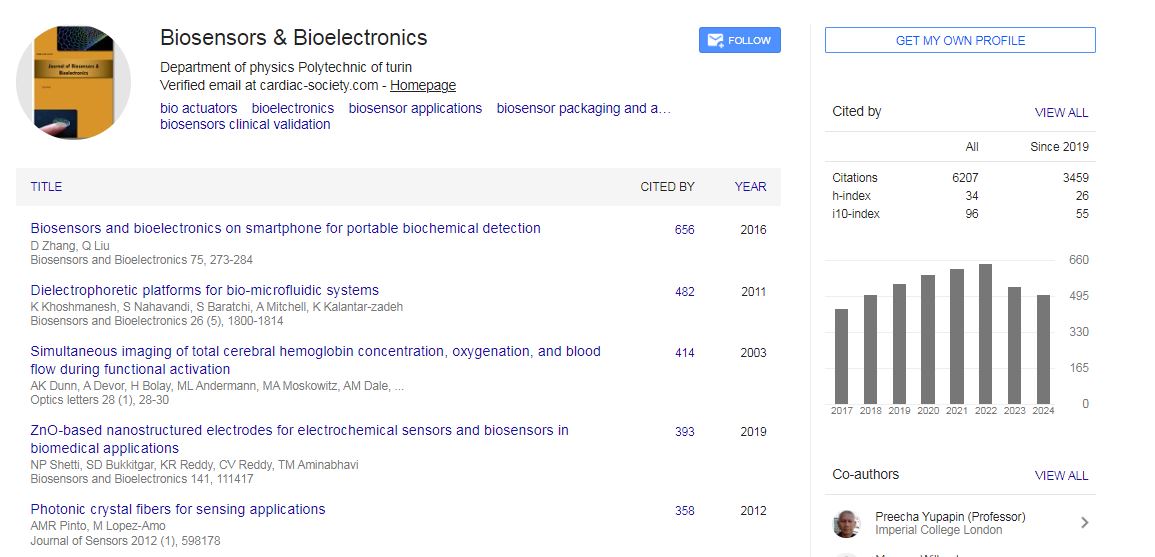
Biosensors & Bioelectronics received 6207 citations as per Google Scholar report