Perspective - (2025) Volume 15, Issue 5
Received: 01-Sep-2025, Manuscript No. jtese-26-184252;
Editor assigned: 03-Sep-2025, Pre QC No. P-184252;
Reviewed: 17-Sep-2025, QC No. Q-184252;
Revised: 22-Sep-2025, Manuscript No. R-184252;
Published:
29-Sep-2025
, DOI: 10.37421/2165-8064.2025.15.675
Citation: Petrov, Stefan. ”Bio-Based Alternatives Drive Sustainable Textile Wet Processing.” J Textile Sci Eng 15 (2025):675.
Copyright: © 2025 Petrov S. This is an open-access article distributed under the terms of the Creative Commons Attribution License, which permits unrestricted use, distribution and reproduction in any medium, provided the original author and source are credited.
The textile industry stands at a critical juncture, facing increasing pressure to mitigate its environmental footprint and embrace sustainable practices. The conventional wet processing of textiles, encompassing dyeing, finishing, and pretreatment, has historically relied on a significant consumption of water, energy, and harsh chemicals, leading to considerable pollution. In response to these challenges, a paradigm shift towards bio-based alternatives is gaining momentum, offering a pathway to a more eco-conscious and circular textile economy [1].
The exploration of bio-based chemicals in textile wet processing is driven by their inherent advantages, including reduced environmental impact and enhanced biodegradability. These renewable resources present a viable alternative to their petroleum-based counterparts, promising a reduction in the ecological burden associated with textile production [1].
Recent advancements have focused on leveraging agricultural byproducts for the creation of novel bio-auxiliaries. These innovative materials are demonstrating efficacy in processes like cotton dyeing, where they can improve dye uptake and fixation while simultaneously reducing the consumption of water and energy compared to traditional synthetic agents [2].
Enzymatic solutions are another significant area of development, offering a green alternative to the often harsh chemical treatments used in textile wet processing. Enzymes can be effectively employed in desizing, scouring, bleaching, and finishing, characterized by their high specificity and mild operating conditions [3].
Biopolymers, such as chitosan derived from chitin, are emerging as versatile finishing agents. Their application to fabrics can impart desirable functional properties, including antimicrobial and antistatic characteristics, contributing to the development of eco-friendly textiles with enhanced performance [4].
The integration of bioplastics and biodegradable polymers into textile coating and lamination processes is also a key focus. These materials help reduce reliance on petroleum-based plastics and improve the end-of-life options for textile products, fostering a more sustainable approach to composite materials [5].
Bio-based surfactants, developed from renewable sources, are being evaluated for their performance in textile scouring and washing. These eco-friendly alternatives offer comparable or superior cleaning capabilities to conventional surfactants, with the added benefit of better biodegradability and lower ecotoxicity [6].
Natural dyes, derived from plant-based extracts, are being explored as a sustainable alternative for textile coloration. While challenges such as color fastness exist, ongoing research aims to improve their application and performance, catering to the growing consumer demand for naturally colored textiles [7].
Furthermore, the development of bio-based crosslinking agents is crucial for creating formaldehyde-free textile finishing. These agents can impart durable press properties to fabrics, offering safer and more sustainable solutions compared to traditional formaldehyde-based compounds [8].
The overarching imperative for adopting bio-based alternatives in textile wet processing stems from the need to significantly reduce the environmental footprint. By quantifying reductions in chemical usage, water consumption, and wastewater pollution, the transition to a circular and sustainable textile economy can be accelerated through policy support and industry collaboration [9].
The transformative potential of bio-based chemicals in textile wet processing is a central theme, with a focus on their contribution to achieving sustainability goals. These renewable resources offer advantages such as reduced environmental impact and biodegradability, finding applications in dyeing, finishing, and pretreatment stages. Research is actively exploring advancements and future prospects for integrating these eco-friendly alternatives into mainstream textile production, addressing challenges through dedicated research and development [1].
A study has investigated the efficacy of novel bio-based auxiliaries derived from agricultural waste for cotton dyeing. The findings demonstrate that these bio-auxiliaries can enhance dye uptake, fixation, and wash fastness, while significantly decreasing water and energy consumption when compared to conventional synthetic counterparts. This research underscores the economic and environmental benefits of valorizing agricultural byproducts for textile applications [2].
Another significant area of exploration involves the application of enzymes in textile wet processing as a green alternative to harsh chemical treatments. This review covers enzymatic desizing, scouring, bleaching, and finishing, highlighting their high specificity, mild operating conditions, and biodegradability. The authors discuss the challenges and opportunities for adopting enzyme technology, including cost-effectiveness and process optimization, to foster a more sustainable textile industry [3].
The use of chitosan, a biopolymer derived from chitin, in textile finishing for improved functional properties is also under investigation. Methods for applying chitosan to fabrics to impart antimicrobial, antistatic, and wrinkle-resistant characteristics are presented. The study highlights chitosan's potential as a sustainable and versatile finishing agent, contributing to the development of eco-friendly textiles with enhanced performance [4].
The integration of bioplastics and biodegradable polymers in textile coating and lamination processes is examined. The advantages of these materials in reducing reliance on petroleum-based plastics and improving the end-of-life options for textiles are discussed. Current technologies and future directions for developing sustainable textile composites are reviewed [5].
Research has focused on developing and evaluating bio-based surfactants for textile scouring and washing applications. The results show that these surfactants, derived from renewable sources, provide cleaning performance comparable to or better than conventional synthetic surfactants, while exhibiting improved biodegradability and lower ecotoxicity. This study contributes to the move towards more environmentally benign textile chemicals [6].
The use of plant-derived extracts as natural dyes for textile coloration is explored. Challenges associated with natural dyes, such as color fastness and reproducibility, are discussed, along with strategies for enhancing their application and performance. The authors emphasize the increasing consumer demand for naturally colored textiles and the potential of bio-based dyes to sustainably meet this demand [7].
In textile finishing, the synthesis and application of bio-based crosslinking agents are being investigated as replacements for formaldehyde-based agents. The performance of these bio-crosslinkers in imparting durable press properties to cotton fabrics is evaluated, demonstrating comparable or improved wrinkle recovery with significantly reduced toxicity. The research emphasizes the development of safer and more sustainable textile finishing solutions [8].
The environmental impacts of conventional textile wet processing and the necessity of adopting bio-based alternatives are reviewed. The potential reduction in chemical usage, water consumption, and wastewater pollution achievable through the implementation of bio-based chemicals is quantified. The authors advocate for policy support and industry collaboration to expedite the transition to a circular and sustainable textile economy [9].
Finally, the potential of microbial fermentation to produce platform chemicals for textile applications, such as organic acids and biosurfactants, is explored. The advantages of using renewable feedstocks and controlled fermentation processes to generate high-value chemicals with a reduced environmental burden are highlighted. This research positions bio-based chemical production as a key strategy for a sustainable textile industry [10].
This collection of research explores the growing importance and application of bio-based alternatives in the textile industry, particularly in wet processing. Studies highlight the development and efficacy of bio-based chemicals, auxiliaries, enzymes, biopolymers, surfactants, natural dyes, and crosslinking agents. These innovations aim to reduce the environmental impact of textile production by minimizing chemical usage, water and energy consumption, and pollution. The research emphasizes the benefits of using renewable resources, valorizing agricultural waste, and employing processes like microbial fermentation. Key advantages include biodegradability, lower ecotoxicity, and enhanced functional properties for textiles. The overall objective is to drive the transition towards a more sustainable and circular textile economy, addressing challenges through ongoing research and development and advocating for supportive policies and industry collaboration.
None
None
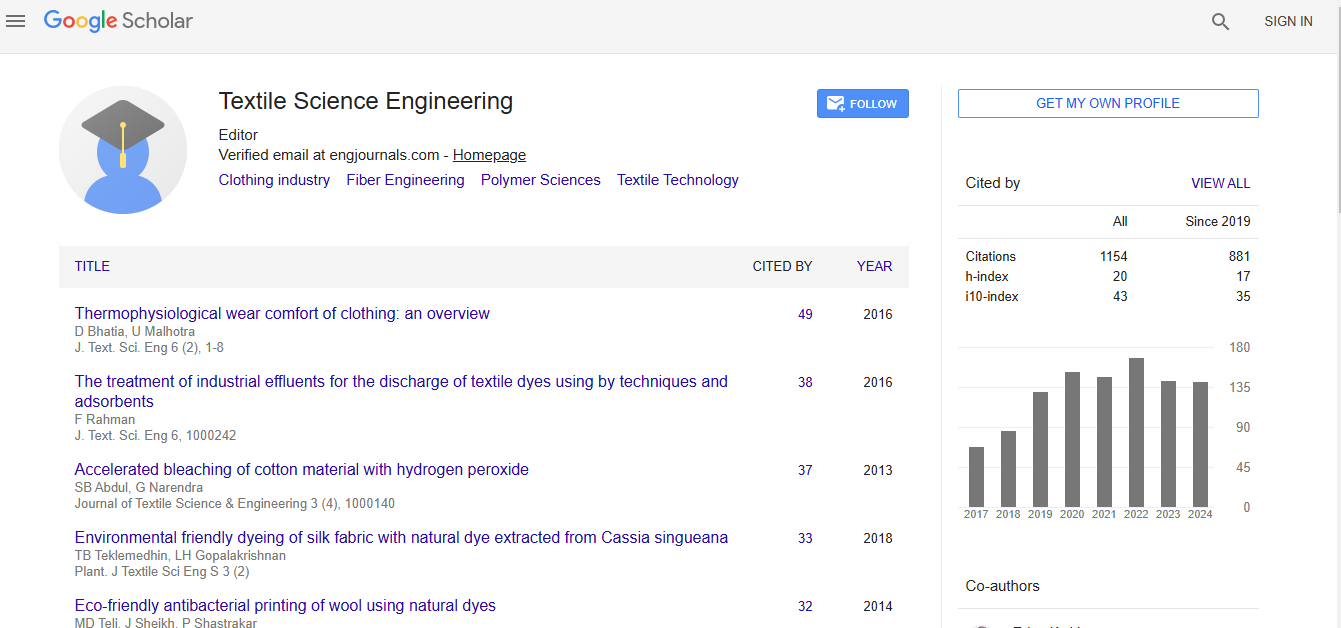
Journal of Textile Science & Engineering received 1008 citations as per Google Scholar report