Opinion - (2025) Volume 17, Issue 5
Received: 02-Oct-2025, Manuscript No. jbabm-26-182357;
Editor assigned: 05-Oct-2025, Pre QC No. P-182357;
Reviewed: 19-Oct-2025, QC No. Q-182357;
Revised: 23-Oct-2025, Manuscript No. R-182357;
Published:
30-Oct-2025
, DOI: 10.37421/1948-593X.2025.17.515
Citation: Silva, Beatriz M.. ”Bioanalytical Methods: Understanding Drug-Drug Interactions.” J Bioanal Biomed 17 (2025):515.
Copyright: © 2025 Silva M. Beatriz This is an open-access article distributed under the terms of the Creative Commons Attribution License, which permits unrestricted use, distribution and reproduction in any medium, provided the original author and source are credited.
Evaluating drug-drug interactions (DDIs) is a critical aspect of ensuring the safety and efficacy of pharmacotherapy. Bioanalytical methods are instrumental in this process, enabling the precise quantification of drug concentrations in biological matrices. This article explores various bioanalytical techniques utilized in DDI studies, focusing on their application in understanding pharmacokinetic and pharmacodynamic alterations induced by co-administered drugs. Key methodologies such as liquid chromatography-mass spectrometry (LC-MS/MS), gas chromatography-mass spectrometry (GC-MS), and immunoassay-based methods are discussed, alongside considerations for their validation and implementation in clinical and preclinical settings [1].
The accurate determination of drug and metabolite concentrations within complex biological matrices is paramount for comprehensive DDI studies. LC-MS/MS has emerged as the benchmark technique due to its exceptional sensitivity, selectivity, and high throughput capabilities. This section will delve into the specific applications of LC-MS/MS in quantifying drugs and their metabolites, identifying metabolic pathways impacted by co-medications, and characterizing the enzyme kinetics that underpin DDIs. Furthermore, it will address challenges like matrix effects and ion suppression, along with strategies to mitigate them [2].
Beyond the dominance of LC-MS/MS, other bioanalytical platforms offer unique advantages for specific DDI assessment scenarios. Immunoassays, for instance, can provide rapid screening and quantification of drugs, particularly in high-throughput environments. This part of the discussion will cover the fundamental principles, diverse applications, and inherent limitations of immunoassay-based techniques in DDI research, including their potential for point-of-care testing. Crucial considerations for assay validation and the management of cross-reactivity will also be examined [3].
Drug metabolism, particularly by cytochrome P450 (CYP) enzymes, stands as a primary driver of DDIs. Bioanalytical methods are indispensable for identifying which CYP isoforms are involved in drug metabolism and how their activity is modulated by co-administered drugs. This section will elaborate on the techniques employed for probing CYP phenotyping and inhibition studies, including the use of specific probe substrates and the analysis of their resultant metabolites via LC-MS/MS. A thorough understanding of these interactions is vital for informed drug development and effective clinical practice [4].
The validation of bioanalytical methods specifically for DDI studies necessitates stringent adherence to established regulatory guidelines. This section will meticulously detail the critical parameters that define method validation, encompassing accuracy, precision, selectivity, sensitivity, stability, and recovery. Ensuring the robustness and unwavering reliability of these methods is essential for generating data that can substantiaterequirementsgulatory submissions and guide clinical decision-making. Common pitfalls encountered during validation and best practices for overcoming them will also be thoroughly discussed [5].
Drug transporters, including prominent examples like P-glycoprotein (P-gp) and organic anion transporters (OATs), are increasingly recognized for their substantial role in DDIs. Bioanalytical methods are employed to accurately quantify drug concentrations at transporter interfaces and to rigorously assess the impact of inhibitors or inducers on transporter activity. This section will explore the various techniques used to investigate drug-substrate interactions with transporters and elucidate their profound implications for drug disposition and overall therapeutic efficacy [6].
The inherent complexity of biological samples encountered in DDI studies, such as plasma, urine, and tissue homogenates, presents unique analytical challenges. This section will focus on effective strategies for sample preparation, including techniques like protein precipitation, liquid-liquid extraction, and solid-phase extraction. These methods are designed to remove interfering substances and selectively enrich analytes, thereby significantly impacting assay performance and the overall reliability of the generated DDI data [7].
Pharmacogenomics plays a notable role in modulating individual drug responses and susceptibility to DDIs. Although not strictly a bioanalytical method itself, the understanding of genetic variations in drug-metabolizing enzymes and transporters is frequently integrated with bioanalytical data. This integration provides a more comprehensive understanding of DDI mechanisms. This section will briefly touch upon the synergistic relationship between pharmacogenomic information and bioanalytical findings in the context of personalized medicine and DDI risk assessment [8].
The continuous evolution of bioanalytical technologies, including advancements in high-resolution mass spectrometry and the development of microfluidic devices, is progressively enhancing the capabilities for DDI evaluation. This section will offer a forward-looking perspective on emerging trends within bioanalytical science. It will highlight the potential for real-time monitoring of drug concentrations and interactions, as well as the application of artificial intelligence for sophisticated data analysis and the prediction of DDIs [9].
In conclusion, bioanalytical methods are unequivocally indispensable tools for the thorough characterization of the intricate interplay involved in drug-drug interactions. From well-established techniques like LC-MS/MS to cutting-edge emerging technologies, these methods provide the essential quantitative data required to rigorously assess drug safety and efficacy. The accurate and meticulously validated bioanalysis of drugs and their metabolites within biological matrices facilitates a profound understanding of the pharmacokinetic and pharmacodynamic alterations induced by co-medications, ultimately contributing to significant improvements in patient outcomes [10].
Evaluating drug-drug interactions (DDIs) is a crucial component of safe and effective pharmacotherapy. Bioanalytical methods are pivotal in this assessment, enabling precise quantification of drug concentrations in biological matrices. This article examines various bioanalytical techniques used in DDI studies, highlighting their applications in understanding pharmacokinetic and pharmacodynamic changes induced by co-administered drugs. Key methodologies include liquid chromatography-mass spectrometry (LC-MS/MS), gas chromatography-mass spectrometry (GC-MS), and immunoassay-based methods, with considerations for their validation and implementation in clinical and preclinical settings [1].
The accurate determination of drug and metabolite concentrations in complex biological matrices is paramount for DDI studies. LC-MS/MS has emerged as the gold standard due to its high sensitivity, selectivity, and throughput. This section explores the application of LC-MS/MS in quantifying drugs and their metabolites, identifying metabolic pathways affected by co-medications, and characterizing enzyme kinetics underpinning DDIs. Specific challenges, such as matrix effects and ion suppression, are also addressed, along with strategies to mitigate them [2].
Beyond LC-MS/MS, other bioanalytical platforms offer distinct advantages for specific DDI assessment scenarios. Immunoassays, for instance, can provide rapid screening and quantification of drugs, particularly in high-throughput settings. This part of the discussion covers the principles, applications, and limitations of immunoassay-based techniques in DDI research, including their potential for point-of-care testing. Considerations for assay validation and cross-reactivity are also examined [3].
Drug metabolism, particularly by cytochrome P450 (CYP) enzymes, is a primary driver of DDIs. Bioanalytical methods are essential for identifying which CYP isoforms are involved in drug metabolism and how their activity is altered by co-administered drugs. This section elaborates on techniques used to probe CYP phenotyping and inhibition studies, including the use of specific probe substrates and the analysis of their metabolites using LC-MS/MS. Understanding these interactions informs drug development and clinical practice [4].
The validation of bioanalytical methods for DDI studies requires rigorous adherence to regulatory guidelines. This section details the critical parameters for method validation, including accuracy, precision, selectivity, sensitivity, stability, and recovery. Ensuring the robustness and reliability of these methods is essential for generating data that can support regulatory submissions and inform clinical decision-making. Common pitfalls and best practices in validation are discussed [5].
Drug transporters, such as P-glycoprotein (P-gp) and organic anion transporters (OATs), are increasingly recognized for their significant role in DDIs. Bioanalytical methods are employed to quantify drug concentrations at transporter interfaces and to assess the impact of inhibitors or inducers on transporter activity. This section covers techniques used to study drug-substrate interactions with transporters and their implications for drug disposition and efficacy [6].
The complexity of biological samples in DDI studies, such as plasma, urine, and tissue homogenates, presents unique challenges for bioanalytical analysis. This section discusses strategies for sample preparation, including protein precipitation, liquid-liquid extraction, and solid-phase extraction, to remove interfering substances and enrich analytes. The choice of sample preparation technique significantly impacts assay performance and the reliability of DDI data [7].
Pharmacogenomics plays a role in modulating drug response and susceptibility to DDIs. While not strictly a bioanalytical method, understanding genetic variations in drug-metabolizing enzymes and transporters is often integrated with bioanalytical data to provide a comprehensive picture of DDI mechanisms. This section touches upon the synergy between pharmacogenomic information and bioanalytical findings in personalized medicine and DDI risk assessment [8].
The development of novel bioanalytical technologies, such as high-resolution mass spectrometry and microfluidic devices, continues to enhance the capabilities for DDI evaluation. This section provides a forward-looking perspective on emerging trends in bioanalytical science, including the potential for real-time monitoring of drug concentrations and interactions, and the application of artificial intelligence for data analysis and prediction of DDIs [9].
In summary, bioanalytical methods are indispensable tools for characterizing the complex interplay of drug-drug interactions. From established techniques like LC-MS/MS to emerging technologies, these methods provide the quantitative data necessary to assess safety and efficacy. The accurate and validated bioanalysis of drugs and their metabolites in biological matrices allows for a deeper understanding of the pharmacokinetic and pharmacodynamic alterations induced by co-medications, ultimately contributing to improved patient outcomes [10].
This collection of articles comprehensively explores the pivotal role of bioanalytical methods in understanding and managing drug-drug interactions (DDIs). It highlights the importance of precise quantification of drug concentrations in biological matrices for assessing pharmacokinetic and pharmacodynamic changes induced by co-administered drugs. Key techniques discussed include LC-MS/MS, GC-MS, and immunoassays, emphasizing their applications, challenges, and validation requirements. The content also delves into the involvement of drug metabolism by CYP enzymes and drug transporters in DDIs, presenting bioanalytical strategies to probe these interactions. Furthermore, it touches upon the integration of pharmacogenomics and the emergence of novel bioanalytical technologies, offering a forward-looking perspective. Ultimately, these bioanalytical tools are presented as indispensable for characterizing DDIs, ensuring drug safety, and improving patient outcomes.
None
None
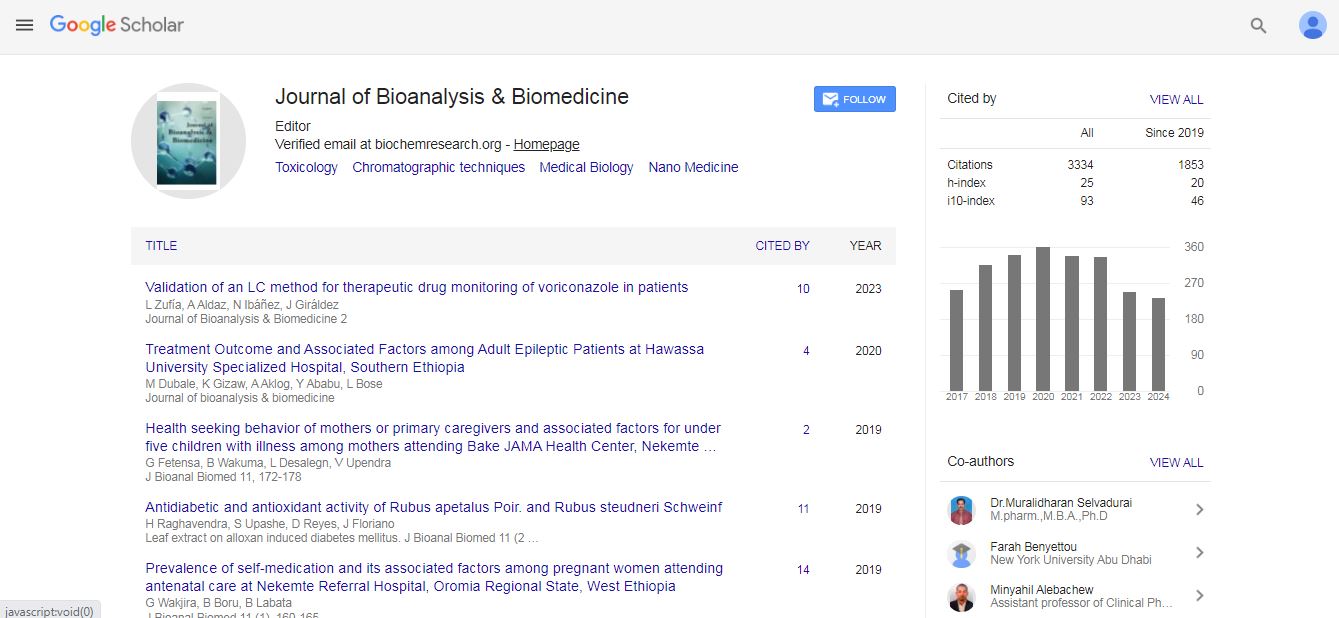
Journal of Bioanalysis & Biomedicine received 3099 citations as per Google Scholar report