Opinion - (2025) Volume 17, Issue 5
Received: 02-Oct-2025, Manuscript No. jbabm-26-182358;
Editor assigned: 05-Oct-2025, Pre QC No. P-182358;
Reviewed: 19-Oct-2025, QC No. Q-182358;
Revised: 23-Oct-2025, Manuscript No. R-182358;
Published:
30-Oct-2025
, DOI: 10.37421/1948-593X.2025.17.516
Citation: Kim, Seong-Min. ”Bioanalysis: Key to Toxicological Risk Assessment.” J Bioanal Biomed 17 (2025):516.
Copyright: © 2025 Kim S. This is an open-access article distributed under the terms of the Creative Commons Attribution License, which permits unrestricted use, distribution and reproduction in any medium, provided the original author and source are credited.
Bioanalysis stands as a cornerstone in the complex field of toxicological risk assessment, offering indispensable quantitative data concerning xenobiotic exposure, metabolic pathways, and the overall disposition of foreign compounds within biological systems. Its role is paramount in elucidating the intricate interactions between xenobiotics and living organisms, thereby enabling informed decisions regarding potential health and environmental impacts. The sophisticated application of techniques, most notably mass spectrometry seamlessly integrated with various chromatographic methods, is crucial for the precise identification and quantification of toxicants present in diverse biological matrices. This analytical rigor directly informs the establishment of dose-response relationships, a fundamental aspect of toxicology, and significantly contributes to understanding the underlying mechanisms by which toxicity manifests. Consequently, bioanalysis empowers more accurate predictions of adverse health effects in both human populations and the broader environment, underpinning the development of effective safety measures and regulatory frameworks [1].
In the specialized domain of pharmaceutical toxicology, bioanalytical methodologies are of utmost importance for thoroughly characterizing the metabolism of drugs and their pharmacokinetic profiles. These characteristics are intrinsically linked to potential toxicological outcomes, making precise measurement and interpretation vital. Through rigorous bioanalysis, potential drug-induced toxicities can be identified at the earliest stages of pharmaceutical development, thereby safeguarding patient safety and ensuring the development of therapeutically beneficial and safe medications. This critical process involves the highly sensitive detection of both the parent drug compounds and their various metabolites within a range of biological fluids, providing a comprehensive view of the drug's journey through the body [2].
Significant advancements in bioanalytical technologies are actively revolutionizing the landscape of toxicological risk assessment, offering unprecedented capabilities and efficiencies. Innovations such as high-resolution mass spectrometry, capable of detecting and quantifying substances at extremely low concentrations with high specificity, and microfluidics, which allows for the manipulation of minute fluid volumes and miniaturization of analytical processes, are at the forefront of these changes. These cutting-edge tools collectively enable higher throughput in analytical workflows, improved sensitivity for detecting trace analytes, and the capacity to analyze highly complex biological samples with enhanced accuracy. The cumulative effect of these technological strides is the generation of more comprehensive toxicological profiles and the refinement of risk assessment strategies, leading to a more robust understanding of chemical safety [3].
The accurate interpretation of bioanalytical data is absolutely crucial for the establishment of reliable exposure levels and for correlating these levels with observed toxicological endpoints. This process necessitates a profound and comprehensive understanding of several key scientific disciplines, including the principles and practices of analytical method validation, the complexities of toxicokinetics (the study of how a substance is absorbed, distributed, metabolized, and excreted by the body), and toxicodynamics (the study of the biochemical and physiological effects of poisons). Ultimately, precise and dependable bioanalytical measurements serve as the fundamental bedrock upon which sound and defensible risk management decisions are made, ensuring that regulatory actions are based on solid scientific evidence [4].
Bioanalysis plays an instrumental role in the successful execution and interpretation of biomonitoring programs, which are designed to assess human exposure to environmental toxicants. By accurately measuring specific biomarkers in collected biological samples, such as blood or urine, scientists can reliably estimate the internal dose of a toxicant that individuals have received. This allows for the identification of the primary sources contributing to environmental exposure, and importantly, provides a means to evaluate the effectiveness of implemented risk mitigation strategies. The data generated from these biomonitoring efforts directly informs and guides the development of public health policies aimed at protecting populations from the adverse effects of environmental pollutants [5].
Within the specific context of occupational toxicology, bioanalysis is an essential tool for the effective monitoring of worker exposure to potentially hazardous substances encountered in the workplace. The quantitative measurement of specific analytes in biological samples, such as blood or urine, provides a direct and unequivocal indication of the absorbed dose received by an individual. This information is critical for accurately assessing the risks associated with workplace exposures and for the timely and effective implementation of preventative measures and safety protocols. Such monitoring is vital for maintaining a safe working environment and protecting the health of employees [6].
The successful development and rigorous validation of sensitive and specific bioanalytical methods are absolutely critical for achieving accurate and reliable toxicological risk assessment. These methods must possess a high degree of robustness to effectively handle the inherent complexities of biological matrices, which often contain a vast array of interfering substances, and to consistently detect analytes even at trace levels. The meticulous process of method validation serves to unequivocally ensure that the data generated by these methods is trustworthy, reproducible, and fit for its intended purpose, particularly in the context of regulatory decision-making processes where scientific accuracy is paramount [7].
Bioanalysis significantly contributes to a deeper understanding of the toxicological mechanisms of action by which chemicals exert their adverse effects. By enabling the profiling of various metabolites produced by the body and the identification of specific biomarkers that indicate exposure or biological effect, researchers gain invaluable insights. This analytical capability allows for the elucidation of the precise ways in which a substance interacts with complex biological systems at a molecular and cellular level. Such detailed mechanistic understanding moves beyond simple dose-response relationships, providing a more nuanced and comprehensive appreciation of chemical toxicity [8].
The application of bioanalytical methodologies in non-clinical toxicology studies is of paramount importance for generating the essential data required for regulatory submissions, particularly for new pharmaceutical products. This includes the precise determination of drug concentrations within target tissues and systemic circulation (plasma), as well as a thorough understanding of the compound's absorption, distribution, metabolism, and excretion (ADME) properties. These ADME parameters are foundational to assessing the overall safety and potential efficacy of a drug candidate, forming a critical part of the preclinical safety evaluation package [9].
Bioanalytical data serves as an integral component in the scientific process of establishing safe exposure limits and deriving acceptable daily intakes (ADIs) for various chemicals. By accurately measuring exposure levels within relevant human populations and meticulously linking these exposure data to observed toxicological effects, regulatory bodies are empowered to set science-based guidelines and standards. These guidelines are crucial for protecting public health from the potential risks posed by exposure to a wide range of chemicals in the environment and in consumer products [10].
Bioanalysis plays a pivotal role in toxicological risk assessment, providing crucial quantitative insights into xenobiotic exposure, metabolism, and disposition. This involves employing advanced techniques like mass spectrometry coupled with chromatography to identify and quantify toxicants in biological samples, which is essential for establishing dose-response relationships and understanding toxicity mechanisms. Such analyses enable more accurate predictions of adverse health effects on humans and the environment [1].
In pharmaceutical toxicology, bioanalytical methods are indispensable for characterizing drug metabolism and pharmacokinetic profiles, direct determinants of toxicological outcomes. The accurate application of bioanalysis ensures early identification of potential drug-induced toxicities, thus safeguarding patient safety by meticulously detecting parent drugs and their metabolites in various biological fluids [2].
Modern bioanalytical technologies, including high-resolution mass spectrometry and microfluidics, are transforming toxicological risk assessment. These innovations facilitate higher throughput, enhance sensitivity, and improve the accuracy of analyzing complex biological samples. This ultimately leads to the generation of more comprehensive toxicological profiles and the refinement of risk assessment methodologies [3].
The interpretation of bioanalytical data is critical for establishing exposure levels and correlating them with toxicological endpoints. This requires a robust understanding of analytical method validation, toxicokinetics, and toxicodynamics, forming the basis for sound risk management decisions grounded in precise bioanalytical measurements [4].
Bioanalysis is central to biomonitoring programs designed to assess human exposure to environmental toxicants. By measuring biomarkers in biological samples, scientists can estimate internal doses, identify exposure sources, and evaluate the efficacy of risk mitigation strategies, thereby directly informing public health policies [5].
In occupational toxicology, bioanalysis is vital for monitoring worker exposure to hazardous substances. Measuring specific analytes in blood or urine provides direct evidence of absorbed dose, enabling risk assessment and the implementation of preventative measures to ensure workplace safety [6].
The development and validation of sensitive and specific bioanalytical methods are paramount for accurate toxicological risk assessment. These methods must be robust enough to handle complex biological matrices and detect analytes at trace levels, ensuring the reliability of data for regulatory decision-making [7].
Bioanalysis contributes significantly to understanding the mechanisms of toxicity by enabling the profiling of metabolites and identification of biomarkers of exposure or effect. This facilitates the elucidation of how substances interact with biological systems, providing a deeper insight into toxicity beyond simple dose-response curves [8].
The application of bioanalysis in non-clinical toxicology studies is crucial for regulatory submissions, involving the determination of drug concentrations, and understanding ADME properties, which are foundational for assessing safety and efficacy [9].
Bioanalytical data is integral to establishing exposure limits and deriving acceptable daily intakes for chemicals. Accurate measurement of exposure levels and their correlation with toxicological effects allow regulatory bodies to set science-based guidelines for public health protection [10].
Bioanalysis is a critical component of toxicological risk assessment, providing quantitative data on xenobiotic exposure and metabolism. Advanced techniques like mass spectrometry and chromatography are essential for identifying and quantifying toxicants, informing dose-response relationships and toxicity mechanisms. This is vital in pharmaceutical toxicology for drug safety, and in environmental and occupational health for biomonitoring and exposure assessment. The development and validation of sensitive bioanalytical methods are crucial for reliable data generation, enabling the establishment of exposure limits and informed risk management decisions. Bioanalysis also aids in understanding toxicological mechanisms and supports regulatory submissions by characterizing ADME properties.
None
None
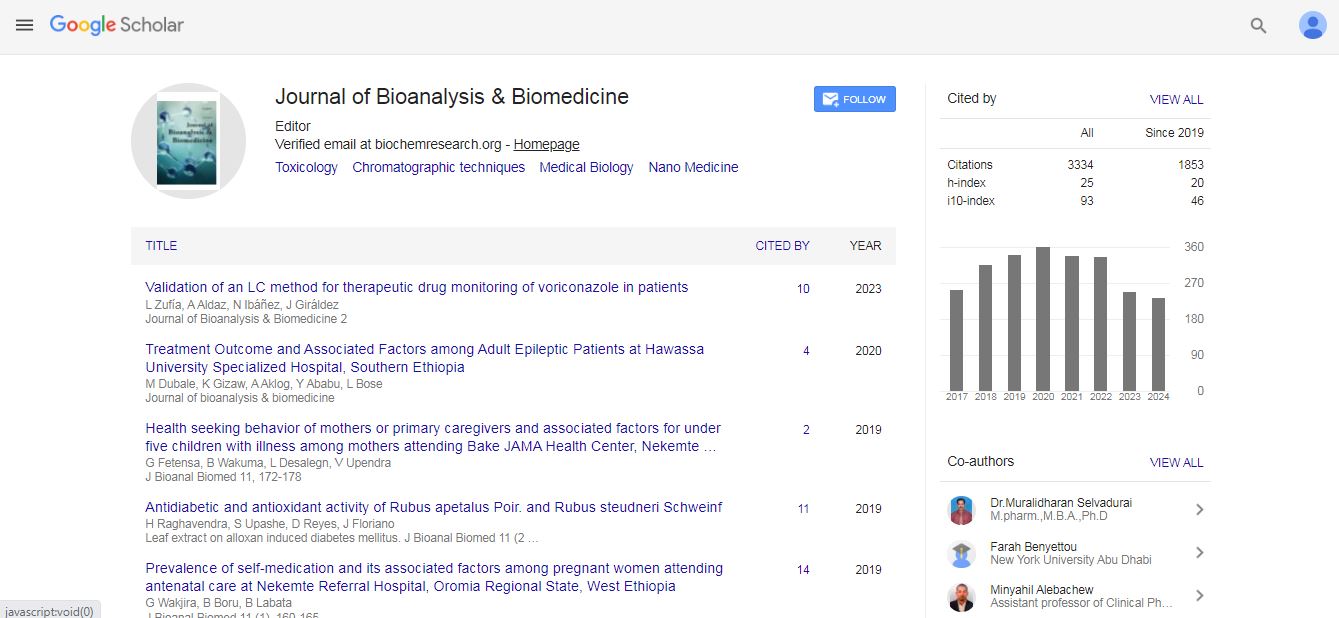
Journal of Bioanalysis & Biomedicine received 3099 citations as per Google Scholar report