Short Communication - (2025) Volume 16, Issue 3
Received: 29-May-2025, Manuscript No. gjto-25-175448;
Editor assigned: 02-Feb-0025, Pre QC No. P-175448;
Reviewed: 16-Jun-2025, QC No. QC-175448;
Revised: 23-Jun-2025, Manuscript No. R-175448;
Published:
30-Jun-2025
, DOI: 10.37421/2229-8711.2025.16.452
Citation: Benali, Samira. ”Big Data Analytics: Reshaping Diverse Industries.” Global J Technol Optim 16 (2025):452.
Copyright: © 2025 Benali S. This is an open-access article distributed under the terms of the Creative Commons Attribution License, which permits unrestricted use, distribution
and reproduction in any medium, provided the original author and source are credited.
Big Data Analytics (BDA) has emerged as a transformative force across virtually every sector, fundamentally altering how organizations operate, innovate, and make decisions. This review synthesizes insights from multiple studies to illustrate the pervasive application and profound impact of BDA. It involves examining large, varied datasets to uncover hidden patterns, trends, and valuable information that drives informed decisions. The sheer volume, velocity, and variety of data generated today necessitate sophisticated analytical techniques to extract meaningful value, making BDA a crucial discipline for future advancements. In smart manufacturing, big data analytics is truly at its core. This paper lays out how manufacturers are actually using big data, looking at what's working well and where the tricky parts are. It points to future directions, suggesting areas like predictive maintenance for machinery and real-time process optimization are where we'll see significant growth, improving efficiency and reducing downtime [1].
Healthcare is another sector where big data analytics is making a real difference. This review looks at how BDA is being applied, covering everything from improving patient care and diagnostics to managing hospital operations more effectively. It highlights the potential for personalized medicine, tailoring treatments to individuals, and preventing diseases through early identification, which is pretty impactful [2].
Financial services are getting a major overhaul thanks to big data. This review specifically examines how big data analytics is being used, especially with an eye towards sustainability in the sector. It shows how institutions use data for crucial fraud detection, robust risk management, and understanding customer behavior, ultimately leading to smarter, more responsible financial practices [3].
Supply chains today need to be tough and green. This paper dives into how big data analytics is playing a huge role in making them both sustainable and resilient. It talks about using data to predict disruptions, optimize logistics for efficiency, and reduce environmental impact, giving us a roadmap for future research in this vital area [4].
For anyone wanting a solid understanding of big data analytics, this review is a great starting point. It covers the essential tools and techniques people are using, points out the common hurdles like data quality and privacy, and gives a good sense of where the field is heading next. It really paints a clear picture of the BDA landscape [5].
Making cities smarter isn't just a dream; it's happening, and big data analytics is a huge part of it. This paper explores the opportunities, like optimizing traffic and public services, but also confronts the challenges involved. It offers insights into how we can effectively use data to build more livable and efficient urban environments [6].
Education is changing, and big data analytics is right in the middle of it. This systematic review looks at how data is being used to personalize learning, improve teaching methods, and even manage educational institutions better. It really shows how analytics can shape the future of learning for students and educators alike [7].
Smart agriculture is critical for feeding a growing population, and big data analytics is making it happen. This paper reviews the new technologies, what they're being used for, and the hurdles we need to overcome. It highlights how data can optimize crop yields, manage resources, and make farming more efficient and sustainable [8].
The energy sector is in constant motion, and big data analytics is really transforming it. This paper gives a thorough look at how data can optimize energy grids, predict demand, and integrate renewables more effectively. It covers the opportunities, the tough challenges, and the practical applications, showing a path towards more sustainable and efficient energy systems [9].
Ever wonder how travel companies know what you want before you do? Big data analytics is the secret. This review shows how data is being used in tourism to understand customer preferences, personalize experiences, and optimize operations. It also lays out some interesting future research areas, which is pretty neat [10].
Big Data Analytics (BDA) stands as a foundational technology driving innovation and efficiency across diverse global sectors. Its core capability lies in processing vast, complex datasets to extract actionable insights, moving beyond traditional data processing limitations. The applications of BDA are widespread, touching everything from industrial operations to public services and personal experiences. This section delves into the specific ways BDA is being applied, highlighting its transformative potential and the challenges that accompany its implementation. The pervasive nature of data generation in the modern era has made BDA an indispensable tool for future-proofing industries and societies.
In smart manufacturing, BDA is proving to be a game-changer by optimizing production processes and enhancing operational intelligence. Manufacturers utilize BDA to analyze real-time data from machinery, sensors, and various stages of the supply chain. This comprehensive analysis allows for the identification of patterns indicative of potential equipment failures, enabling predictive maintenance strategies that significantly reduce downtime and maintenance costs. Beyond this, BDA facilitates real-time process optimization, ensuring production lines run at peak efficiency and product quality is consistently maintained. This systematic review clearly demonstrates how integrating BDA transforms manufacturing into a more responsive, efficient, and data-driven environment, addressing both current challenges and future opportunities for growth [1].
The healthcare industry is experiencing a profound shift due to the capabilities of big data analytics. BDA is applied across a spectrum of healthcare operations, from enhancing direct patient care to refining administrative processes. By analyzing extensive patient records, diagnostic imaging, and genetic data, BDA aids in more accurate diagnoses and the development of personalized treatment plans tailored to individual patient needs. Furthermore, it plays a vital role in managing hospital operations more effectively, optimizing resource allocation, reducing wait times, and improving overall service delivery. The potential for personalized medicine and proactive disease prevention through early risk assessment are areas where BDA promises significant, life-changing impact, pushing the boundaries of medical science and public health [2].
Financial services have embraced big data analytics to navigate complex markets and bolster security while pursuing sustainable practices. The sector generates colossal amounts of transaction data, market trends, and customer interactions daily, which BDA can parse for strategic advantage. One critical application is fraud detection, where BDA algorithms can identify anomalous patterns in transactions that signal fraudulent activity, significantly reducing financial losses. Simultaneously, BDA refines risk management strategies, providing deeper insights into market volatility and creditworthiness. Beyond these, understanding customer behavior through BDA enables financial institutions to offer personalized products and services, fostering stronger customer relationships. This drive towards data-informed decisions ultimately leads to smarter, more transparent, and responsible financial practices, aligning with broader sustainability goals [3].
The increasing complexity of global supply chains demands advanced solutions for both resilience and sustainability, and big data analytics provides many of these answers. BDA allows for comprehensive data collection and analysis across the entire network, offering unparalleled visibility. This analytical capability is instrumental in predicting potential disruptions and optimizing logistics by improving route efficiency, inventory management, and warehouse operations, leading to substantial cost reductions. Crucially, it contributes to environmental sustainability by identifying opportunities to reduce waste, lower energy consumption, and minimize the carbon footprint of operations. The ongoing research continues to refine these applications, creating more robust and environmentally conscious supply chains [4].
Beyond these specific sectors, big data analytics offers a comprehensive framework for understanding and addressing a wide range of societal and operational challenges. Its foundational tools and techniques, including distributed computing platforms and advanced machine learning algorithms, are continuously evolving. However, implementation is not without hurdles, such as ensuring data quality and integrity, addressing privacy and security, and overcoming the shortage of skilled professionals [5]. This broader scope includes optimizing urban environments, where BDA is pivotal for smart cities to manage traffic and public services [6]. In education, it revolutionizes learning by personalizing content and improving pedagogical approaches [7]. For agriculture, BDA enables precision farming, enhancing yields and resource efficiency [8]. The energy sector leverages BDA to optimize grids and integrate renewable sources [9]. Finally, in tourism, BDA personalizes customer experiences and streamlines operations, reflecting its versatility and indispensable role in modern enterprises [10].
Big Data Analytics (BDA) is fundamentally reshaping a wide array of industries by providing powerful tools for insight and optimization. In smart manufacturing, BDA is central to improving operational efficiency, enabling predictive maintenance, and streamlining real-time process optimization [C001]. Healthcare benefits significantly from BDA through enhanced patient care, more accurate diagnostics, and better hospital management, paving the way for personalized medicine and disease prevention [C002]. The financial services sector leverages BDA for robust fraud detection, advanced risk management, and a deeper understanding of customer behavior, fostering more sustainable and responsible practices [C003]. BDA is also crucial for building sustainable and resilient supply chains by predicting disruptions, optimizing logistics, and reducing environmental impact [C004]. Its application in smart cities helps optimize traffic flow and public services, contributing to more livable and efficient urban environments [C006]. Similarly, BDA is transforming education by enabling personalized learning experiences, refining teaching methods, and improving institutional management [C007]. In smart agriculture, BDA aids in optimizing crop yields, managing resources effectively, and promoting sustainable farming practices [C008]. The energy sector uses BDA to optimize grids, forecast demand, and integrate renewable sources, leading to more sustainable systems [C009]. Lastly, BDA is key to understanding customer preferences, personalizing experiences, and optimizing operations in tourism [C010]. Overall, these reviews offer a comprehensive look at the tools, techniques, challenges, and future prospects of BDA across these critical sectors [C005].
None
None
Muhammad I, Ghulam M, M. UA. "Big data analytics in smart manufacturing: A systematic review and future research directions".Journal of Manufacturing Systems 69 (2023):110-128.
Indexed at, Google Scholar, Crossref
V. S, R. SK, N. JN. "Applications of big data analytics in healthcare: A systematic review".Computers in Biology and Medicine 147 (2022):105671.
Indexed at, Google Scholar, Crossref
G. PS, S. KD, R. B. "Big data analytics in financial services: A systematic literature review".Journal of Cleaner Production 300 (2021):126989.
Indexed at, Google Scholar, Crossref
Mahla M, Mohammad HP, Seyed MS. "Big data analytics for supply chain sustainability and resilience: a systematic literature review and future research agenda".Annals of Operations Research 334 (2024):429-470.
Indexed at, Google Scholar, Crossref
Sachin K, Pradeep KS, Vivek S. "Big data analytics: A comprehensive review on tools, techniques, challenges and future prospects".Journal of Big Data 7 (2020):1-27.
Indexed at, Google Scholar, Crossref
J. L, P. Z, X. C. "Big Data Analytics for Smart Cities: A Review on Opportunities, Challenges, and Solutions".Sustainable Cities and Society 92 (2023):104443.
Indexed at, Google Scholar, Crossref
X. W, Y. L, S. L. "Big Data Analytics in Education: A Systematic Review".IEEE Access 9 (2021):13919-13936.
Indexed at, Google Scholar, Crossref
A. K, P. S, R. KA. "Big Data Analytics for Smart Agriculture: A Review of Emerging Technologies, Applications, and Challenges".Computers and Electronics in Agriculture 198 (2022):107052.
Indexed at, Google Scholar, Crossref
M. KS, A. K, V. KS. "Big data analytics for energy systems: A comprehensive review of opportunities, challenges, and applications".Renewable and Sustainable Energy Reviews 177 (2023):113171.
Indexed at, Google Scholar, Crossref
X. L, Y. L, A. L. "Big data analytics in tourism: A systematic review and research agenda".Tourism Management Perspectives 32 (2019):100589.
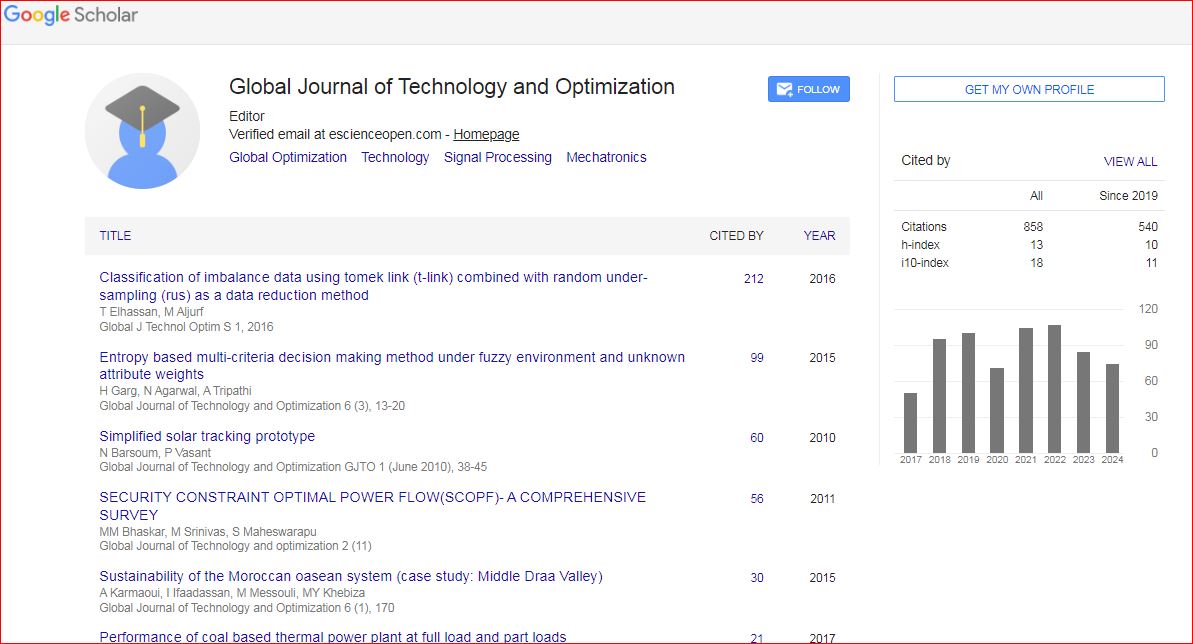
Global Journal of Technology and Optimization received 847 citations as per Google Scholar report