Commentary - (2025) Volume 9, Issue 5
Received: 01-Sep-2025, Manuscript No. hps-26-184489;
Editor assigned: 03-Sep-2025, Pre QC No. P-184489;
Reviewed: 17-Sep-2025, QC No. Q-184489;
Revised: 22-Sep-2025, Manuscript No. R-184489;
Published:
29-Sep-2025
, DOI: 10.37421/2573-4563.2025.9.370
Citation: Rao, Arjun P.. ”Beta-Cell Regeneration: A New Hope for Diabetes.” J Hepatol Pancreat Sci 09 (2025):370.
Copyright: © 2025 Rao P. Arjun This is an open-access article distributed under the terms of the Creative Commons Attribution License, which permits unrestricted use, distribution and reproduction in any medium, provided the original author and source are credited.
Beta-cell failure represents a critical pathological event in the progression of both type 1 and type 2 diabetes, marked by the gradual demise of insulin-producing beta cells. Understanding the intricate mechanisms that lead to beta-cell dysfunction and death, encompassing oxidative stress, inflammatory processes, glucolipotoxicity, and endoplasmic reticulum stress, is of paramount importance for developing effective therapeutic strategies. Recent scientific advancements have begun to elucidate the signaling pathways involved in promoting beta-cell regeneration and survival, thereby unveiling new therapeutic avenues for diabetes management. Extensive research is currently investigating the potential of various approaches, including the use of stem cells, growth factors, and small molecules, to restore beta-cell mass and functionality, with the ultimate goal of reversing or halting the advancement of diabetes. Significant progress has been made in understanding the molecular underpinnings of beta-cell dedifferentiation and loss, particularly in the context of type 2 diabetes. This knowledge highlights how chronic exposure to elevated glucose levels and lipid overload can trigger cellular stress responses that compromise insulin secretion and promote programmed cell death (apoptosis). Furthermore, the examination of emerging strategies for beta-cell regeneration has focused on the modulation of key signaling pathways that govern beta-cell proliferation and survival, offering promising targets for novel therapeutic interventions. The pivotal role of inflammation in the pathogenesis of beta-cell failure is a subject of critical examination. It has been established that pro-inflammatory cytokines, which are often found at elevated levels in individuals with metabolic diseases, directly contribute to beta-cell apoptosis and impaired function. Consequently, therapeutic approaches that target these inflammatory pathways, in conjunction with strategies aimed at enhancing beta-cell resilience, present a compelling dual strategy for managing diabetes by protecting existing beta cells and potentially stimulating their regenerative capacity. Investigating the potential of induced pluripotent stem cells (iPSCs) for beta-cell replacement therapy has opened a promising frontier. This research details the precise differentiation protocols required to generate functional beta-like cells from iPSCs and critically assesses the challenges that must be overcome, including ensuring cell survival, preventing immune rejection, and achieving long-term therapeutic efficacy. The findings derived from these studies offer a hopeful prospect for generating a sustainable and renewable source of insulin-producing cells for the treatment of diabetes. Oxidative stress has been identified as a significant contributor to the pathogenesis of beta-cell dysfunction, particularly in type 1 diabetes. The accumulation of reactive oxygen species (ROS) can inflict damage on crucial cellular components, leading to impaired insulin production and secretion. Therefore, research into protective strategies, such as the use of antioxidants and the maintenance of redox balance, is vital for preserving beta-cell health and function. The signaling pathways that orchestrate beta-cell regeneration are a key area of investigation, with a particular focus on the efficacy of GLP-1 receptor agonists. Studies have demonstrated that these agents possess the capability to promote beta-cell proliferation and enhance survival in preclinical models of diabetes. These findings strongly suggest that targeting the GLP-1 pathway represents a viable therapeutic strategy for augmenting beta-cell mass and improving overall beta-cell function. The detrimental effects of glucolipotoxicity on beta-cell function and survival are a growing concern. Chronic exposure to high concentrations of glucose and free fatty acids can induce significant cellular stress, including endoplasmic reticulum stress and mitochondrial dysfunction, ultimately culminating in beta-cell apoptosis. Understanding these mechanisms is crucial for developing interventions to mitigate these adverse impacts. Exploring the regenerative potential of various cell types for diabetes therapy, including pancreatic progenitor cells and mesenchymal stem cells, has yielded valuable insights. This research discusses their therapeutic advantages, the mechanisms through which they exert their effects, and the current limitations that impede their widespread clinical application. The ongoing efforts to translate these promising regenerative strategies into effective clinical practices for both type 1 and type 2 diabetes are a testament to their therapeutic promise. The regulatory role of microRNAs (miRNAs) in governing beta-cell function and survival is an active area of research. Identification of specific miRNAs that exhibit dysregulation in diabetic conditions and elucidation of their impact on key signaling pathways involved in beta-cell homeostasis are crucial. These findings suggest that miRNAs hold significant potential as therapeutic targets for the preservation of beta-cell function. The application of exosome-mediated delivery systems for therapeutic agents aimed at beta-cell regeneration presents an innovative approach. Exosomes derived from stem cells have shown promise in delivering specific cargo, such as proteins and RNA, that can promote beta-cell survival and enhance function. This research underscores the potential of exosomes as a novel and efficient delivery platform for regenerative medicine in the context of diabetes.
Beta-cell failure is recognized as a central pathological event in both type 1 and type 2 diabetes, characterized by the progressive decline in the population of insulin-producing beta cells. A comprehensive understanding of the mechanisms driving beta-cell dysfunction and death, including oxidative stress, inflammation, glucolipotoxicity, and endoplasmic reticulum stress, is essential for effective therapeutic interventions. Furthermore, recent breakthroughs have shed light on pathways that promote beta-cell regeneration and survival, opening up new avenues for treatment. Current research is exploring the potential of stem cells, growth factors, and small molecules to restore beta-cell mass and function, aiming to reverse or halt the progression of diabetes [1].
This review meticulously examines the complex molecular mechanisms that underlie beta-cell dedifferentiation and loss in type 2 diabetes. It emphasizes how chronic hyperglycemia and lipotoxicity provoke cellular stress pathways, which ultimately impair insulin secretion and promote apoptosis. The paper also delves into emerging strategies for beta-cell regeneration, with a focus on modulating signaling pathways that control beta-cell proliferation and survival, thereby identifying potential novel therapeutic targets [2].
The critical role of inflammation in beta-cell failure is thoroughly investigated in this study. It elucidates how pro-inflammatory cytokines, frequently elevated in metabolic diseases, directly contribute to beta-cell apoptosis and dysfunction. Additionally, it explores how targeting inflammatory pathways, in conjunction with fostering beta-cell resilience, could offer a dual therapeutic approach to managing diabetes by protecting existing beta cells and potentially stimulating their regeneration [3].
This research rigorously investigates the potential of induced pluripotent stem cells (iPSCs) for beta-cell replacement therapy. It provides detailed protocols for differentiating iPSCs into functional beta-like cells and discusses the significant challenges associated with cell survival, immune rejection, and long-term therapeutic efficacy. The findings represent a promising pathway for generating a renewable source of insulin-producing cells for diabetes treatment [4].
This study scrutinizes the role of oxidative stress in the pathogenesis of beta-cell dysfunction in type 1 diabetes. It clarifies how reactive oxygen species (ROS) damage cellular components, leading to compromised insulin production and secretion. The research also explores protective strategies involving antioxidants and underscores the importance of maintaining cellular redox balance for the overall health of beta cells [5].
This paper investigates the signaling pathways involved in beta-cell regeneration, with a specific emphasis on the impact of GLP-1 receptor agonists. It demonstrates that these agents can effectively promote beta-cell proliferation and survival in preclinical diabetes models. The results suggest that targeting the GLP-1 pathway is a promising therapeutic strategy for enhancing beta-cell mass and improving function [6].
This study analyzes the effects of glucolipotoxicity on beta-cell function and survival. It offers insights into how persistent exposure to high glucose and free fatty acids induces endoplasmic reticulum stress and mitochondrial dysfunction, ultimately leading to beta-cell apoptosis. The paper also discusses potential interventions to mitigate these deleterious effects [7].
This review examines the regenerative capabilities of various cell types for diabetes therapy, including pancreatic progenitor cells and mesenchymal stem cells. It discusses their therapeutic benefits, mechanisms of action, and current limitations, highlighting the ongoing efforts to translate these regenerative strategies into clinical practice for both type 1 and type 2 diabetes [8].
This research investigates the regulatory functions of microRNAs (miRNAs) in beta-cell function and survival. It identifies specific miRNAs that are dysregulated in diabetic conditions and explores their influence on key signaling pathways essential for beta-cell homeostasis. The findings suggest that miRNAs could serve as potential therapeutic targets for preserving beta-cell function [9].
This work explores the potential of exosome-mediated delivery of therapeutic agents for beta-cell regeneration. It details how exosomes derived from stem cells can deliver specific cargo, such as proteins and RNA, to promote beta-cell survival and function, highlighting the promise of exosomes as a novel and efficient delivery system for regenerative medicine in diabetes [10].
Beta-cell failure is a central issue in both type 1 and type 2 diabetes, involving the loss of insulin-producing cells. Key contributing factors include oxidative stress, inflammation, glucolipotoxicity, and endoplasmic reticulum stress. Research is actively exploring therapeutic avenues such as stem cell therapies, growth factors, and small molecules to restore beta-cell mass and function. Emerging strategies focus on modulating signaling pathways to promote beta-cell regeneration and survival. Specific interventions like GLP-1 receptor agonists and exosome-mediated delivery are showing promise. Understanding the roles of inflammation, oxidative stress, and microRNAs is crucial for developing effective treatments. Induced pluripotent stem cells and other cell-based therapies are being investigated for beta-cell replacement. Glucolipotoxicity's impact on beta cells is a significant concern, leading to dysfunction and apoptosis. Overall, the field is moving towards regenerative approaches to combat diabetes by preserving and restoring beta-cell health.
None
None
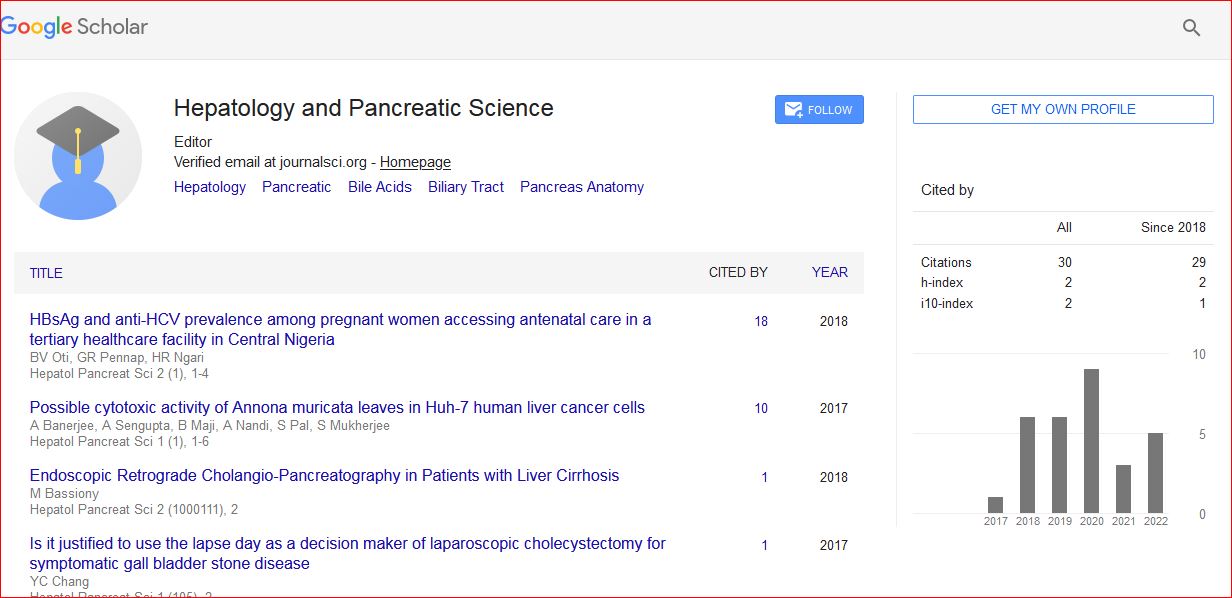
Hepatology and Pancreatic Science received 34 citations as per Google Scholar report