Short Communication - (127) Volume 11, Issue 2
Received: 31-Mar-2025, Manuscript No. cdp-25-165842;
Editor assigned: 02-Apr-2025, Pre QC No. P-165842;
Reviewed: 16-Apr-2025, QC No. Q-165842;
Revised: 24-Apr-2025, Manuscript No. R-165842;
Published:
30-Apr-2025
, DOI: 10.37421/2572-0791.2025.11.172
Citation: Alastair, Grajales. “Behavioral Rhythms and Depression Severity: A Digital Phenotyping Approach.” Clin Depress 11 (2025): 172.
Copyright: © 2025 Alastair G. This is an open-access article distributed under the terms of the Creative Commons Attribution License, which permits unrestricted use, distribution and reproduction in any medium, provided the original author and source are credited.
Depression remains a leading contributor to global disability and disease burden, with estimates from the World Health Organization indicating that more than 280 million people worldwide suffer from the disorder. Despite growing awareness and advances in therapeutic interventions, the identification and monitoring of depression remain reliant on self-reports and intermittent clinical assessments that are often limited by recall bias and inconsistent reporting. Recent years have seen the emergence of digital phenotypingâ??a method that captures individual behavioral and physiological patterns through passive data collection from personal devicesâ??as a promising approach to addressing these challenges. By continuously monitoring everyday behaviors, such as sleep, physical activity, phone usage, and social interaction, digital phenotyping has the potential to uncover subtle behavioral rhythms that correlate with depressive states and their severity [1].
Human behavior naturally follows circadian and ultradian rhythms that are influenced by both internal biological clocks and external social cues. Disruptions to these rhythms have long been implicated in the pathophysiology of depression, with irregular sleep-wake cycles, decreased physical activity, and social withdrawal being prominent behavioral manifestations. However, traditional methodologies for assessing these rhythms, such as actigraphy and self-reported diaries, are often constrained by subject compliance and environmental variability. Smartphones and wearable sensors, by contrast, enable the unobtrusive and scalable collection of high-frequency behavioral data, offering an unprecedented window into the daily lives of individuals in naturalistic settings. In this context, digital phenotyping offers the unique capacity to quantify behavioral rhythms continuously and to detect deviations that may signal changes in mental health status [2].
The current study leverages smartphone sensor data and machine learning techniques to investigate the relationship between behavioral rhythms and depression severity. By analyzing passive data streamsâ??including GPS location, screen time, accelerometry, and communication logsâ??we seek to identify recurring patterns of behavior and assess their stability, regularity, and temporal dynamics. Participants diagnosed with varying levels of depression, as measured by standardized clinical instruments such as the PHQ-9 (Patient Health Questionnaire-9), provided informed consent to share anonymized behavioral data over a 30-day observation period. This longitudinal design allows us to map daily and weekly rhythms in real-world settings and correlate these with concurrent self-reports of mood and affect [3,4].
Our analytical framework draws upon a range of temporal and statistical metrics to capture rhythm characteristics, such as amplitude, acrophase, and entropy, across multiple behavioral domains. For example, GPS data are used to assess mobility patterns and the degree of environmental engagement, while accelerometer readings provide insight into physical activity levels and sleep duration. Communication logs and app usage offer additional layers of social and cognitive engagement, reflecting potential withdrawal or rumination. Each of these data streams is analyzed for periodicity using spectral analysis, autocorrelation, and other time-series methods, enabling the detection of disrupted rhythms and the assessment of their association with depressive symptom severity [5].
In conclusion, this study underscores the relevance of behavioral rhythms as a digital biomarker for depression severity. By harnessing the power of passive sensing and computational modeling, digital phenotyping opens new avenues for understanding the temporal dynamics of mental health. The ability to detect early warning signs, track treatment responses, and personalize care based on real-world data represents a paradigm shift in psychiatric practice. As technology becomes more embedded in daily life, ethical, inclusive, and transparent approaches to digital mental health research will be critical to ensuring that the benefits of these innovations are equitably realized. Our findings lay the groundwork for future clinical applications and point toward a future where mental health support is proactive, personalized, and deeply informed by the rhythms of human behavior.
None.
None.
Google Scholar Cross Ref Indexed at
Google Scholar Cross Ref Indexed at
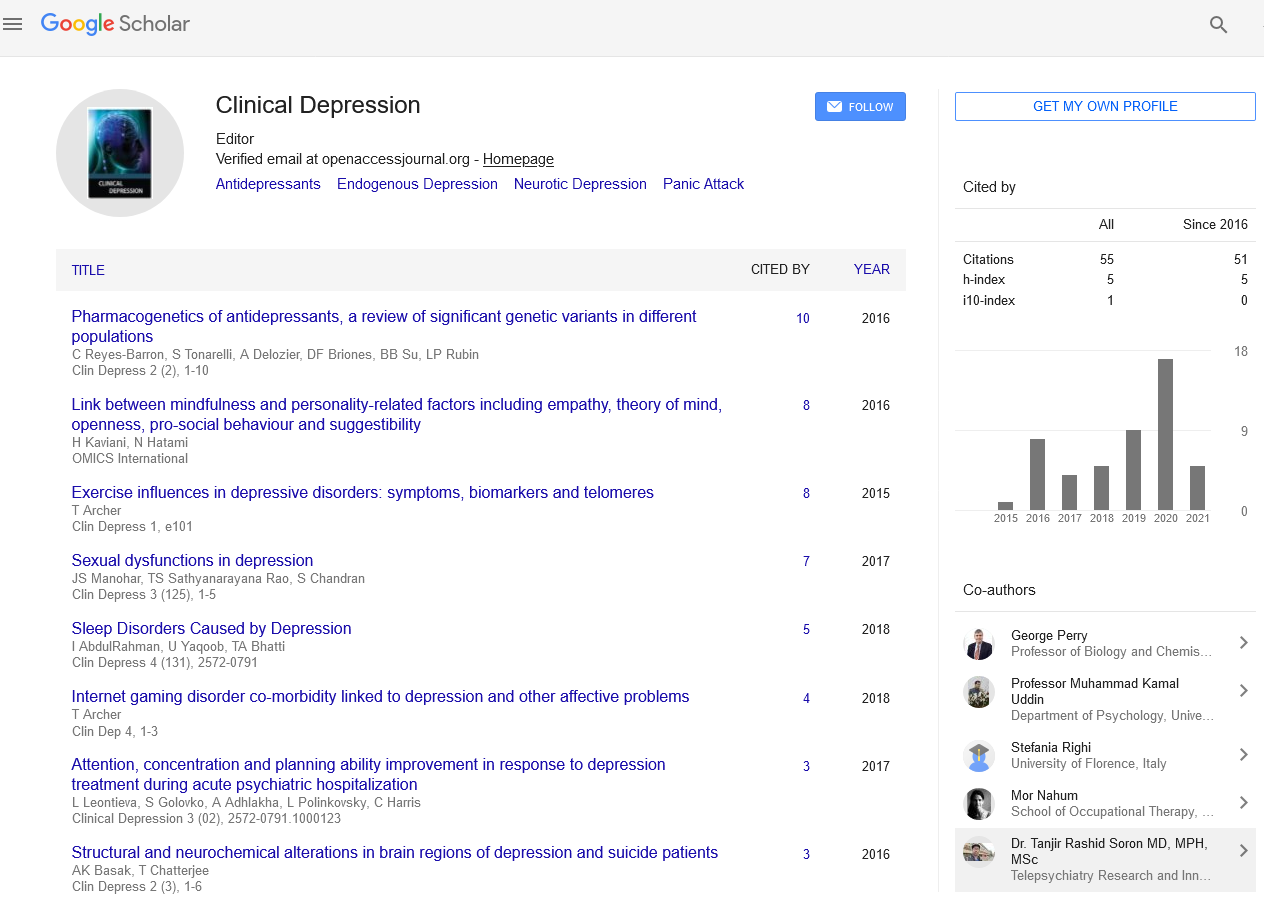
Clinical Depression received 89 citations as per Google Scholar report