Brief Report - (2025) Volume 9, Issue 5
Received: 01-Oct-2025, Manuscript No. ahbs-26-182530;
Editor assigned: 03-Oct-2025, Pre QC No. P-182530;
Reviewed: 17-Oct-2025, QC No. Q-182530;
Revised: 22-Oct-2025, Manuscript No. R-182530;
Published:
29-Oct-2025
, DOI: 10.37421/2952-8097.2025.9.336
Citation: Nowak, Mateusz. ”Behavioral Ecology: Keys To Animal
Health And Well-being.” J Anim Health Behav Sci 09 (2025):336.
Copyright: © 2025 Nowak M. This is an open-access article distributed under the terms of the Creative Commons Attribution License, which permits unrestricted use,
distribution and reproduction in any medium, provided the original author and source are credited.
Behavioral ecology offers profound insights into animal health by examining how an animal's behavior influences its susceptibility to diseases, its ability to cope with stressors, and its overall well-being. Understanding foraging strategies, social interactions, mating behaviors, and predator avoidance mechanisms can reveal how these activities impact physiological states, immune function, and the transmission of pathogens. For instance, stress-induced behavioral changes can compromise immune defenses, making animals more vulnerable to infections. Similarly, social structures can facilitate or hinder disease spread. By applying principles of behavioral ecology, we can develop more effective strategies for disease prevention, management, and the enhancement of animal welfare, particularly in managed animal populations and wildlife conservation [1].
The study explores how environmental enrichment, a key concept in behavioral ecology related to providing stimuli that promote psychological well-being, can significantly improve the health of captive animals. By mimicking natural environments and offering opportunities for complex behaviors like foraging and exploration, enrichment reduces stress, prevents abnormal repetitive behaviors (stereotypies), and enhances immune function. This research highlights that understanding an animal's natural behavioral repertoire is crucial for designing effective enrichment programs that directly contribute to better physical and mental health outcomes in managed settings [2].
This paper investigates the link between social stress and health in group-housed animals, a central theme in behavioral ecology. Chronic social instability, hierarchical conflicts, and reduced social support can lead to elevated stress hormones, impaired immune responses, and increased susceptibility to diseases. The research emphasizes that understanding the social dynamics and behavioral coping mechanisms of individuals within a group is vital for mitigating the negative health consequences of social stress and promoting a healthier social environment [3].
The article examines how predator-prey interactions, a core component of behavioral ecology, influence the stress physiology and health of prey animals. Constant vigilance, fleeing, and hiding behaviors in response to perceived threats can lead to chronic stress, impacting immune function, reproductive success, and growth. Understanding the behavioral adaptations prey species employ to balance the risks of predation with the need to forage and reproduce is key to assessing their overall health and resilience in natural ecosystems [4].
This research highlights the critical role of foraging behavior in the nutritional health of animals. Behavioral ecology helps us understand how animals seek, select, and consume food, which directly impacts nutrient intake, energy balance, and susceptibility to diet-related diseases. Factors like food availability, competition, and learned foraging skills are explored to show how these behavioral aspects shape an animal's physiological status and overall health in diverse environments [5].
The study investigates how disease transmission dynamics are influenced by animal behavior, a key intersection of behavioral ecology and animal health. Social contact rates, group size, movement patterns, and territoriality all play significant roles in the spread of infectious agents. By understanding these behavioral drivers, researchers can develop more targeted interventions for disease control and prevention, especially in wildlife and livestock management [6].
This paper focuses on how mating behaviors and mate choice can impact an animal's health. Factors such as the energetic costs of courtship, the risks associated with competitive mating, and the genetic quality of mates selected can all have direct consequences for an individual's fitness and survival, as well as the health of their offspring. Behavioral ecology provides the framework to analyze these complex trade-offs [7].
The article examines the influence of habitat use and movement patterns, key behavioral ecology concepts, on an animal's exposure to environmental hazards and disease vectors. How animals navigate their environment, utilize different resources, and interact with varying habitats directly affects their physiological stress levels and their likelihood of encountering pathogens or toxins, thus impacting their health status [8].
This study explores the behavioral responses of animals to anthropogenic disturbances and their implications for health. Changes in noise levels, human presence, and habitat fragmentation can induce stress behaviors, alter foraging and breeding patterns, and ultimately compromise an animal's physiological condition and resilience to disease. Understanding these behavioral adaptations is crucial for managing wildlife in human-dominated landscapes [9].
The paper delves into the relationship between communication behaviors and animal health, particularly in social species. Effective communication for detecting threats, coordinating group activities, and maintaining social bonds can buffer stress and improve collective well-being. Conversely, disruptions in communication can lead to increased stress, social isolation, and a higher risk of health problems [10].
Behavioral ecology provides a comprehensive framework for understanding animal health by elucidating the intricate connections between an animal's actions and its physiological state. The study of foraging strategies, for instance, reveals how an animal's approach to acquiring food directly influences its nutritional intake, energy balance, and vulnerability to diet-related illnesses, underscoring the importance of understanding food availability and competition in shaping health outcomes [1].
Environmental enrichment, a concept rooted in behavioral ecology, plays a pivotal role in enhancing the well-being of captive animals. By simulating natural conditions and encouraging species-appropriate behaviors, enrichment can significantly reduce stress, prevent the development of abnormal behaviors, and bolster immune function, demonstrating that tailored environments are critical for good health in managed populations [2].
Social dynamics within groups profoundly impact animal health, as explored through the lens of behavioral ecology. Chronic social stress arising from instability and conflict can elevate stress hormones, weaken immune systems, and increase disease susceptibility, highlighting the necessity of managing social environments to promote health [3].
Predator-prey interactions are a significant behavioral ecology subject that directly affects the health of prey animals. The constant need for vigilance and escape behaviors in response to predation risk can lead to chronic stress, negatively impacting immune function and reproductive success, thereby emphasizing the balance prey species must strike between safety and survival needs [4].
Foraging behavior is central to an animal's nutritional health, as detailed by behavioral ecology principles. The intricate process of seeking, selecting, and consuming food is directly linked to nutrient assimilation, energy regulation, and the development of diet-related diseases, making the understanding of foraging ecology crucial for assessing an animal's physiological status [5].
Disease transmission dynamics are intrinsically linked to animal behavior, a key area of inquiry in behavioral ecology. Social interactions, spatial movements, and territorial behaviors all influence the rate and pattern of infectious disease spread, providing critical insights for developing effective control and prevention strategies [6].
Mating behaviors and mate selection processes have direct implications for animal health and fitness. The energetic expenditures during courtship, the risks associated with competition for mates, and the genetic quality of chosen partners can all impact an individual's survival and the health of its offspring, showcasing the complex trade-offs involved in sexual selection [7].
Habitat use and movement patterns, fundamental concepts in behavioral ecology, are instrumental in determining an animal's exposure to environmental hazards and disease vectors. An animal's navigation of its surroundings and its interactions with various habitats directly influence stress levels and the likelihood of encountering pathogens, thereby shaping its overall health profile [8].
Animal responses to anthropogenic disturbances, a significant focus of behavioral ecology, have considerable health implications. Alterations in behavior due to factors like noise and habitat fragmentation can induce stress, disrupt essential life functions, and reduce an animal's resilience to disease, underscoring the need for careful management of wildlife in human-altered landscapes [9].
Communication behaviors play a vital role in the health of social animals, as studied within behavioral ecology. Effective communication facilitates threat detection, group coordination, and social bonding, which can buffer stress and enhance collective well-being, while communication disruptions can lead to increased stress and health issues [10].
Behavioral ecology offers critical insights into animal health by linking an animal's behavior to its susceptibility to disease, stress coping abilities, and overall well-being. Key behavioral aspects such as foraging, social interactions, predator avoidance, and mating strategies directly impact physiological states and immune function. Environmental enrichment is shown to improve the health of captive animals by reducing stress and enhancing immune function. Social stress, predation risk, and anthropogenic disturbances can lead to chronic stress and compromised health. Furthermore, habitat use, movement patterns, and communication behaviors influence exposure to hazards and disease, as well as social well-being. Understanding these behavioral drivers is essential for developing effective strategies in disease prevention, management, and animal welfare, particularly in wildlife conservation and managed populations.
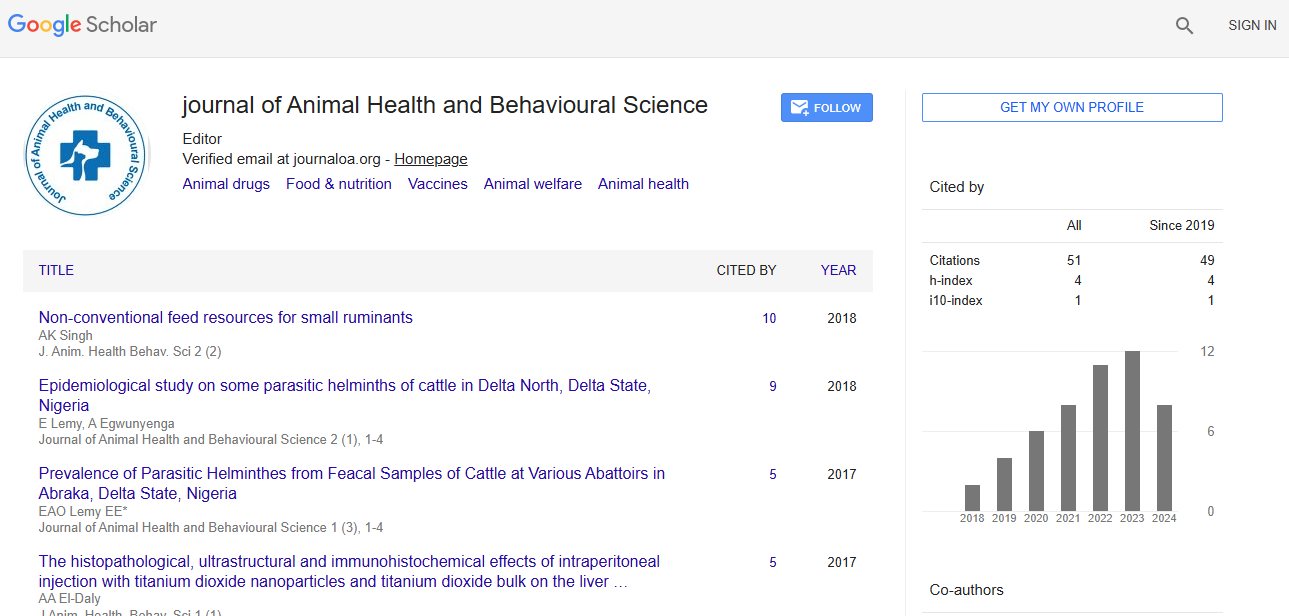
Journal of Animal Health and Behavioural Science received 38 citations as per Google Scholar report