Commentary - (2025) Volume 16, Issue 2
Received: 01-Apr-2025, Manuscript No. jbmbs-26-183378;
Editor assigned: 03-Apr-2025, Pre QC No. P-183378;
Reviewed: 17-Apr-2025, QC No. Q-183378;
Revised: 22-Apr-2025, Manuscript No. R-183378;
Published:
29-Apr-2025
, DOI: 10.37421/2155-6180.2025.16.265
Citation: Li, Chen. ”Bayesian Methods: Advancing Biostatistics and Health Research.” J Biom Biosta 16 (2025):265.
Copyright: © 2025 Li C. This is an open-access article distributed under the terms of the Creative Commons Attribution License, which permits unrestricted use, distribution and reproduction in any medium, provided the original author and source are credited.
The field of biostatistics and health research has seen a significant surge in the application of Bayesian methods, owing to their inherent ability to integrate prior knowledge and manage complex data structures, thereby providing more interpretable probabilistic inferences. These approaches offer unparalleled flexibility in modeling, particularly for intricate scenarios such as longitudinal data, survival analysis, and the nuanced designs of clinical trials. Advancements in computational techniques, notably Markov Chain Monte Carlo (MCMC) methods, have been instrumental in facilitating the estimation of these complex Bayesian models, making them more accessible and practical for researchers. The implications of Bayesian thinking are expanding into areas like evidence synthesis and personalized medicine, underscoring its growing importance in modern health sciences [1].
Beyond general applications, Bayesian hierarchical models are proving invaluable for analyzing health data that exhibits inherent complexity and variation across different units, such as study sites or patient groups. This hierarchical structure leads to more robust and generalizable findings, a fact illustrated through real-world epidemiological studies where parameter estimation and uncertainty interpretation are key. A significant advantage highlighted is Bayesian shrinkage, a mechanism that stabilizes estimates by drawing them towards a common mean, thus improving precision, especially within smaller subgroups [2].
Clinical trials are also benefiting from Bayesian methodologies, particularly in the realm of adaptive designs, which promise enhanced efficiency and ethical considerations. Bayesian methods enable the dynamic updating of treatment allocation probabilities as evidence accumulates, accelerating the identification of effective treatments. The principles of Bayesian optimal design, when applied to fields like oncology and infectious diseases, offer notable advantages in sample size reduction and improved patient outcomes compared to traditional fixed designs [3].
Understanding complex causal relationships within public health is another area where Bayesian network models are making significant inroads. These graphical models excel at integrating diverse data sources to pinpoint key risk factors and effective intervention targets for various diseases. A tutorial approach to constructing and interpreting these networks, especially for infectious disease epidemiology and chronic disease prevention, reveals their utility. The capacity for sensitivity analyses and simulating 'what-if' scenarios further solidifies their value [4].
Longitudinal health data, characterized by repeated measurements over time and potential missingness, are effectively addressed by Bayesian methods. The application of Bayesian mixed-effects models within this framework allows for the capture of individual variability and time-dependent effects, leading to more accurate treatment effect estimations. Careful consideration of prior specification and its impact on posterior inference is crucial for practical application in health research [5].
Survival analysis, a cornerstone of biostatistics, is also being advanced by Bayesian approaches. Various Bayesian techniques for modeling time-to-event data, encompassing parametric, semi-parametric, and non-parametric models, are available. These methods offer distinct advantages in managing complex covariates, informative censoring, and comparing multiple treatment groups, with practical guidance on model selection and prior elicitation complementing clinical examples [6].
Evidence synthesis through Bayesian meta-analysis is revolutionizing how findings from multiple health studies are integrated. The statistical framework facilitates the incorporation of prior information and the use of hierarchical models to account for study heterogeneity, offering more flexible and comprehensive uncertainty quantification for treatment effects. Practical benefits are evident in systematic reviews across diverse medical fields [7].
In toxicology and pharmacology, Bayesian penalized spline models are proving adept at analyzing dose-response relationships. These flexible, non-parametric methods can capture complex, non-linear associations between exposure and outcome, a common occurrence in dose-response studies. The Bayesian framework for estimating these models, along with robust model assessment and interpretation, is critical within the context of regulatory science [8].
Causal inference in observational health studies is significantly enhanced by Bayesian approaches. These methods are adept at addressing confounding and unmeasured confounding, particularly through the judicious use of prior information and sensitivity analyses. The application of these techniques to estimate treatment effects and risk factors, demonstrated with real-world health datasets, emphasizes the transparency and interpretability inherent in Bayesian causal inference [9].
Finally, the spatial dimensions of public health are being illuminated by Bayesian geostatistical models. These models are designed to analyze spatial patterns of disease prevalence and risk factors, incorporating geographical covariates and accounting for spatial autocorrelation. This leads to more accurate predictions and a deeper understanding of disease distribution, with notable applications in infectious disease surveillance and environmental epidemiology [10].
The application of Bayesian methods in biostatistics and health research is multifaceted, offering significant advantages in handling complex data and incorporating prior information. These methods are particularly adept at providing interpretable probabilistic inferences, crucial for advancing scientific understanding and decision-making. The flexibility in modeling longitudinal data, survival outcomes, and clinical trial designs allows for more nuanced and accurate analyses. Furthermore, the development of computational tools like MCMC has democratized the use of these advanced models, making them practical for a wider range of research questions. The influence of Bayesian thinking is extending to personalized medicine and evidence synthesis, highlighting its pivotal role in contemporary health sciences [1].
Bayesian hierarchical models are a powerful tool for dissecting complex health data by accounting for variations across different units of analysis. This approach yields more reliable and broadly applicable conclusions, as demonstrated in epidemiological research where precise parameter estimation and uncertainty quantification are paramount. The concept of Bayesian shrinkage is a key mechanism that improves the precision of estimates, especially for smaller or more heterogeneous subgroups, by moderating extreme values towards a central tendency [2].
In the domain of clinical trials, Bayesian adaptive designs represent a paradigm shift towards greater efficiency and ethical considerations. These designs leverage Bayesian principles to dynamically adjust trial parameters based on accumulating data, thereby accelerating the identification of effective interventions. The implementation of Bayesian optimal design principles, evidenced in oncology and infectious disease trials, has shown promise in reducing sample sizes and improving patient outcomes compared to conventional trial designs [3].
Bayesian network models offer a robust framework for elucidating complex causal relationships within public health. By integrating disparate data sources, these graphical models can effectively identify critical risk factors and targets for intervention. Their utility in areas such as infectious disease epidemiology and chronic disease prevention is further enhanced by their ability to support sensitivity analyses and 'what-if' scenario simulations, providing a deeper understanding of public health challenges [4].
Analyzing longitudinal health data, with its inherent complexities like individual variability and time-dependent effects, is significantly improved by Bayesian approaches. The use of mixed-effects models within a Bayesian framework allows for the precise handling of missing data and the accurate estimation of treatment effects over time. The judicious specification of prior distributions is a critical aspect that influences posterior inference and necessitates careful consideration in practical health research applications [5].
Bayesian survival analysis provides a comprehensive set of methods for modeling time-to-event data in biostatistics and health research. The availability of parametric, semi-parametric, and non-parametric Bayesian models caters to a wide range of data complexities. These methods are particularly advantageous for dealing with intricate covariate structures, informative censoring, and comparisons involving multiple treatment arms. Guidance on model selection and prior elicitation is essential for their effective application [6].
Bayesian meta-analysis is a vital tool for synthesizing evidence from multiple health studies, offering a flexible and comprehensive approach to uncertainty quantification. By incorporating prior information and employing hierarchical models to manage study heterogeneity, Bayesian meta-analysis yields more robust estimates of treatment effects. Its practical benefits are clearly demonstrated in various systematic reviews across different medical disciplines [7].
In toxicological and pharmacological research, Bayesian penalized spline models are employed to analyze dose-response relationships. These non-parametric models are highly effective at capturing complex, non-linear associations between exposure and outcome, which are frequently observed in such studies. The Bayesian framework provides a rigorous method for estimating these models and assessing their validity, crucial for regulatory decision-making [8].
Bayesian causal inference offers significant advantages for observational health studies, particularly in addressing confounding and potential unmeasured confounding. The incorporation of prior information and the execution of sensitivity analyses are key strategies employed by these methods. Their application in estimating treatment effects and identifying risk factors, supported by real-world data, underscores their transparency and interpretability [9].
Bayesian geostatistical models are instrumental in analyzing the spatial distribution of diseases and risk factors in public health. These models effectively incorporate spatial covariates and account for spatial autocorrelation, leading to more precise predictions and a better understanding of disease patterns. Their utility is evident in applications related to infectious disease surveillance and environmental epidemiology, emphasizing their value in spatially explicit health research [10].
This collection of research highlights the pervasive and impactful application of Bayesian methods across various domains of biostatistics and health research. Bayesian approaches are instrumental in handling complex data structures, incorporating prior knowledge, and providing interpretable probabilistic inferences. Specific applications include advanced modeling for longitudinal and survival data, adaptive clinical trial designs, causal inference in observational studies, and evidence synthesis through meta-analysis. The research also showcases the utility of Bayesian hierarchical models for complex data, Bayesian networks for causal relationships, and geostatistical models for spatial health research. Furthermore, specialized models like Bayesian penalized splines are used for dose-response analysis, demonstrating the breadth and depth of Bayesian contributions to improving health outcomes and research methodologies.
None
None
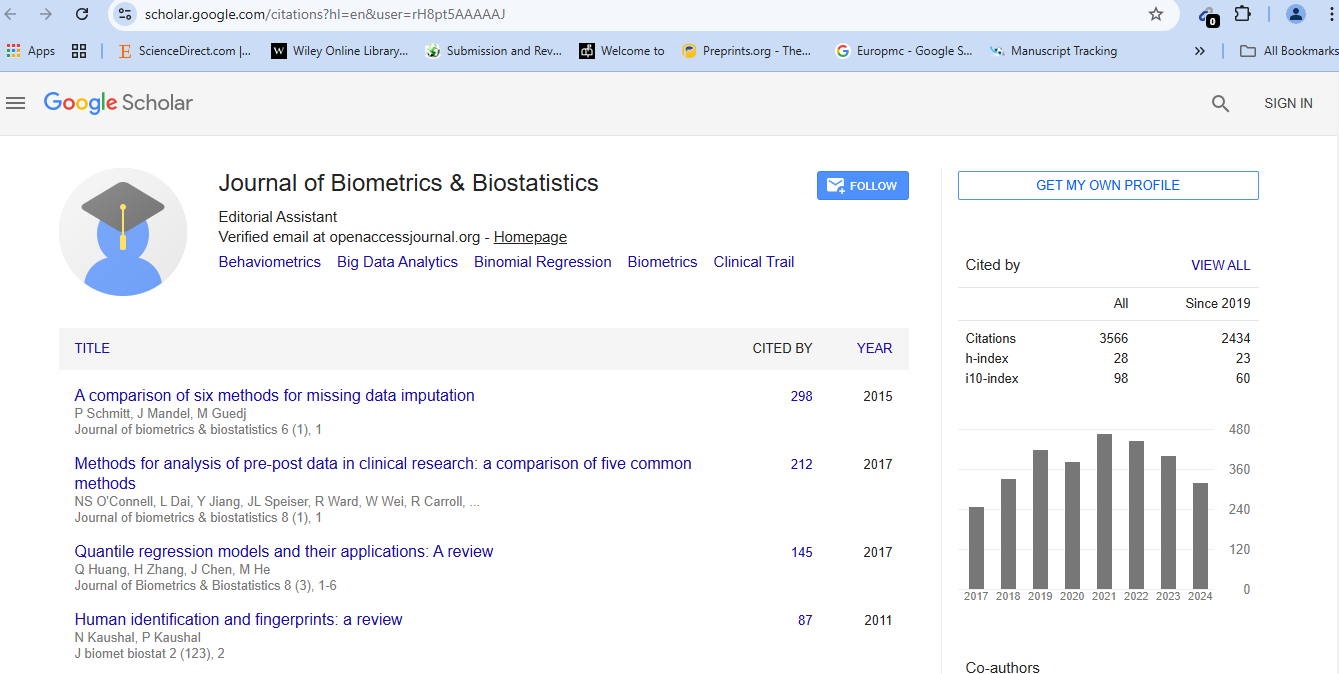
Journal of Biometrics & Biostatistics received 3496 citations as per Google Scholar report