Short Communication - (127) Volume 14, Issue 2
Received: 02-Jun-2025, Manuscript No. ara-25-175583;
Editor assigned: 04-Jun-2025, Pre QC No. P-175583;
Reviewed: 18-Jun-2025, QC No. Q-175583;
Revised: 23-Jun-2025, Manuscript No. R-175583;
Published:
30-Jun-2025
, DOI: 10.37421/2168-9695.2025.14.332
Citation: Chen, Mei-Ling. ”Automated AI’s Diverse Transformative Applications.” Adv Robot Autom 14 (2025):332.
Copyright: © 2025 Chen M. This is an open-access article distributed under the terms of the Creative Commons Attribution License, which permits unrestricted use, distribution and reproduction in any medium, provided the original author and source are credited.
The burgeoning field of automated deep learning is revolutionizing numerous sectors, with a profound impact on critical areas like medical image analysis. These sophisticated methods, which encompass techniques such as neural architecture search, hyperparameter optimization, and automated data augmentation, are proving instrumental in elevating diagnostic accuracy and streamlining operational efficiency. Naturally, this innovative domain also grapples with various challenges that actively shape future research directions [1].
Parallel to this, the applications of Automated Machine Learning (AutoML), frequently incorporating deep learning, are proving invaluable in the context of smart cities. AutoML techniques offer robust solutions for a spectrum of urban challenges, ranging from sophisticated traffic management systems to comprehensive environmental monitoring initiatives. The inherent benefits of automation are strikingly evident in its capacity to process and interpret complex city data, thereby enhancing decision-making processes across urban infrastructures [2].
A closer examination of automated deep learning, often abbreviated as AutoDL, reveals its significant contributions, particularly within medical imaging. This comprehensive approach utilizes diverse AutoDL methodologies to simplify the design and meticulous optimization of deep learning models. This simplification directly translates into heightened efficiency and superior performance in critical diagnostic and prognostic tasks within the healthcare ecosystem [3].
Furthermore, automated Machine Learning (ML), including its deep learning facets, is making considerable strides in accelerating the process of drug discovery. These automated paradigms expedite crucial stages such as precise target identification, efficient compound screening, and optimized lead optimization. The net effect is a drug development process that is not only faster but also inherently more data-driven and precise [4].
In the specialized realm of brain disease classification, automated deep learning methods are providing an essential overview. These techniques are designed to streamline the entire development cycle of deep learning models specifically tailored for medical image analysis. Their effectiveness is manifest in improving both the accuracy and speed of brain disease diagnosis across a variety of imaging modalities [5].
Considering the broader implications for healthcare, Automated Machine Learning (AutoML) presents a landscape of both immense promise and inherent pitfalls, especially regarding its deep learning components. AutoML's capability to automate the entire model development pipeline offers substantial advantages in areas like medical diagnosis, personalized treatment strategies, and proactive disease prediction. However, this advancement also necessitates careful navigation of its inherent complexities and critical ethical considerations [6].
Another transformative approach is federated learning within healthcare. This distributed Machine Learning (ML) paradigm inherently automates the training of deep learning models across disparate, decentralized datasets. Crucially, federated learning effectively addresses pervasive privacy and data access concerns by enabling model aggregation without centralizing sensitive patient data, profoundly impacting the trajectory of medical Artificial Intelligence (AI) development [7].
Moving beyond clinical applications, an innovative automated deep learning framework has been introduced for multi-label text classification, ingeniously leveraging transformer models. This framework vividly illustrates how automating the configuration and training of such intricate models can significantly enhance both performance and efficiency. This is particularly vital when processing text data that carries multiple associated categories, a cornerstone task in various natural language processing applications [8].
The utility of Automated Deep Learning (AutoDL) extends even further, as evidenced by its application in the semantic segmentation of satellite imagery. Surveys in this area highlight techniques that automate the precise delineation of objects and regions within satellite images. This capability is indispensable for diverse applications such as remote sensing, meticulous urban planning, and comprehensive environmental monitoring, all while substantially minimizing the manual effort typically involved in model design [9].
Finally, Neural Architecture Search (NAS) stands out as a fundamental component of deep learning automation, particularly within medical image analysis. Comprehensive surveys on NAS methodologies reveal their ability to automatically discover optimal neural network architectures. This automation not only markedly improves model performance but also drastically reduces the extensive manual effort traditionally expended in designing complex deep learning systems for critical medical tasks [10].
Automated deep learning methods are fundamentally reshaping the landscape of medical image analysis, delivering substantial improvements in diagnostic accuracy and overall efficiency. This involves sophisticated techniques like neural architecture search, hyperparameter optimization, and automated data augmentation [1]. These methods, often referred to as AutoDL, are critically enhancing efficiency and performance in diagnostic and prognostic tasks within the healthcare sector by simplifying the design and optimization of deep learning models [3]. Specifically, in the domain of brain disease classification, automated deep learning methods streamline the development of models for medical image analysis, boosting the accuracy and speed of diagnoses across various imaging modalities [5]. A core component of this automation is Neural Architecture Search (NAS), which automatically discovers optimal neural network architectures, significantly reducing the extensive manual effort traditionally associated with designing deep learning systems for medical applications [10]. This collective emphasis on automation points towards a future where medical diagnostics become more precise and less labor-intensive.
Beyond medical imaging, Automated Machine Learning (AutoML), frequently incorporating deep learning, is addressing complex challenges in diverse fields. In smart cities, for example, AutoML techniques are pivotal in tackling urban issues from traffic management to environmental monitoring, emphasizing the benefits of automation in handling complex urban data and facilitating decision-making processes [2]. Similarly, in drug discovery, automated Machine Learning (ML) accelerates critical stages such as target identification, compound screening, and lead optimization, making the drug development process more efficient and data-driven [4]. The broader healthcare sector also sees the potential of AutoML to automate the entire model development pipeline, leading to benefits in medical diagnosis, personalized treatment, and disease prediction. However, this advancement also brings inherent complexities and ethical considerations that demand careful attention [6].
Further specialized approaches highlight the versatility of automation. Federated learning, a distributed Machine Learning (ML) method, inherently automates the training of deep learning models across decentralized datasets in healthcare. This innovative approach effectively addresses privacy and data access concerns by aggregating models without centralizing sensitive patient data, showcasing its substantial impact on medical Artificial Intelligence (AI) development [7]. In other domains, research introduces an automated deep learning framework for multi-label text classification, leveraging transformer models. This demonstrates how automating model configuration and training can enhance performance and efficiency when handling text data with multiple associated categories, a key task in natural language processing [8]. The application of Automated Deep Learning (AutoDL) also extends to the semantic segmentation of satellite imagery, where it automates the delineation of objects and regions, crucial for remote sensing, urban planning, and environmental monitoring, by minimizing manual design efforts [9].
These advancements collectively underscore the transformative power of automation in Machine Learning and deep learning across scientific and industrial applications. The drive to automate model design, optimization, and deployment reflects a clear need for increased efficiency, accuracy, and scalability in handling vast and complex datasets. While the benefits are profound, including accelerated research, improved diagnostic capabilities, and optimized urban management, the ongoing development also necessitates a continuous focus on addressing existing challenges and navigating ethical implications to fully realize the potential of these powerful automated systems.
Automated deep learning (AutoDL) is transforming medical image analysis, enhancing diagnostic accuracy and efficiency through techniques like neural architecture search and hyperparameter optimization. It also plays a crucial role in classifying brain diseases, streamlining model development for medical image analysis. AutoDL, especially Neural Architecture Search (NAS), automatically discovers optimal neural network architectures, reducing manual effort in medical tasks. Automated Machine Learning (AutoML), often including deep learning, addresses urban challenges from traffic management to environmental monitoring in smart cities, simplifying complex data handling. In drug discovery, automated Machine Learning (ML) accelerates target identification, compound screening, and lead optimization, making the process more efficient. Healthcare benefits from AutoML by automating model development pipelines for medical diagnosis, personalized treatment, and disease prediction, though ethical considerations exist. Federated learning, a distributed ML approach, inherently involves automation in training deep learning models across decentralized datasets, addressing privacy issues in medical AI without centralizing sensitive patient data. For text classification, an automated deep learning framework utilizing transformer models improves performance and efficiency in handling multi-label text data. AutoDL also proves valuable for semantic segmentation of satellite imagery, automating object delineation for remote sensing and urban planning, minimizing manual model design. These automated methods collectively aim to simplify the design and optimization of deep learning models across various critical fields, improving both efficiency and performance in complex data-driven tasks.
None
None
Wei W, Haoran X, Hao C. "Automated Deep Learning for Medical Image Analysis: A Survey".IEEE J Biomed Health Inform 27 (2023):111-122.
Indexed at, Google Scholar, Crossref
Farhad A, Muhammad I, Mohammad A. "A Review of Automated Machine Learning (AutoML) in Smart Cities".Sensors (Basel) 23 (2023):1475.
Indexed at, Google Scholar, Crossref
Xiaofeng L, Fang Y, Yan C. "Automated Deep Learning (AutoDL): a comprehensive review with a focus on medical imaging".Comput Biol Med 167 (2023):107662.
Indexed at, Google Scholar, Crossref
Qi L, Tian-Shu J, Tian-Hao Z. "Automated machine learning in drug discovery: recent advances and future perspectives".J Chem Inf Model 62 (2022):4038-4054.
Indexed at, Google Scholar, Crossref
Yanan C, Guanjun L, Jianhua C. "Automated deep learning for brain disease classification: A review".Comput Methods Programs Biomed 226 (2022):107147.
Indexed at, Google Scholar, Crossref
Siddharth K, Siqi L, Mandar D. "The Promises and Pitfalls of Automated Machine Learning (AutoML) in Healthcare: A Comprehensive Review".Int J Environ Res Public Health 18 (2021):11075.
Indexed at, Google Scholar, Crossref
Xiaohan D, Hongyu Z, Xiangtao S. "Federated Learning in Healthcare: A Review".Artif Intell Med 140 (2023):102555.
Indexed at, Google Scholar, Crossref
Ayan R, Abdulaziz MA, Abdallah H. "Automated multi-label deep learning for text classification using transformer models".Comput Methods Programs Biomed 246 (2024):108035.
Indexed at, Google Scholar, Crossref
Muhammad A, M UA, Faheem H. "Automated Deep Learning (AutoDL) Based Semantic Segmentation for Satellite Imagery: A Survey".IEEE Access 12 (2024):29707-29720.
Indexed at, Google Scholar, Crossref
Xuehai Z, Dian Z, Yuan Z. "A comprehensive survey on neural architecture search for medical image analysis".Med Image Anal 83 (2022):102662.
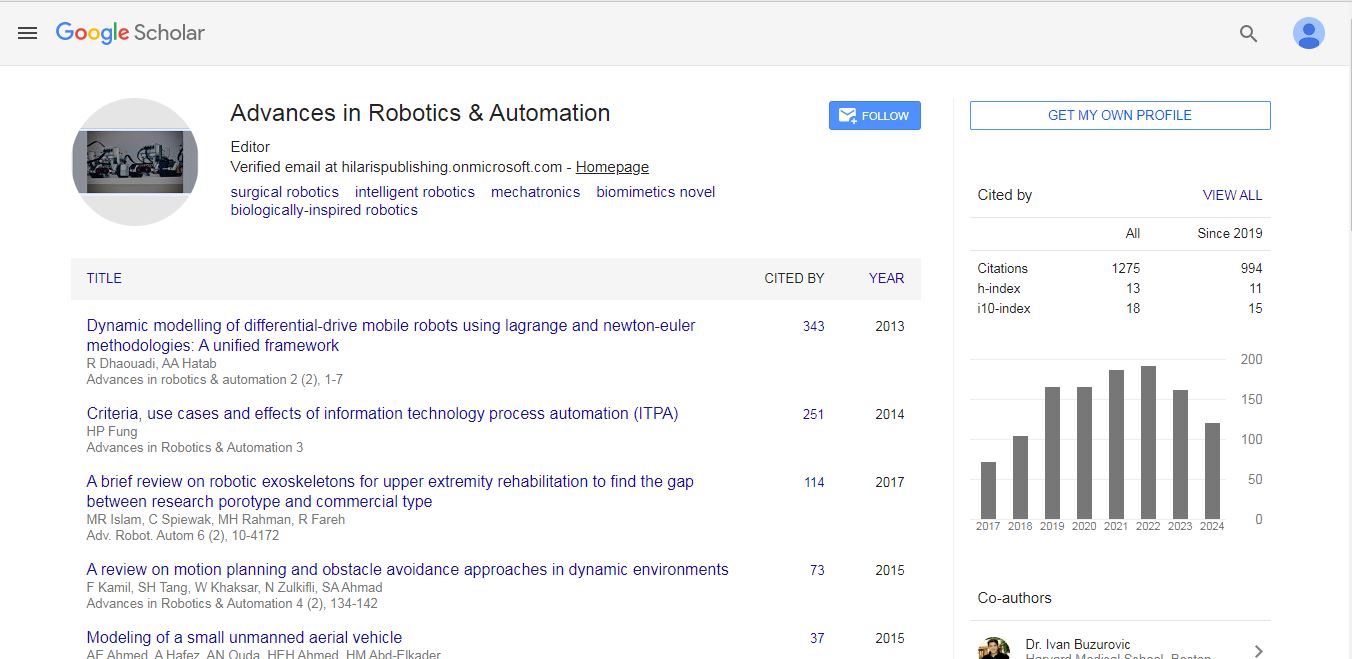
Advances in Robotics & Automation received 1275 citations as per Google Scholar report