Commentary - (2025) Volume 14, Issue 5
Received: 02-Oct-2025, Manuscript No. jsp-26-182280;
Editor assigned: 06-Oct-2025, Pre QC No. P-182280;
Reviewed: 20-Oct-2025, QC No. Q-182280;
Revised: 23-Oct-2025, Manuscript No. R-182280;
Published:
30-Oct-2025
, DOI: 10.37421/2165-7939.2025.14.747
Citation: Cheng, Lillian M.. ”Athlete Spine Disorders: Causes, Management, and Recovery.” J Spine 14 (2025):747.
Copyright: © 2025 Cheng M. Lillian This is an open-access article distributed under the terms of the Creative Commons Attribution License, which permits unrestricted use, distribution and reproduction in any medium, provided the original author and source are credited.
Athletes face a heightened risk of developing various spine disorders due to the demanding and often repetitive nature of their sports, leading to conditions ranging from acute injuries like disc herniations and fractures to chronic ailments such as spondylolysis and facet joint arthropathy. Understanding the intricate biomechanics underlying athletic movements is paramount for accurately identifying risk factors and subsequently developing and implementing effective preventative strategies. Treatment for these spine-related issues in athletes typically necessitates a comprehensive, multidisciplinary approach. This approach integrates physical therapy, specialized rehabilitation programs, and, in certain challenging instances, surgical intervention. The cornerstone of successful management lies in achieving early diagnosis and initiating appropriate therapeutic interventions, which are crucial for enabling athletes to safely return to their respective sports with optimal physical function. Spondylolysis, characterized as a stress fracture occurring in the pars interarticularis, is a prevalent cause of low back pain among young athletes. This condition is particularly common in those participating in sports that involve repetitive hyperextension movements, such as gymnastics and football. The early detection of spondylolysis through advanced imaging techniques, including Magnetic Resonance Imaging (MRI) or Computed Tomography (CT) scans, is of vital importance for timely intervention. Fortunately, conservative management strategies, which encompass periods of rest, targeted physical therapy, and the use of bracing, often prove to be highly successful in treating this condition. However, for cases that are persistent or particularly severe, surgical stabilization may become a necessary course of action. Disc herniations in athletes can manifest with acute, debilitating radicular pain and noticeable neurological deficits. The underlying mechanism frequently involves sudden, forceful movements such as flexion, rotation, or axial loading of the spine. Treatment strategies are carefully tailored based on the severity of the symptoms experienced by the athlete and the degree of neurological involvement observed. Non-operative management, comprising pain medication, physical therapy to strengthen supporting muscles and improve flexibility, and modification of athletic activities, serves as the primary line of treatment. In more severe instances or when conservative care proves ineffective, surgical decompression and spinal fusion may be required to restore function and alleviate pain. Facet joint arthropathy represents a degenerative spinal condition that can be a significant source of axial low back pain in athletes. This is especially true for individuals participating in sports that inherently involve repeated spinal extension and rotation. The pain associated with facet joint arthropathy is characteristically exacerbated by spinal extension movements and is typically relieved by flexion. Management strategies primarily focus on effective pain relief, often involving anti-inflammatory medications, and a tailored physical therapy regimen aimed at enhancing core strength and spinal flexibility. In some cases, intra-articular injections into the affected facet joints may also be utilized as part of the treatment plan. Cervical spine injuries, particularly within the context of high-impact contact sports, present a broad spectrum of severity, ranging from minor ligamentous sprains to catastrophic spinal cord injuries with profound consequences. The prevention of these severe injuries hinges on several critical factors, including the promotion of proper athletic techniques, the consistent use of appropriate protective equipment, and the implementation of rules designed to curtail dangerous play. Acute management of any suspected cervical spine injury mandates immediate spinal immobilization and a thorough medical evaluation to definitively rule out spinal instability or any neurological compromise, ensuring the athlete's safety and long-term well-being. The role of robust core strengthening and sophisticated neuromuscular control cannot be overstated when considering the prevention of spine injuries in athletes. A strong and stable core musculature provides an essential foundation for the efficient transfer of forces throughout the body and plays a crucial role in shielding the spine from excessive and potentially damaging stress. Exercise programs designed to enhance core stability should prioritize exercises that effectively activate and strengthen the deep abdominal and back muscles, complemented by drills that improve balance and coordination, thereby creating a resilient spinal support system. Decisions regarding an athlete's return to play following a spine injury require a meticulous and comprehensive evaluation of both their physical readiness and the specific, often strenuous, demands of their sport. A carefully structured, phased approach to rehabilitation, coupled with a progressive return to athletic activity under the guidance of qualified medical professionals, is absolutely essential to minimize the inherent risk of re-injury. This systematic process involves gradually increasing the intensity, duration, and complexity of both therapeutic exercises and sport-specific drills, ensuring a safe and effective reintegration into competition. Advanced imaging modalities, such as Magnetic Resonance Imaging (MRI) and Computed Tomography (CT) scans, are indispensable tools in the diagnostic armamentarium for identifying and characterizing spine disorders in athletes. These techniques offer detailed visualization of both bony structures and soft tissues, allowing for precise identification of injuries. In more complex or subtle cases, advanced imaging techniques may be employed to gain further diagnostic clarity. A thorough understanding of the specific strengths, limitations, and optimal applications of each imaging modality is critical for achieving accurate diagnoses and formulating effective treatment plans. Surgical management of spine disorders in athletes is primarily undertaken with the distinct goals of restoring spinal stability, effectively alleviating debilitating pain, and ultimately enabling a safe and timely return to their sport. The surgical techniques employed can vary substantially, depending on the specific nature of the condition, and range from minimally invasive decompression procedures to more complex spinal fusion operations. The ultimate decision to proceed with surgery is made only after a careful and thorough consideration of the athlete's response to conservative treatment failures and a comprehensive assessment of the potential impact of the condition and subsequent surgery on their athletic career. The psychological ramifications of sustaining spine injuries can be profound and are frequently underestimated or overlooked in the overall recovery process for athletes. The pervasive fear of re-injury, the potential loss of athletic identity, and the immense pressure to return to competition can collectively contribute to significant levels of anxiety and depression. Therefore, a truly comprehensive treatment plan must proactively address the athlete's mental and emotional well-being in parallel with their physical rehabilitation, often necessitating the involvement of specialized sports psychologists to provide essential support and guidance.
Athletes are particularly vulnerable to a spectrum of spine disorders due to the high-impact and repetitive nature inherent in many sports. These conditions can manifest as acute injuries, such as disc herniations and fractures, or as chronic issues like spondylolysis and facet joint arthropathy. A deep understanding of the biomechanics that govern athletic movements is crucial for identifying potential risk factors and for the subsequent development and implementation of effective preventative measures. The management of these spine-related injuries in athletes typically involves a collaborative, multidisciplinary approach, integrating specialized physical therapy, targeted rehabilitation programs, and, in some instances, surgical intervention. Prioritizing early diagnosis and appropriate management are key components that facilitate a safe return to sport with optimal functional capacity. Spondylolysis, defined as a stress fracture of the pars interarticularis, is a common etiology of low back pain in young athletes, especially those engaged in sports that require repetitive hyperextension, such as gymnastics and football. Early identification through sophisticated imaging techniques, including MRI or CT scans, is critical for effective intervention. Conservative management, encompassing rest, physical therapy, and bracing, often leads to successful outcomes. However, persistent or severe cases may necessitate surgical stabilization to restore structural integrity and alleviate pain. In athletes, disc herniations can present with acute radicular pain and significant neurological deficits. The causative mechanism often involves sudden, forceful spinal movements such as flexion, rotation, or axial loading. Treatment paradigms are contingent upon the severity of the symptoms and the extent of neurological involvement. Non-operative strategies, including pharmacological pain management, physical therapy interventions aimed at improving strength and flexibility, and modifications in activity levels, are typically the initial course of action. For athletes with severe symptoms or those unresponsive to conservative care, surgical decompression and fusion may be indicated to restore spinal function. Facet joint arthropathy, a degenerative condition, can lead to axial low back pain in athletes, particularly those involved in sports characterized by repeated spinal extension and rotation. The pain is characteristically aggravated by extension and relieved by flexion. Management strategies are primarily directed towards pain amelioration, often utilizing anti-inflammatory medications, alongside a tailored physical therapy program focused on enhancing core strength and flexibility. In select cases, intra-articular injections may also be employed to manage inflammation and pain within the facet joints. Cervical spine injuries are a serious concern for athletes, especially in contact sports, with potential consequences ranging from mild sprains to devastating spinal cord injuries. Prevention strategies are multifaceted, emphasizing proper technique, adequate protective equipment, and the enforcement of rules designed to minimize hazardous play. Immediate immobilization and comprehensive medical evaluation are imperative for acute cervical spine injuries to rule out instability or neurological compromise, ensuring the athlete's safety and minimizing long-term risks. The significance of core strengthening and effective neuromuscular control in the prevention of spine injuries among athletes cannot be overstated. A robust and stable core provides a critical foundation for efficient force transmission and helps to shield the spine from excessive biomechanical stress. Exercise programs should be designed to target and strengthen the deep abdominal and back muscles, while also incorporating balance and coordination drills to enhance overall spinal stability and reduce injury susceptibility. Return-to-play decisions following a spine injury in athletes necessitate a careful and individualized assessment of both the athlete's physical recovery status and the specific demands of their sport. A phased rehabilitation approach, coupled with a gradual and progressive return to activity, guided by healthcare professionals, is essential for mitigating the risk of re-injury. This process involves systematically increasing the intensity, duration, and complexity of exercises and sport-specific movements. Imaging techniques such as MRI and CT scans play a pivotal role in the diagnosis of spine disorders affecting athletes, offering detailed insights into the integrity of bony and soft tissues. For intricate cases or subtle injuries, advanced imaging modalities may be utilized to achieve a more definitive diagnosis. A comprehensive understanding of the capabilities and limitations of each imaging technique is vital for accurate diagnosis and the subsequent development of effective treatment plans. Surgical interventions for spine pathologies in athletes are aimed at restoring spinal stability, alleviating pain, and facilitating a safe return to their sport. The surgical approaches vary widely depending on the specific diagnosis, ranging from minimally invasive decompression to complex fusion procedures. The decision to pursue surgical management is typically made after conservative treatment options have been exhausted and the potential impact on the athlete's career has been thoroughly evaluated. The psychological impact of spine injuries on athletes is often substantial and can be overlooked. Concerns about re-injury, the potential loss of their athletic identity, and the pressure to resume competition can contribute to significant anxiety and depression. Consequently, a holistic treatment plan must incorporate strategies to address the athlete's mental health alongside their physical recovery, frequently involving the expertise of sports psychologists.
Athletes are susceptible to spine disorders due to intense sports activities. Common issues include disc herniations, spondylolysis, and facet joint arthropathy, which can arise from acute injuries or chronic stress. Effective management involves understanding biomechanics, early diagnosis, and a multidisciplinary approach combining physical therapy, rehabilitation, and sometimes surgery. Spondylolysis, a stress fracture, is prevalent in young athletes and often managed conservatively, though surgery may be needed. Disc herniations can cause radicular pain and neurological deficits, with non-operative treatments being primary, followed by surgery for severe cases. Facet joint arthropathy results in axial back pain, managed with pain relief, medication, and physical therapy. Cervical spine injuries in contact sports require immediate immobilization and thorough evaluation. Core strengthening and neuromuscular control are vital for prevention. Return-to-play decisions require careful assessment of physical readiness and sport demands. Advanced imaging like MRI and CT are crucial for diagnosis. Surgical interventions aim to restore stability and enable return to sport. The psychological impact of injuries, including fear of re-injury and identity loss, necessitates mental health support.
None
None
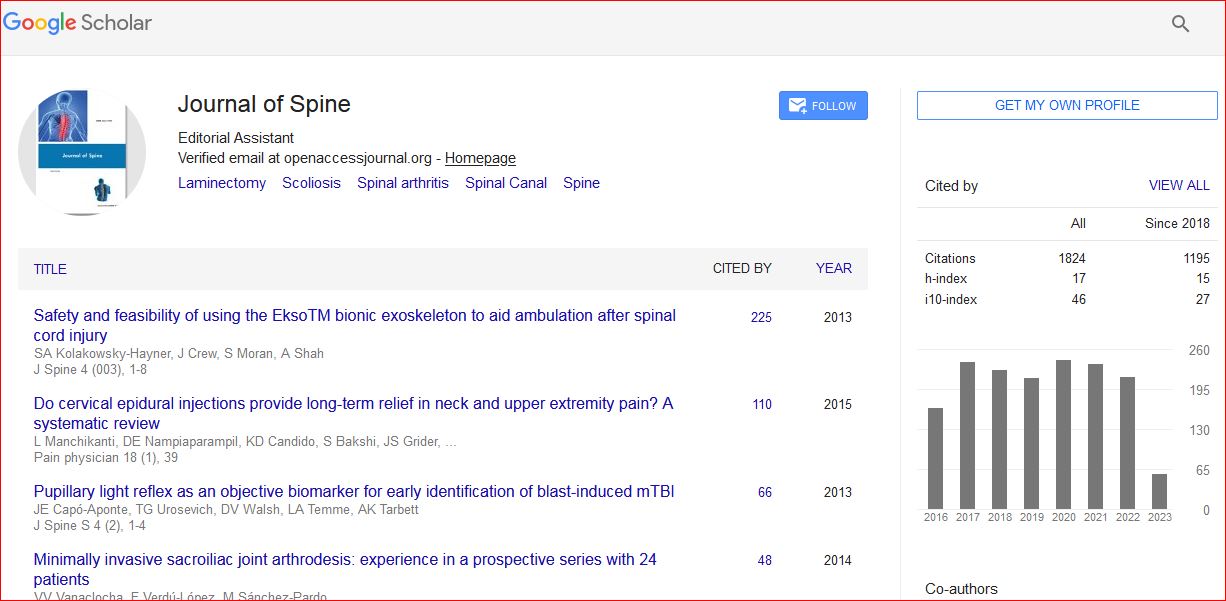
Journal of Spine received 2022 citations as per Google Scholar report