Short Communication - (2025) Volume 13, Issue 6
Received: 01-Dec-2025, Manuscript No. jaat-26-183194;
Editor assigned: 03-Dec-2025, Pre QC No. P-183194;
Reviewed: 17-Dec-2025, QC No. Q-183194;
Revised: 22-Dec-2025, Manuscript No. R-183194;
Published:
29-Dec-2025
, DOI: 10.37421/2329-6542.2025.13.390
Citation: Conti, Federico. ”Astrophysics’ Future: Innovation, AI, and Interstellar Dreams.” J Astrophys Aerospace Technol 13 (2025):390.
Copyright: © 2025 Conti F. This is an open-access article distributed under the terms of the Creative Commons Attribution License, which permits unrestricted use, distribution and reproduction in any medium, provided the original author and source are credited.
The landscape of astrophysical research is undergoing a profound transformation, marked by an unprecedented acceleration in the pace of innovation across multiple fronts. This progress is intrinsically linked to the development and deployment of cutting-edge observational technologies, enabling scientists to probe the universe with unparalleled detail and sensitivity. The James Webb Space Telescope, a monumental achievement in observational astronomy, stands as a prime example of this technological leap, opening new windows into the early universe and the formation of celestial objects. This scientific advancement is not occurring in isolation but is deeply intertwined with parallel progress in aerospace engineering and related technological fields. The synergy between astronomical discovery and aerospace capabilities is fostering the creation of novel solutions to long-standing observational challenges. The development of advanced propulsion systems, for instance, is becoming increasingly critical as missions aim to venture further into the solar system and beyond, facilitating more ambitious scientific exploration. The miniaturization of spacecraft, particularly in the form of CubeSats, is democratizing access to space for astrophysical research. These smaller, more cost-effective platforms are enabling dedicated missions focused on specific scientific goals, such as the high-resolution detection and characterization of exoplanets. Their modularity and rapid development cycles allow for quicker responses to emerging scientific questions and opportunities. Furthermore, the sheer volume of data generated by modern astronomical instruments presents a significant computational challenge, necessitating the development of sophisticated data processing techniques. The integration of artificial intelligence and machine learning algorithms is proving invaluable in sifting through vast datasets, identifying patterns, and extracting meaningful scientific insights that would otherwise remain hidden. Looking ahead, the scientific community is setting its sights on increasingly ambitious goals, including the design and deployment of interstellar probes. These missions, while technologically demanding, promise to provide direct observational data from beyond our solar system, revolutionizing our understanding of planetary science and the potential for life elsewhere in the galaxy. A key objective within this forward-looking vision is the enhanced characterization of exoplanetary atmospheres. The ability to analyze the chemical composition of these distant atmospheres will provide crucial clues about their formation, evolution, and potential habitability, bringing us closer to answering fundamental questions about our place in the cosmos. Simultaneously, fundamental questions about the universe's composition and evolution continue to drive research, particularly concerning the enigmatic nature of dark matter and dark energy. These pervasive but invisible components of the cosmos hold the key to understanding cosmic structure formation and the ultimate fate of the universe. The quest for life beyond Earth, a long-standing human fascination, is also experiencing a renaissance, fueled by advancements in astrobiology and the growing catalog of exoplanets. The search for biosignatures, indicators of life, is becoming an increasingly targeted and sophisticated endeavor. Underpinning these ambitious scientific endeavors is the continuous development of advanced materials and manufacturing techniques for spacecraft. Innovations in lightweight alloys, composites, and additive manufacturing are enabling the construction of more capable, durable, and efficient spacecraft and observational instruments. Finally, the engineering of next-generation space telescopes, including the sophisticated optical systems and control mechanisms required for their operation, remains a critical area of development. The precision and stability needed for instruments like the James Webb Space Telescope are pushing the boundaries of engineering, paving the way for future observational breakthroughs.
The accelerating pace of innovation in astrophysics is being significantly driven by advancements in observational instruments, with the James Webb Space Telescope serving as a prominent example. This progress is intrinsically linked to new theoretical frameworks that guide observations and interpret data. The synergy between astronomical discovery and aerospace technology is a defining characteristic of current research, leading to the development of novel propulsion systems essential for deep-space exploration. Furthermore, the miniaturization of satellites, particularly CubeSats, is revolutionizing astrophysical surveys by offering cost-effective platforms for high-resolution imaging and spectral analysis. Advanced data processing techniques, including artificial intelligence and machine learning, are crucial for handling the vast astronomical datasets generated by modern instruments. Future directions in astrophysics point towards ambitious goals such as developing interstellar probes capable of reaching other star systems. Concurrently, there is a strong focus on enhanced exoplanetary characterization, aiming to understand the potential habitability of worlds beyond our solar system. A deeper understanding of fundamental cosmological mysteries, such as dark matter and dark energy, remains a primary objective, necessitating the development of next-generation observatories. The search for life beyond Earth is also a key area of research, integrating telescopic observations with in-situ measurements. Advancements in materials science are critical for constructing more robust and capable spacecraft and telescopes, essential for the success of future missions. The intricate design and precise control of large-aperture space telescopes are vital for pushing the boundaries of observational astrophysics, enabling discoveries that were once unimaginable. Recent progress in electric propulsion, such as Hall thrusters and ion engines, along with promising concepts like nuclear thermal and nuclear electric propulsion, are crucial for enabling ambitious deep-space missions. These technologies are vital for reducing transit times to outer planets and Mars, impacting both scientific exploration and human spaceflight. The increasing capabilities of small satellites, often termed CubeSats, are revolutionizing astrophysical surveys. The miniaturization of telescopes and sensors allows these small spacecraft to conduct high-resolution imaging and spectral analysis. The cost-effectiveness and modularity of CubeSat constellations offer new avenues for dedicated missions, such as searching for exoplanets and studying transient astronomical events. The analysis of big data generated by modern astronomical instruments presents significant computational challenges. The application of artificial intelligence and machine learning algorithms for classifying galaxies, detecting anomalies in sky surveys, and optimizing telescope scheduling is essential for extracting meaningful scientific insights from the deluge of observational data. The prospect of interstellar travel is gradually becoming a tangible goal, with ongoing research examining the theoretical and engineering challenges associated with developing probes capable of reaching other star systems. Concepts like solar sails and advanced fusion propulsion are being explored. Characterizing the atmospheres of exoplanets is a key objective for understanding their potential habitability. State-of-the-art techniques, including transit spectroscopy and direct imaging, are employed to detect and analyze exoplanetary atmospheres. Future missions aim to achieve high-precision measurements of atmospheric composition. Understanding the nature of dark matter and dark energy remains one of the most significant challenges in modern cosmology. Advanced astronomical surveys and theoretical modeling are being used to probe these enigmatic components of the universe. The development of next-generation telescopes and particle detectors will be critical for unraveling their properties. The field of astrobiology is advancing rapidly, with a focus on identifying potential biosignatures on other planets and moons. The integration of telescopic observations with in-situ measurements from space probes is crucial. Future efforts will involve developing sophisticated instruments to detect complex organic molecules and atmospheric gases. The application of advanced materials in spacecraft construction is critical for enhancing performance and reducing mass. Developments in lightweight alloys, composites, and in-space manufacturing techniques are vital for enabling the construction of larger telescopes and more efficient propulsion systems. The design and operation of large-aperture telescopes in space require sophisticated control systems and optical technologies. Challenges include maintaining precise alignment and stability, with future directions in adaptive optics and coronagraphy for exoplanet imaging being crucial for pushing observational boundaries.
The field of astrophysics is experiencing rapid innovation driven by advanced observational instruments like the James Webb Space Telescope and new theoretical models. This progress is closely tied to aerospace technology, spurring developments in propulsion systems, miniaturized satellites for exoplanet detection, and sophisticated data processing using AI and machine learning. Future ambitions include interstellar probes, detailed exoplanet atmosphere characterization, and unraveling the mysteries of dark matter and dark energy. Astrobiology is also advancing, seeking biosignatures beyond Earth. Innovations in advanced materials for spacecraft and sophisticated optical systems for space telescopes are essential for these ambitious scientific goals.
None
None
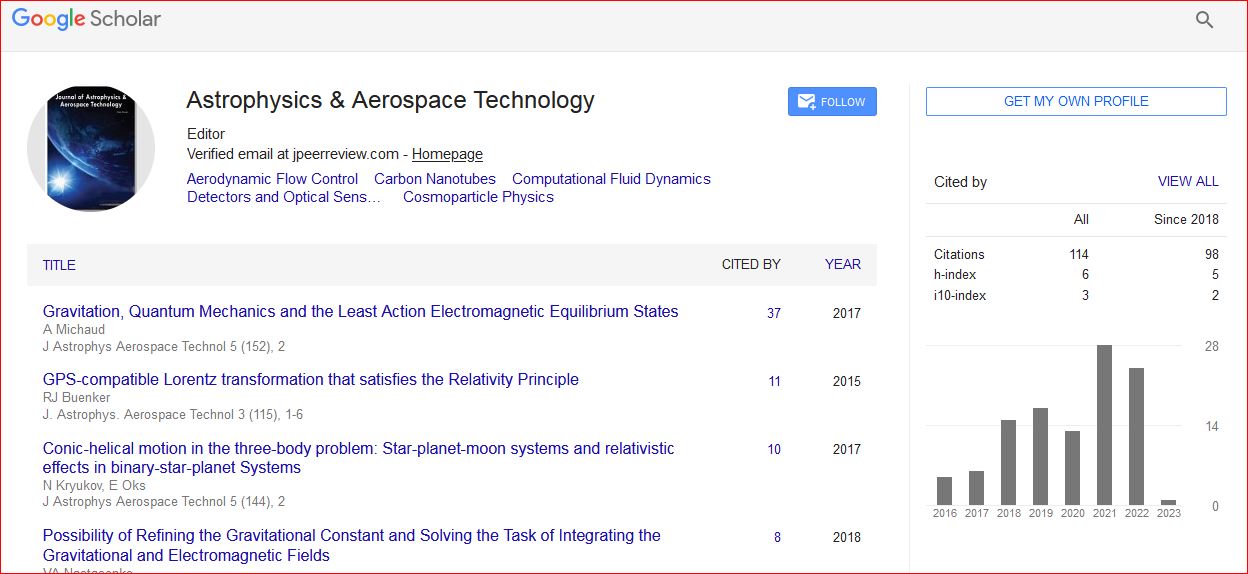
Astrophysics & Aerospace Technology received 114 citations as per Google Scholar report