Short Communication - (2025) Volume 13, Issue 4
Received: 04-Aug-2025, Manuscript No. jcdd-25-176821;
Editor assigned: 06-Aug-2025, Pre QC No. P-176821;
Reviewed: 20-Aug-2025, QC No. Q-176821;
Revised: 25-Aug-2025, Manuscript No. R-176821;
Published:
01-Sep-2025
, DOI: 10.37421/2329-9517.2025.13.687
Citation: Ali Rezaei. "Anticoagulation: Progress, Practicalities,
Future Horizons. "J Cardiovasc Dis Diagn 13 (2025):687.
Copyright: © 2025 R. Ali This is an open-access article distributed under the terms of the Creative Commons Attribution License, which permits unrestricted use, distribution
and reproduction in any medium, provided the original author and source are credited.
Anticoagulation therapy remains a cornerstone in the prevention and management of thrombotic events across a wide spectrum of clinical conditions. Direct oral anticoagulants (DOACs) have significantly advanced treatment paradigms. For patients suffering from atrial fibrillation, a crucial meta-analysis of real-world data demonstrates that DOACs are generally safer and more effective than warfarin for stroke prevention [1].
What this really means is a substantial reduction in strokes and systemic embolisms, coupled with a decreased risk of major bleeding events, especially within the brain, in day-to-day clinical practice [1].
The field of anticoagulation isn't standing still, with exciting new frontiers being explored beyond the current generation of DOACs. Researchers are actively investigating therapies like factor XI inhibitors, which show considerable promise [2].
Here's the thing: these novel agents are being developed with the aim of providing even better safety profiles, particularly concerning bleeding, while either maintaining or potentially boosting their antithrombotic effectiveness [2].
They are designed to address the unmet needs and limitations that existing anticoagulant treatments sometimes present [2].
Crucially, the ability to reverse anticoagulant effects is vital for patient safety. An important article outlines the current and developing strategies for reversing DOACs, detailing specific reversal agents such as idarucizumab and andexanet alfa [3].
What this really means is a deeper understanding of their mechanisms of action and how they are clinically applied when patients on DOACs encounter life-threatening bleeding episodes or require urgent surgical procedures [3].
This knowledge is essential for effective emergency management [3].
Anticoagulant treatment also plays a significant role in emerging health crises, like COVID-19. A systematic review and meta-analysis examined the efficacy and safety of anticoagulant therapy in COVID-19 patients, concluding that preventive doses may lower mortality and the incidence of blood clots in hospitalized individuals, particularly those who are severely ill [4].
This clearly highlights the vital contribution of anticoagulation in managing the pro-thrombotic complications frequently observed with COVID-19 [4].
Managing anticoagulation in specific patient populations, such as those with chronic kidney disease (CKD), requires careful consideration. A systematic review and meta-analysis focusing on atrial fibrillation patients with CKD found that DOACs are generally both effective and safe for this group [5].
However, itâ??s worth noting that some agents may offer better profiles depending on the stage of kidney disease, underscoring the absolute necessity for precise dose adjustments and tailored patient selection [5].
Perioperative management of patients on DOACs is a complex balancing act between preventing bleeding and avoiding thrombotic events during surgical procedures [6].
A practical review provides guidance on strategies for temporarily discontinuing these medications, assessing the need for 'bridging' therapy, and determining the appropriate time to restart DOACs [6].
The goal is always to minimize risks while ensuring patient safety [6].
Anticoagulation in pediatric patients presents unique challenges due to physiological differences and often limited clinical research. An updated overview of anticoagulation in children emphasizes that treating kids necessitates distinct considerations for dosing, monitoring, and mitigating bleeding risks, covering both traditional and newer anticoagulant options [7].
The complexities arise from a lack of extensive data and the specific needs of young patients [7].
For individuals with venous thromboembolism (VTE), determining the ideal duration of anticoagulation is a critical decision. A review delves into current guidelines and ongoing controversies, aiming to identify the optimal duration that prevents VTE recurrence while simultaneously keeping bleeding risks to a minimum [8].
This involves evaluating factors such as the VTEâ??s etiology, individual patient risk factors, and engaging in collaborative decision-making with the patient [8].
The advent of pharmacogenomics offers a pathway to more personalized anticoagulant therapy. A systematic review and meta-analysis investigated how genetic variations influence individual responses to anticoagulants, including warfarin and DOACs, and their associated side effects [9].
The core idea here is to identify key genetic markers to customize treatments, moving towards a future where anticoagulant regimens are precisely tailored to each patientâ??s genetic makeup [9].
Finally, cancer patients represent a particularly vulnerable group requiring specialized anticoagulation management due to their heightened risk of both thrombosis and hemorrhage [10].
A comprehensive review addresses current guidelines for VTE prevention and treatment in this population, tackling practical clinical challenges like drug interactions, managing low platelet counts, and selecting the most suitable anticoagulant agent [10].
This area demands careful clinical judgment to navigate complex patient needs [10].
Anticoagulation plays a vital role in preventing and managing thrombotic conditions across various patient populations, from those with atrial fibrillation to individuals facing critical illnesses like COVID-19. Studies consistently show that direct oral anticoagulants (DOACs) often outperform traditional treatments like warfarin. For instance, a meta-analysis of real-world studies found that DOACs significantly reduce stroke and systemic embolism, with a lower risk of major bleeding, especially intracranial hemorrhage, in atrial fibrillation patients compared to warfarin [1]. This evidence strongly supports the widespread adoption of DOACs as a first-line treatment in many cases.
Beyond established therapies, the field is rapidly advancing with novel anticoagulant agents. Here's the thing: new developments, such as factor XI inhibitors, are showing real promise [2]. These emerging therapies aim to offer enhanced safety, particularly in terms of bleeding risk, while maintaining or even improving antithrombotic effectiveness [2]. They are designed to fill current gaps in treatment, potentially offering alternatives for patients who may not tolerate existing anticoagulants well or who require different risk-benefit profiles. The ongoing exploration into these frontiers reflects a commitment to continually improving patient outcomes [2].
Managing complex patients on anticoagulants demands careful consideration of specific clinical scenarios. When patients on DOACs experience life-threatening bleeding or need urgent surgery, understanding reversal strategies is critical [3]. Research identifies specific reversal agents like idarucizumab and andexanet alfa, detailing their mechanisms and clinical application to mitigate risks [3]. Moreover, anticoagulant therapy has proven beneficial in emergent contexts like the COVID-19 pandemic. A systematic review and meta-analysis demonstrated that preventive doses of anticoagulants could reduce mortality and the risk of blood clots in hospitalized COVID-19 patients, especially those who are severely ill [4]. This highlights the crucial role of these treatments in managing the hypercoagulable state often seen in severe infections [4].
Special patient populations present unique challenges. For atrial fibrillation patients with chronic kidney disease (CKD), DOACs are generally effective and safe [5]. However, the choice and dosing of specific agents need careful adjustment based on the stage of kidney disease, underscoring the importance of individualized patient management [5]. Similarly, perioperative management of DOACs is a delicate balance. A review offers practical strategies for temporary discontinuation, potential bridging therapy, and restarting DOACs to balance bleeding and thrombotic risks during surgical procedures [6]. These guidelines are essential for safely navigating surgical interventions in anticoagulated patients [6].
Treating children with anticoagulants presents its own set of complexities, differing significantly from adult protocols due to physiological differences and limited specific pediatric research [7]. An updated overview highlights the unique challenges in dosing, monitoring, and managing bleeding risks in young patients, encompassing both traditional and newer anticoagulants [7]. Furthermore, determining the appropriate duration of anticoagulation for venous thromboembolism (VTE) is a critical decision, balancing recurrence prevention against bleeding risks [8]. This involves considering VTE etiology, patient risk factors, and shared decision-making, acknowledging ongoing controversies in this area [8].
Finally, personalized medicine and complex patient demographics are shaping future anticoagulation strategies. Pharmacogenomics, the study of how genes affect a person's response to drugs, is offering insights into how genetic variations impact anticoagulant efficacy and side effects for drugs like warfarin and DOACs [9]. The aim is to tailor treatments based on an individual's genetic profile, moving towards precision medicine [9]. Moreover, cancer patients are particularly vulnerable to both thrombosis and bleeding, making their anticoagulation management highly complex [10]. Current guidelines address specific challenges such as drug interactions, low platelet counts, and selecting the most appropriate anticoagulant agent for this population, requiring careful clinical judgment [10]. These diverse applications and ongoing research efforts collectively aim to enhance the safety and efficacy of anticoagulation for all patients [10].
The provided research highlights broad advancements and challenges in anticoagulation therapy. A core finding is the superior safety and effectiveness of Direct Oral Anticoagulants (DOACs) compared to warfarin for stroke prevention in atrial fibrillation, showing reduced stroke, systemic embolism, and major bleeding, especially intracranial hemorrhage [1]. The field is also pushing forward with novel therapies like factor XI inhibitors, which promise even better safety profiles, specifically regarding bleeding risks, while maintaining or boosting antithrombotic effectiveness [2]. Beyond new drug development, practical management strategies are crucial. This includes understanding the mechanisms and clinical use of specific agents like idarucizumab and andexanet alfa for reversing DOAC effects in emergency bleeding or urgent surgical scenarios [3]. Furthermore, anticoagulation has demonstrated critical benefits in specific high-risk contexts, such as reducing mortality and blood clots in hospitalized COVID-19 patients, particularly the severely ill, when administered in preventive doses [4]. Managing anticoagulation extends to diverse patient groups. For atrial fibrillation patients with chronic kidney disease, DOACs are generally found to be safe and effective, though careful dose adjustments and patient selection based on kidney disease stage are vital [5]. Perioperative management of DOACs also requires precise strategies for temporary discontinuation, bridging therapy, and restarting medications to balance bleeding and clotting risks during surgery [6]. Specialized considerations are also needed for pediatric patients due to physiological differences and limited research, focusing on dosing, monitoring, and bleeding risk management [7]. The duration of anticoagulation for venous thromboembolism involves ongoing debate, aiming to strike a balance between preventing recurrence and minimizing bleeding, influenced by VTE cause and patient factors [8]. Lastly, personalized medicine is on the horizon through pharmacogenomics, identifying genetic markers to tailor anticoagulant treatments like warfarin and DOACs for individual responses and side effects [9]. Complex challenges remain in managing anticoagulation for cancer patients, who are highly vulnerable to both clots and bleeding, requiring adherence to guidelines on drug interactions, platelet counts, and appropriate agent selection [10].
Indexed at, Google Scholar, Crossref
Indexed at, Google Scholar, Crossref
Indexed at, Google Scholar, Crossref
Indexed at, Google Scholar, Crossref
Indexed at, Google Scholar, Crossref
Indexed at, Google Scholar, Crossref
Indexed at, Google Scholar, Crossref
Indexed at, Google Scholar, Crossref
Indexed at, Google Scholar, Crossref
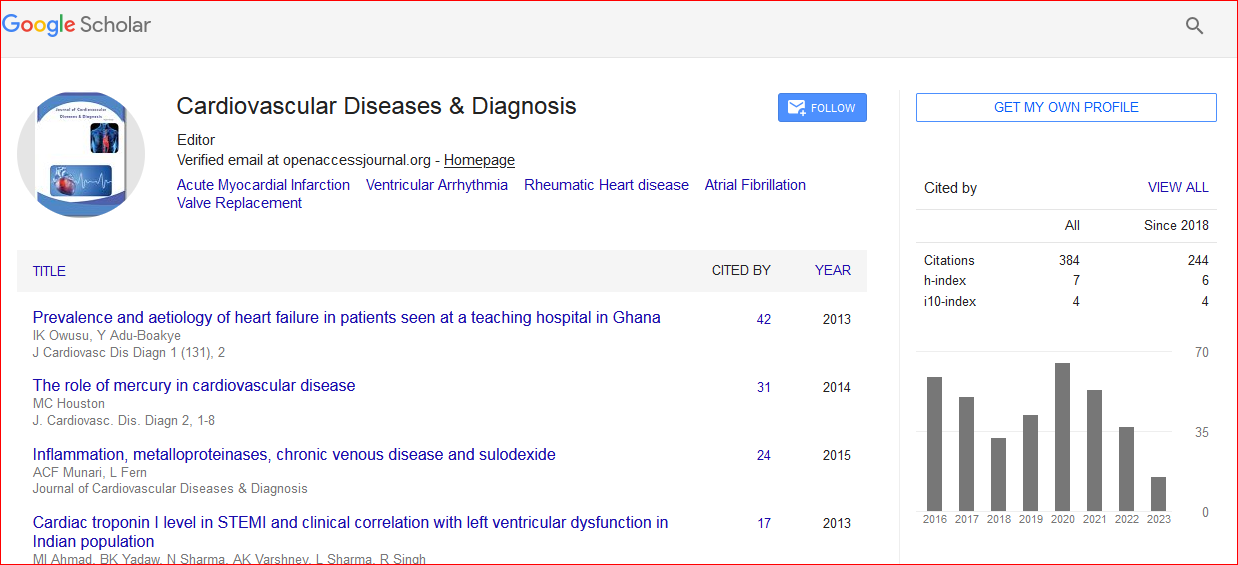
Cardiovascular Diseases & Diagnosis received 427 citations as per Google Scholar report