Short Communication - (2025) Volume 12, Issue 3
Received: 01-Jun-2025, Manuscript No. jreac-26-185791;
Editor assigned: 03-Jun-2025, Pre QC No. P-185791;
Reviewed: 17-Jun-2025, QC No. Q-185791;
Revised: 23-Jun-2025, Manuscript No. R-185791;
Published:
30-Jun-2025
, DOI: 10.37421/2380-2391.2025.12.427
Citation: Novak, Katarina. ”Groundwater Heavy Metal: Detection, Risk, and Management.” J Environ Anal Chem 12 (2025):427.
Copyright: © 2025 Novak K. This is an open-access article distributed under the terms of the Creative Commons Attribution License, which permits unrestricted use, distribution and reproduction in any medium, provided the original author and source are credited.
Heavy metal contamination in groundwater represents a significant and persistent environmental challenge, necessitating robust analytical techniques for its detection and evaluation [1].
The comprehensive overview provided in the Journal of Environmental Analytical Chemistry details established and emerging methodologies, stressing their sensitivity, selectivity, and applicability for various metal species, alongside a critical examination of risk evaluation frameworks and management strategies [1].
Advanced spectroscopic methods, including Inductively Coupled Plasma-Mass Spectrometry (ICP-MS) and Atomic Absorption Spectrometry (AAS), are pivotal for the accurate quantification of trace heavy metals in groundwater, with a strong emphasis on sample preparation and the mitigation of matrix effects [2].
The development of portable and field-deployable sensors for real-time monitoring is a crucial advancement in enabling rapid risk assessment of groundwater quality [2].
Electrochemical sensing platforms have emerged as promising tools for detecting specific heavy metals like lead and cadmium in groundwater, offering advantages in fabrication, performance characteristics, and cost-effectiveness for widespread surveillance [3].
The fabrication of novel electrode materials and their performance metrics, such as detection limits and response times, are key considerations in the efficacy of these electrochemical methods [3].
Hyphenated techniques, such as Gas Chromatography-ICP-MS and Liquid Chromatography-ICP-MS, are instrumental in the speciation analysis of heavy metals within complex groundwater matrices, a critical step for understanding their toxicity and bioavailability [4].
These techniques are crucial for accurately assessing the environmental and health risks associated with different chemical forms of metals present in groundwater [4].
The advent of portable sensor systems, exemplified by Surface Plasmon Resonance (SPR) technology, offers rapid and on-site detection of specific heavy metals like arsenic and mercury, enhancing immediate risk assessment capabilities, particularly in remote or emergency scenarios [5].
The practical implementation and field applicability of these advanced analytical tools are paramount for effective groundwater monitoring and management [5].
Microfluidic devices integrated with electrochemical detection present an efficient approach for the simultaneous analysis of multiple heavy metal ions in groundwater, offering benefits such as reduced sample and reagent consumption, faster analysis, and improved sensitivity [6].
The performance evaluation of such microfluidic systems is vital for accurately assessing potential health risks from complex mixtures of heavy metals [6].
Nanomaterial-based sensors are at the forefront of advancements in detecting heavy metals in environmental water, with functionalized nanoparticles and nanocomposites significantly enhancing the sensitivity and selectivity of analytical methods [7].
Addressing the challenges and opportunities in applying these novel nanomaterials in routine groundwater quality monitoring is crucial for effective risk assessment [7].
Probabilistic risk assessment models, which incorporate exposure assessment and toxicological endpoints, provide a comprehensive framework for understanding the health risks associated with heavy metal contamination in groundwater [8].
These models emphasize the importance of considering diverse exposure pathways and population sensitivities to prioritize remediation efforts effectively [8].
Field-portable X-ray fluorescence (XRF) spectroscopy offers a rapid screening solution for heavy metals in groundwater, minimizing sample preparation and enabling non-destructive analysis at the point of sampling [9].
The utility of XRF in preliminary risk assessment and identifying areas for further detailed investigation is a significant advantage for environmental monitoring [9].
The ecological implications of mixed heavy metal exposure in groundwater require careful investigation, as the toxicity of individual metals can be altered in mixtures, necessitating sophisticated analytical characterization and correlation with biological impacts for accurate ecological risk assessment [10].
The landscape of environmental science is continually shaped by the persistent threat of heavy metal contamination in water resources, with groundwater being a particularly vulnerable and vital source [1].
Addressing this challenge requires sophisticated analytical approaches to accurately identify and quantify these pollutants [1].
A foundational understanding of these techniques, coupled with a thorough risk evaluation framework, is indispensable for safeguarding public health and ecosystem integrity [1].
The development and refinement of analytical methodologies have seen significant progress, moving towards greater sensitivity, selectivity, and real-world applicability across a spectrum of heavy metal species [1].
In the realm of trace element analysis, advanced spectroscopic techniques stand out for their precision and accuracy [2].
ICP-MS and AAS, renowned for their ability to quantify minute concentrations of heavy metals, are critical tools in groundwater monitoring [2].
However, the reliability of these methods hinges on meticulous sample preparation and a keen awareness of potential matrix effects, which can significantly influence analytical outcomes [2].
The drive towards immediate and accessible environmental monitoring has spurred the development of portable sensors, enabling on-site, real-time assessment of groundwater quality and facilitating prompt risk evaluation [2].
Electrochemical sensing platforms represent an innovative and often cost-effective avenue for heavy metal detection [3].
Specifically, the detection of metals like lead and cadmium in groundwater samples can be effectively achieved using these platforms [3].
The scientific community's focus has been on the fabrication of novel electrode materials and the rigorous evaluation of their performance, including crucial parameters like detection limits and response times, to ensure their suitability for environmental surveillance [3].
The complexity of groundwater matrices often necessitates more advanced analytical strategies, such as hyphenated techniques [4].
The combination of separation science with elemental analysis, for instance, GC-ICP-MS and LC-ICP-MS, allows for the crucial speciation of heavy metals [4].
Understanding the specific chemical forms of metals is paramount for a precise assessment of their toxicity and bioavailability, which directly informs risk assessment [4].
Beyond laboratory-based analysis, the demand for rapid, on-site detection has led to the development of innovative portable sensor systems [5].
Technologies like Surface Plasmon Resonance (SPR) have been successfully applied for the swift identification of arsenic and mercury in groundwater, providing immediate risk assessment capabilities, especially in remote regions or during environmental emergencies [5].
The practical implementation and field applicability of such advanced tools are key to their widespread adoption [5].
Further advancements in analytical instrumentation include microfluidic devices integrated with electrochemical detection [6].
These systems are designed for the simultaneous analysis of multiple heavy metal ions, offering significant advantages in terms of reduced sample and reagent consumption, accelerated analysis times, and enhanced sensitivity [6].
Evaluating the performance of these integrated microfluidic systems is essential for assessing the potential health risks posed by mixtures of heavy metals [6].
In parallel, the exploration of nanomaterials has opened new horizons in sensor technology for heavy metal detection [7].
Nanomaterial-based sensors, leveraging the unique properties of functionalized nanoparticles and nanocomposites, offer substantial improvements in both sensitivity and selectivity [7].
Overcoming the challenges and capitalizing on the opportunities presented by these novel nanomaterials will be critical for their integration into routine groundwater quality monitoring and risk assessment protocols [7].
Complementing the analytical advancements, robust risk assessment models are essential for interpreting the data and informing policy decisions [8].
Probabilistic risk assessment models, which integrate exposure assessment with toxicological endpoints, provide a quantitative framework for evaluating the health risks associated with heavy metal contamination [8].
These models underscore the importance of considering various exposure pathways and population sensitivities to effectively prioritize remediation efforts [8].
The need for rapid, field-based screening has driven the development of portable analytical techniques like X-ray fluorescence (XRF) spectroscopy [9].
This method allows for the rapid and non-destructive screening of heavy metals directly at the sampling site, requiring minimal sample preparation [9].
Its utility in preliminary risk assessment and identifying areas that warrant more in-depth laboratory analysis makes it an invaluable tool for initial environmental evaluations [9].
Finally, the ecological impact of heavy metal contamination cannot be overstated, particularly when metals are present in mixtures [10].
Research into the synergistic and antagonistic effects of these mixtures on aquatic organisms is vital for accurate ecological risk assessment [10].
The use of advanced analytical techniques to characterize metal composition and correlate it with observed biological impacts provides crucial insights into the complex ecotoxicological consequences of groundwater pollution [10].
The broad spectrum of analytical techniques for detecting heavy metal contamination in groundwater is a subject of extensive research, with a focus on both established and novel methodologies [1].
These techniques are assessed based on their sensitivity, selectivity, and applicability to different metal species, forming the backbone of environmental monitoring and risk assessment [1].
The Journal of Environmental Analytical Chemistry provides a comprehensive overview, highlighting the importance of these analytical advancements alongside robust risk evaluation frameworks that consider health and ecological impacts [1].
Inductively Coupled Plasma-Mass Spectrometry (ICP-MS) and Atomic Absorption Spectrometry (AAS) are cornerstones in the accurate quantification of trace heavy metals in groundwater [2].
These advanced spectroscopic methods demand rigorous attention to sample preparation protocols to minimize the influence of matrix effects on the analytical results [2].
Furthermore, the evolution of this field is marked by the development of portable and field-deployable sensors, which significantly enhance the capacity for real-time monitoring and rapid risk assessment of groundwater quality [2].
Electrochemical sensing platforms offer a compelling alternative for the detection of heavy metals, such as lead and cadmium, in groundwater samples [3].
The research in this area details the fabrication of novel electrode materials and the careful characterization of their performance, including critical metrics like detection limits and response times [3].
The inherent advantages of electrochemical methods, including cost-effectiveness and miniaturization potential, make them highly suitable for extensive environmental surveillance and risk assessment [3].
For intricate groundwater matrices, hyphenated techniques have become indispensable for comprehensive heavy metal analysis [4].
Methods like Gas Chromatography-ICP-MS and Liquid Chromatography-ICP-MS are vital for speciation analysis, which is fundamental to accurately evaluating the toxicity and bioavailability of different metal forms [4].
Case studies demonstrate the successful application of these techniques in identifying various chemical species and assessing their associated environmental and health risks [4].
The pursuit of rapid, on-site detection solutions has led to the development of portable sensor systems, such as those based on Surface Plasmon Resonance (SPR) [5].
These SPR sensors are designed for the swift detection of specific heavy metals like arsenic and mercury directly in groundwater, offering immediate risk assessment capabilities essential for emergency situations or remote monitoring [5].
The focus here is on the practical implementation and field applicability of these advanced analytical tools [5].
Microfluidic devices integrated with electrochemical detection represent an efficient and integrated approach for the simultaneous analysis of multiple heavy metal ions in groundwater [6].
This technology offers notable benefits, including reduced consumption of samples and reagents, faster analysis turnaround times, and improved analytical sensitivity [6].
The performance evaluation of these microfluidic systems is crucial for their application in assessing the health risks associated with complex mixtures of heavy metals found in groundwater [6].
Nanomaterial-based sensors are emerging as a powerful class of tools for detecting heavy metals in environmental water samples [7].
The utilization of functionalized nanoparticles and nanocomposites significantly enhances the sensitivity and selectivity of analytical methods [7].
The scientific community is actively addressing the challenges and exploring the opportunities associated with applying these novel nanomaterials in routine groundwater quality monitoring and risk assessment efforts [7].
Beyond detection, robust risk assessment models are critical for interpreting the potential impacts of heavy metal contamination [8].
Probabilistic risk assessment models, which meticulously incorporate exposure assessment and relevant toxicological endpoints, provide a comprehensive framework for evaluating health risks [8].
These models highlight the importance of considering diverse exposure pathways and the varying sensitivities of human populations to effectively prioritize remediation strategies based on quantifiable health risks [8].
For rapid, preliminary assessments in the field, portable X-ray fluorescence (XRF) spectroscopy offers a valuable solution for screening heavy metals in groundwater [9].
The advantages of XRF for on-site analysis include its non-destructive nature and minimal sample preparation requirements, making it ideal for initial environmental surveys [9].
This technique is particularly useful in identifying areas that may require more detailed laboratory analysis and in preliminary risk assessment processes [9].
Finally, understanding the ecological consequences of heavy metal contamination, especially in the context of mixtures, is paramount for environmental protection [10].
Research investigating the synergistic and antagonistic effects of mixed heavy metal exposure on aquatic organisms is crucial for ecological risk assessment [10].
The application of advanced analytical techniques to characterize metal compositions and correlate them with observed biological impacts provides essential data for assessing these complex ecological risks in contaminated groundwater [10].
This collection of research addresses the critical issue of heavy metal contamination in groundwater, focusing on advanced analytical techniques and risk assessment methodologies. Various spectroscopic and electrochemical methods, including ICP-MS, AAS, and novel sensing platforms, are detailed for accurate quantification and detection. The importance of speciation analysis using hyphenated techniques and the development of portable sensors for on-site monitoring are highlighted. Microfluidic systems and nanomaterial-based sensors offer enhanced sensitivity and efficiency. Risk assessment models, both probabilistic and ecological, are presented to evaluate health and environmental impacts, guiding remediation efforts. Field-portable techniques like XRF spectroscopy are also discussed for rapid screening. The overall aim is to provide comprehensive tools and frameworks for effective groundwater quality monitoring and management to mitigate the risks associated with heavy metal pollution.
None
None
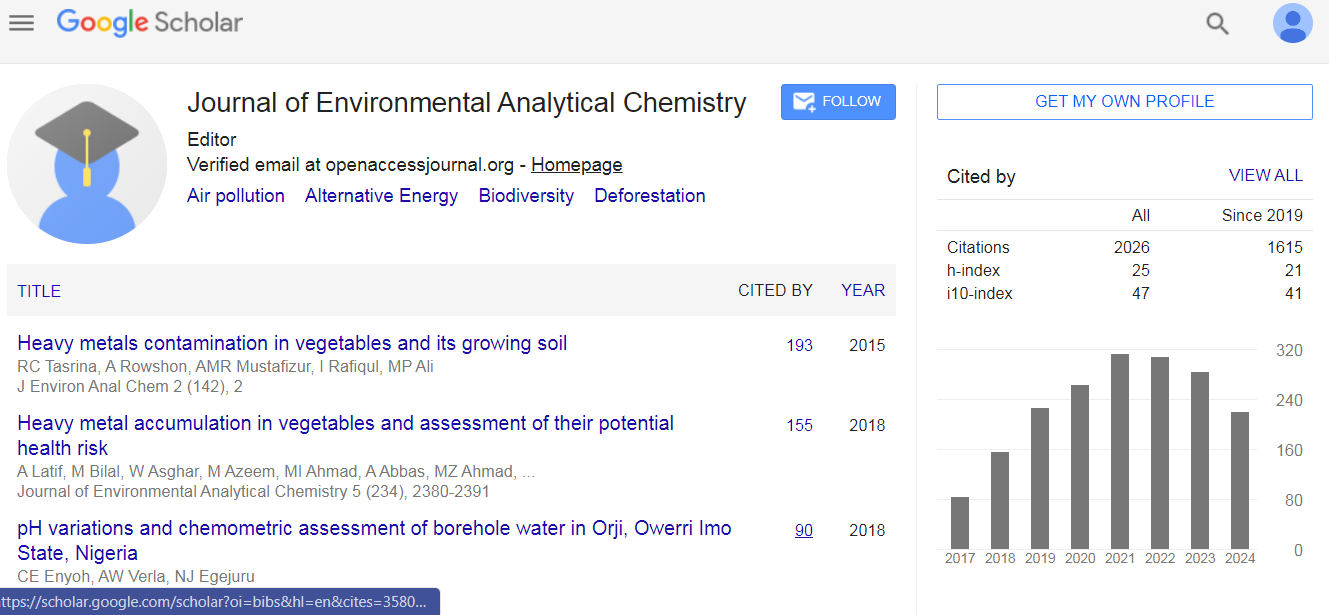
Journal of Environmental Analytical Chemistry received 1781 citations as per Google Scholar report