Opinion - (2025) Volume 12, Issue 6
Received: 01-Dec-2025, Manuscript No. jreac-26-185806;
Editor assigned: 03-Dec-2025, Pre QC No. P-185806;
Reviewed: 17-Dec-2025, QC No. Q-185806;
Revised: 22-Dec-2025, Manuscript No. R-185806;
Published:
29-Dec-2025
, DOI: 10.37421/2380-2391.2025.12.464
Citation: Boateng, Kwame. ”Analytical Chemistry: Guarding Environment and Public Health.” J Environ Anal Chem 12 (2025):464.
Copyright: © 2025 Boateng K. This is an open-access article distributed under the terms of the Creative Commons Attribution License, which permits unrestricted use,
distribution and reproduction in any medium, provided the original author and source are credited.
The indispensable role of analytical chemistry in environmental monitoring and regulation is underscored by its critical function in ensuring environmental legislation and policy are both effective and enforceable. Advancements in techniques such as spectroscopy, chromatography, and mass spectrometry provide the precise data essential for monitoring pollution levels, assessing environmental impact, and verifying compliance, thereby safeguarding public health and ecosystems. This foundation of reliable analytical data is crucial for sound environmental decision-making, from setting regulatory standards to prosecuting polluters [1].
Novel sensors represent a significant leap in enhancing real-time environmental monitoring capabilities, which are increasingly vital for adapting to evolving environmental policies. The development and application of electrochemical and optical sensors for detecting specific pollutants like heavy metals and volatile organic compounds in complex matrices are crucial for rapid response and targeted interventions mandated by legislation. Such innovations are key to the practical implementation of environmental laws [2].
The practicality of enforcing environmental regulations is significantly enhanced by the application of portable and field-deployable analytical instruments. Techniques like portable X-ray fluorescence (pXRF) and handheld Raman spectroscopy allow for on-site assessment of contamination, accelerating compliance checks and reducing reliance on costly laboratory analyses. Policies that encourage or mandate these field-based approaches are supported by such practical advancements [3].
Assessing the environmental impact of emerging contaminants, a focal point of modern environmental policy, necessitates robust analytical methods. The challenges posed by microplastics, pharmaceuticals, and per- and polyfluoroalkyl substances (PFAS) require sophisticated techniques like LC-MS/MS and GC-MS/MS for their detection and quantification. This research informs policy development by highlighting critical data gaps and analytical needs for these complex substances [4].
Significant advancements in atmospheric analytical chemistry are vital for supporting air quality legislation and policy. Techniques for monitoring criteria pollutants, greenhouse gases, and secondary pollutants, with an emphasis on speciation and isotopic analysis for source apportionment, refine our understanding. These enhanced analytical capabilities are essential for developing and evaluating targeted air pollution control strategies [5].
The management of water resources and related policies heavily rely on the application of analytical chemistry. Methods for detecting and quantifying a wide array of contaminants in various water bodies, including pesticides, pharmaceuticals, and heavy metals, are fundamental. Accurate and reliable analytical data is indispensable for setting water quality standards and ensuring the protection of aquatic ecosystems as mandated by environmental laws [6].
Advanced spectroscopic techniques, such as Laser-Induced Breakdown Spectroscopy (LIBS) and Inductively Coupled Plasma Optical Emission Spectrometry (ICP-OES), offer rapid screening and analysis of solid waste and contaminated soils. These methods provide crucial data for waste management policies, remediation efforts, and the assessment of hazardous materials, thereby contributing to more efficient environmental regulation [7].
The characterization of contaminated land and the development of effective remediation strategies are critically supported by analytical chemistry. Various soil extraction and analytical techniques, including GC-MS and HPLC, are employed to understand the extent and nature of contamination. Precise analytical data is indispensable for risk assessment and the creation of legally sound remediation strategies [8].
Ensuring the legal defensibility of environmental legislation hinges on the validation of analytical methods. The establishment of reliable, accurate, and reproducible methods that can withstand legal scrutiny is paramount. Validated methods are essential for enforcing pollution limits, monitoring compliance, and maintaining the integrity of data used in policy decisions and legal proceedings [9].
International environmental agreements, particularly those addressing persistent organic pollutants (POPs), require sophisticated analytical methods for monitoring trace levels. Advanced chromatographic and mass spectrometric techniques, such as HRMS, are crucial for identifying and quantifying POPs. Advancements in these methods are indispensable for the effective implementation and enforcement of policies aimed at controlling these hazardous substances [10].
The critical role of analytical techniques in environmental monitoring and regulation is evident in their contribution to making environmental legislation and policy effective and enforceable. Techniques like spectroscopy, chromatography, and mass spectrometry provide the precise data required to monitor pollution, assess impact, and verify compliance, which is fundamental for public health and ecosystem protection. This reliance on analytical data informs all levels of environmental decision-making, from standard-setting to legal enforcement [1].
Innovative analytical tools, particularly novel sensors, are advancing real-time environmental monitoring, which is essential for evolving environmental policies. Electrochemical and optical sensors designed to detect specific pollutants in complex environments allow for rapid responses and targeted interventions, aligning with legislative mandates. These sensor advancements are key to proactive environmental management [2].
For practical enforcement of environmental regulations, portable and field-deployable analytical instruments are invaluable. Methods such as portable X-ray fluorescence (pXRF) and handheld Raman spectroscopy enable on-site contamination assessments, streamlining compliance checks and reducing laboratory costs. This supports policies that promote efficient, on-the-ground environmental monitoring [3].
Addressing the environmental impact of emerging contaminants, a significant concern for current environmental policy, demands advanced analytical methodologies. Microplastics, pharmaceuticals, and PFAS present unique detection and quantification challenges that are being met by techniques like LC-MS/MS and GC-MS/MS. This analytical progress is vital for informing policies that manage these complex substances [4].
Air quality legislation and policy are substantially supported by analytical chemistry advancements in atmospheric monitoring. Refined techniques for analyzing criteria pollutants, greenhouse gases, and secondary pollutants, including speciation and isotopic analysis, are critical. These improved analytical capabilities are essential for developing effective strategies to control air pollution [5].
Water resource management and policy are built upon the foundation of analytical chemistry for water quality assessment. The ability to detect and quantify a wide spectrum of contaminants in water bodies ensures that water quality standards are met and aquatic ecosystems are protected, as required by environmental laws. This analytical rigor is central to sustainable water management [6].
Solid waste management and contaminated soil remediation policies benefit greatly from advanced spectroscopic methods like LIBS and ICP-OES. These techniques facilitate rapid screening and analysis, providing essential data for policy formulation, remediation planning, and hazardous material assessment, leading to more effective environmental regulation [7].
Policies concerning contaminated land remediation are critically dependent on analytical chemistry for detailed soil analysis. Techniques such as GC-MS and HPLC are used to thoroughly characterize soil contamination. The precision of this analytical data is fundamental for accurate risk assessments and the development of effective, legally sound remediation strategies [8].
The legal enforceability of environmental legislation is directly tied to the validation of analytical methods. Ensuring that these methods are reliable, accurate, and reproducible is crucial for their acceptance in legal contexts. Validated methods are indispensable for compliance monitoring and the integrity of environmental data in policy and legal decisions [9].
Monitoring trace levels of persistent organic pollutants (POPs) under international environmental agreements relies heavily on advanced analytical techniques. Sophisticated chromatographic and mass spectrometric methods, including HRMS, are essential for identifying and quantifying these substances. Progress in these analytical methods directly supports the implementation and enforcement of global environmental policies [10].
This collection of research highlights the pivotal role of analytical chemistry in shaping and enforcing environmental legislation and policy. From traditional techniques like spectroscopy and chromatography to advanced methods for emerging contaminants and real-time monitoring, analytical science provides the essential data for informed decision-making. This includes assessing pollution, managing water resources, monitoring air quality, addressing contaminated land, and ensuring compliance with international agreements. The development of portable instruments and validated methods further strengthens the practical application and legal defensibility of environmental regulations, ultimately safeguarding public health and ecosystems. The research underscores a continuous need for innovation in analytical techniques to meet the evolving challenges of environmental protection.
None
None
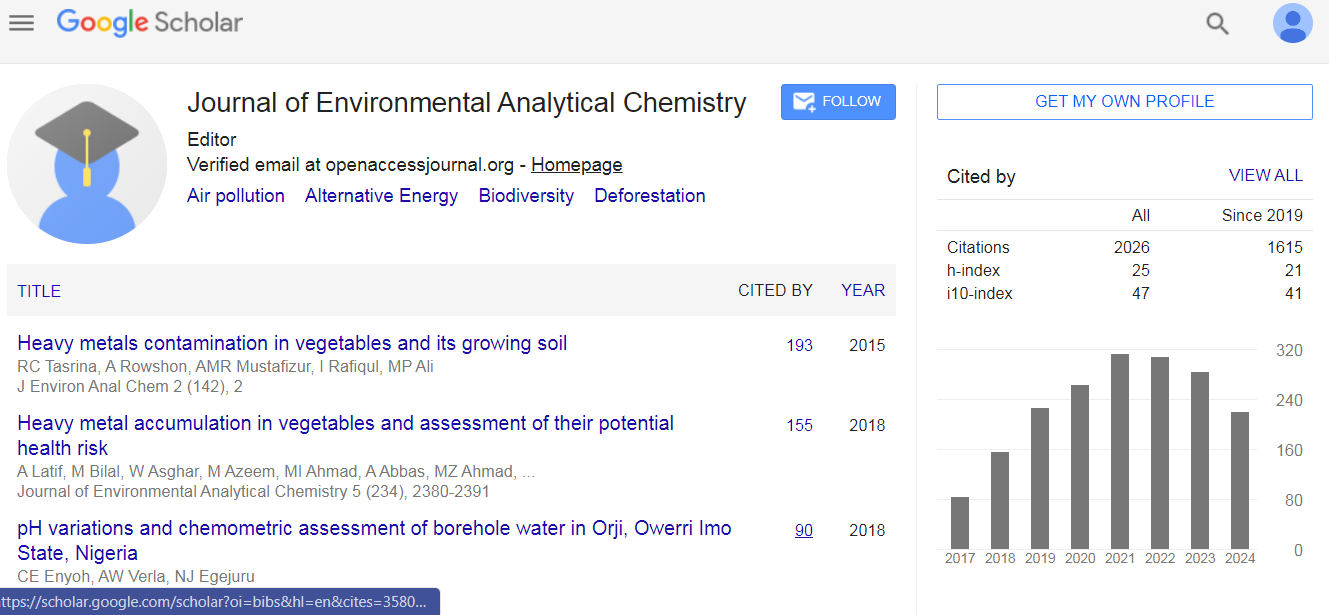
Journal of Environmental Analytical Chemistry received 1781 citations as per Google Scholar report