Opinion - (2025) Volume 16, Issue 5
Received: 01-Sep-2025, Manuscript No. hycr-25-174503;
Editor assigned: 03-Sep-2025, Pre QC No. P-174503;
Reviewed: 17-Sep-2025, QC No. Q-174503;
Revised: 22-Sep-2025, Manuscript No. R-174503;
Published:
29-Sep-2025
, DOI: 10.37421/2157-7587.2025.16.619
Citation: Martens, Olivia. ”Altered Streamflow: Human Drivers, Extreme Futures, Management.” Hydrol Current Res 16 (2025):619.
Copyright: © 2025 Martens O. This is an open-access article distributed under the terms of the Creative Commons Attribution License, which permits unrestricted use,
distribution and reproduction in any medium, provided the original author and source are credited.
The Earth's hydrological regimes are undergoing significant transformations, with global streamflow trends profoundly impacted by a complex interplay of climate change, evolving land use patterns, and various human interventions, notably damming. A comprehensive grasp of these fundamental drivers is critically important for the effective management of water resources, especially in the face of escalating global changes and the increasing frequency of extreme flow events, which demand urgent attention and adaptive strategies [1].
Investigating these dynamics further, an innovative attribution framework has been instrumental in delineating the primary drivers behind observed streamflow alterations across the world's major river basins. This research underscores that while natural climate variability continues to exert a substantial influence, human activities, particularly through extensive water abstractions and significant land use modifications, are progressively becoming the predominant factors reshaping global streamflow patterns. This evolving dominance necessitates the development and implementation of highly integrated water management strategies to address these complex challenges effectively [2].
Beyond broad climate and human activities, specific land cover changes, such as forest management practices, have been shown to significantly influence streamflow characteristics, particularly in temperate regions. Findings from a global meta-analysis reveal that practices like afforestation and reforestation generally contribute to a reduction in streamflow, whereas activities such as deforestation and timber harvesting often lead to an increase. This highlights the indispensable role of land cover changes in determining regional water availability and influencing localized hydrological cycles [3].
Looking towards the future, various climate change scenarios project substantial alterations in the frequency and intensity of global extreme streamflow events. Projections indicate that escalating warming levels will likely result in more frequent and intense flood events across numerous regions, while simultaneously exacerbating prolonged droughts in other areas. This dual threat unequivocally points to an urgent need for the development and adoption of robust adaptive water management strategies. Such measures are essential to mitigate the escalating risks to global water security and critical infrastructure [4].
Furthermore, the rapid pace of urbanization exerts a profound and often detrimental impact on both streamflow dynamics and sediment yield within rapidly developing catchments. The proliferation of impervious surfaces, a hallmark of urban expansion, contributes to significantly higher peak flows and a corresponding reduction in baseflows. Concurrently, increased erosion rates in construction areas lead to elevated sediment loads in water bodies. Collectively, these urbanization-driven changes fundamentally disrupt natural hydrological processes and present considerable challenges for sustainable urban water resource management [5].
To effectively monitor, understand, and predict these intricate hydrological shifts, the development and application of advanced modeling tools are becoming indispensable. Here, machine learning models are emerging as exceptionally powerful instruments for long-term streamflow forecasting, particularly when applied to complex climate change scenarios. These advanced algorithms possess the unique capability to capture highly non-linear relationships within hydrological data, thereby offering substantially improved accuracy compared to more traditional hydrological models. This technological advancement significantly enhances our collective ability to predict future water availability and proactively manage the risks associated with droughts [6].
A crucial, yet often overlooked, aspect of hydrological health involves groundwater-streamflow interactions. These interactions are fundamental not only for maintaining healthy aquatic ecosystems but also for preserving water quality. However, they are increasingly under threat from changing climatic conditions and intensified land use. A global perspective reveals how altered precipitation patterns, combined with increased groundwater abstraction, directly modify baseflow contributions to streams. This, in turn, has cascading effects on aquatic habitats and significantly impacts downstream water availability for various uses [7].
Agricultural land use practices also have a profound and widespread impact on both the quantity and quality of streamflow. Intensive farming methods frequently lead to increased surface runoff, which often carries significant nutrient and pesticide loading into aquatic ecosystems, adversely affecting their delicate balance. Therefore, promoting and implementing sustainable agricultural practices is not merely beneficial but absolutely crucial for mitigating these negative environmental impacts and safeguarding the long-term health and integrity of stream environments [8].
For regions heavily reliant on snowmelt, the integration of conceptual hydrological models with advanced satellite snow products represents a significant leap forward in improving the accuracy of snowmelt-driven streamflow forecasting. This powerful synergy provides more reliable predictions that are critically important for comprehensive water resources management in snow-dominated areas. Such precision is vital for supporting key economic sectors, including agriculture, hydropower generation, and effective flood control initiatives [9].
Ultimately, the overarching importance of effective watershed management cannot be overstated. It is truly vital for regulating streamflow and sustaining a multitude of critical ecosystem services that underpin human well-being and biodiversity. Global reviews highlight how integrated approachesâ??encompassing strategic land-use planning, targeted restoration efforts, and robust conservation initiativesâ??can collectively enhance water retention capacities, significantly reduce flood risks, and demonstrably improve water quality. These holistic strategies are fundamental to supporting diverse biodiversity and ensuring sustainable human well-being across various landscapes [10].
The global hydrological cycle is under immense pressure, with streamflow trends reflecting complex interactions between natural variability and anthropogenic forces. A comprehensive review establishes that climate change, shifts in land use, and direct human interventions, such as dam construction, collectively reshape hydrological regimes, leading to an increasing frequency of extreme flow events. Effectively managing water resources amid these escalating global changes demands a profound understanding of these underlying drivers [1]. Recent research using a novel attribution framework further clarifies that while climate variability indeed plays a significant role in observed streamflow changes across major global river basins, human activities, particularly water abstractions and modifications to land use, are increasingly becoming the dominant factors. This necessitates the adoption of integrated water management strategies to address the altered streamflow patterns [2].
Land use practices exert a substantial influence on streamflow. For instance, in temperate regions, forest management practices significantly alter streamflow; afforestation and reforestation typically reduce streamflow, whereas deforestation and timber harvesting often lead to increases. This highlights the critical role that land cover changes play in regional water availability and hydrological cycles [3]. The rapid pace of urbanization in developing catchments also profoundly impacts streamflow and sediment yield. Increased impervious surfaces in urban areas result in higher peak flows and reduced baseflows, while construction activities contribute to elevated sediment loads. These changes disrupt natural hydrological processes, presenting significant challenges for urban water resource management [5]. Similarly, agricultural land use practices have a profound impact on both streamflow quantity and water quality. Intensive farming often results in increased surface runoff and the loading of nutrients and pesticides into aquatic ecosystems. Adopting sustainable agricultural practices is therefore crucial for mitigating these negative impacts and preserving healthy stream environments [8].
The projections for future climate change indicate significant alterations in global extreme streamflow events. Rising warming levels are expected to cause more frequent and intense flood events in many regions, while paradoxically, other areas may experience prolonged droughts. This duality underscores the urgent need for adaptive water management strategies to mitigate escalating risks to water security and critical infrastructure [4]. Furthermore, the vital role of groundwater-streamflow interactions in maintaining ecosystem health and water quality is increasingly threatened by changing climate and land use. Altered precipitation patterns and heightened groundwater abstraction modify baseflow contributions, directly impacting aquatic habitats and downstream water availability [7].
To address these evolving challenges, advanced analytical tools are becoming indispensable. Machine learning models are emerging as powerful solutions for long-term streamflow forecasting, especially under complex climate change scenarios. These advanced algorithms excel at capturing non-linear relationships, offering improved accuracy over traditional hydrological models, which in turn enhances our ability to predict future water availability and effectively manage drought risks [6]. In snow-dominated regions, integrating conceptual hydrological models with satellite snow products significantly improves the accuracy of snowmelt-driven streamflow forecasting. This synergistic approach provides more reliable predictions crucial for water resources management in sectors like agriculture, hydropower, and flood control [9].
Ultimately, effective watershed management stands as a cornerstone for regulating streamflow and sustaining critical ecosystem services. A global review emphasizes that integrated approaches, which include strategic land-use planning, targeted restoration, and conservation efforts, can significantly enhance water retention capabilities, reduce flood risks, and improve water quality. Such holistic strategies are fundamental not only for supporting biodiversity but also for ensuring human well-being in the face of ongoing environmental changes [10].
Streamflow patterns globally are experiencing profound shifts, largely driven by climate change, land use changes, and human interventions like damming. These factors collectively alter hydrological regimes and lead to more frequent extreme flow events. While climate variability remains a significant driver, human activities, such as water abstractions and land use modifications, are becoming increasingly dominant in shaping streamflow. Forest management, for example, directly impacts regional water availability; afforestation tends to reduce streamflow, while deforestation can increase it. Future projections indicate that rising global temperatures will intensify extreme streamflow events, leading to more frequent floods in some areas and extended droughts in others, underscoring the urgency for adaptive water management. Urbanization also contributes to hydrological changes, increasing peak flows and sediment loads due to impervious surfaces and construction. Understanding these complex interactions, including groundwater-streamflow dynamics and the effects of agricultural practices on water quantity and quality, is vital for managing water resources. Advanced tools like Machine Learning models and the integration of satellite snow products are enhancing streamflow forecasting, particularly for long-term predictions and snowmelt-driven events. Ultimately, effective watershed management, through integrated planning and conservation, is crucial for regulating streamflow, mitigating risks, and sustaining essential ecosystem services.
None
None
Indexed at, Google Scholar, Crossref
Indexed at, Google Scholar, Crossref
Indexed at, Google Scholar, Crossref
Indexed at, Google Scholar, Crossref
Indexed at, Google Scholar, Crossref
Indexed at, Google Scholar, Crossref
Indexed at, Google Scholar, Crossref
Indexed at, Google Scholar, Crossref
Indexed at, Google Scholar, Crossref
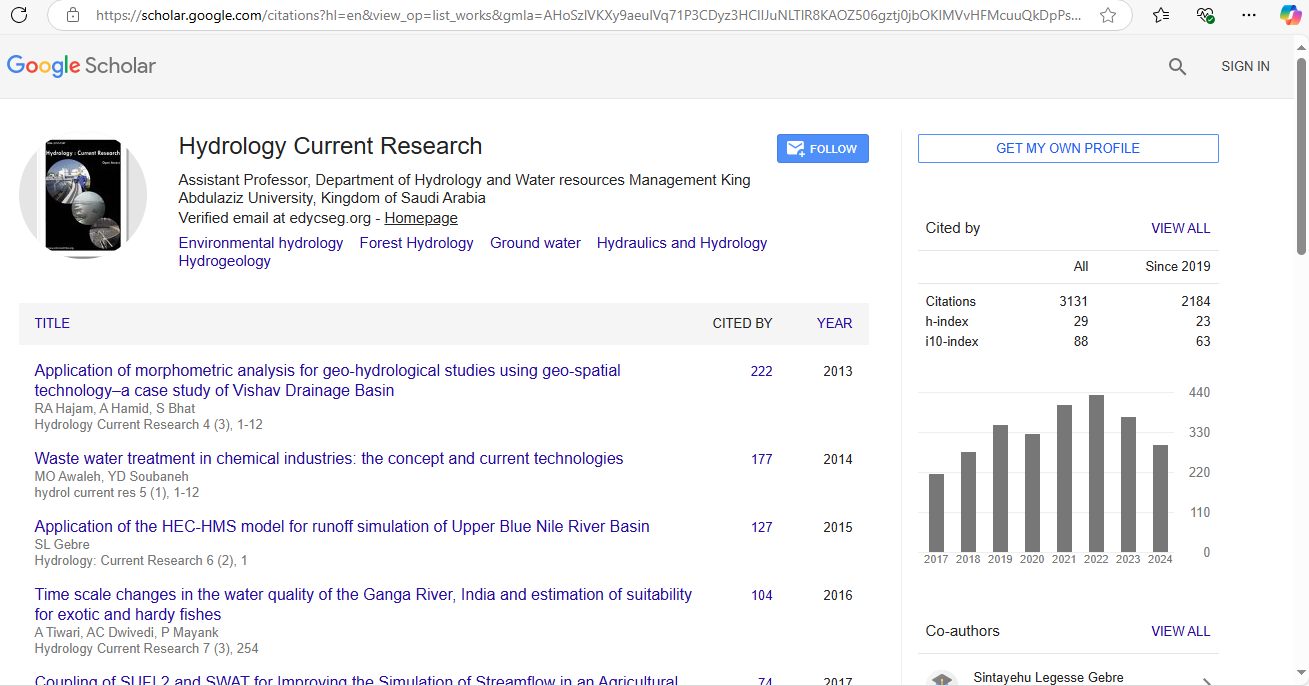
Hydrology: Current Research received 2843 citations as per Google Scholar report