Commentary - (2025) Volume 15, Issue 5
Received: 02-Oct-2025, Manuscript No. jeat-26-188650;
Editor assigned: 06-Oct-2025, Pre QC No. P-188650;
Reviewed: 20-Oct-2025, QC No. Q-188650;
Revised: 23-Oct-2025, Manuscript No. R-188650;
Published:
30-Oct-2025
, DOI: 10.37421/2161-0525.2025.15.870
Citation: Osei, Samuel. ”Air Quality Analysis: Pollutants, Impacts,
and Control.” J Environ Anal Toxicol 15 (2025):870.
Copyright: © 2025 Osei S. This is an open-access article distributed under the terms of the Creative Commons Attribution License, which permits unrestricted use, distribution
and reproduction in any medium, provided the original author and source are credited.
The intricate realm of environmental science is increasingly focused on the pervasive issue of air pollution and its multifaceted impacts on both ecosystems and human health. A significant area of research involves the meticulous analytical investigation into the presence and concentration of various toxic compounds within ambient air samples. These studies employ specific analytical methodologies for the accurate detection and quantification of these pollutants, often highlighting primary sources and assessing their potential health implications to underscore the necessity for stringent air quality monitoring and control measures [1].
Another critical aspect of air quality assessment involves examining the spatial and temporal distribution of fine particulate matter (PM2.5) in urban environments. Advanced analytical techniques are pivotal in characterizing the chemical composition of PM2.5, with findings frequently correlating elevated levels with specific emission sources such as traffic and industrial activities. This data is crucial for informing urban air quality management strategies and issuing timely public health advisories [2].
The continuous threat posed by hazardous gases necessitates the development and validation of novel sensor technologies for their real-time monitoring in ambient air. Research in this domain focuses on achieving enhanced sensitivity and selectivity for gases like nitrogen oxides and sulfur dioxide, thereby paving the way for more effective early warning systems and robust pollution control strategies [3].
Industrial activities are a prominent contributor to localized air pollution, and investigations into their impact often center on the analysis of heavy metals present in airborne particulate matter. Techniques such as inductively coupled plasma-mass spectrometry are vital for identifying and quantifying significant contaminants like lead, cadmium, and mercury, linking their elevated levels to specific industrial processes [4].
Long-term monitoring of semi-volatile organic compounds (SVOCs) in both indoor and outdoor air presents a persistent challenge. The development of novel passive sampling techniques offers a cost-effective and low-maintenance alternative to traditional active sampling methods, providing invaluable data on chronic exposure levels in various environments [5].
The effectiveness of air pollution control technologies is a subject of ongoing research, with studies often analyzing the reduction of specific pollutants like polycyclic aromatic hydrocarbons (PAHs) from industrial stacks. Employing techniques such as gas chromatography-mass spectrometry, these investigations quantify emissions before and after the implementation of advanced abatement systems, demonstrating significant improvements in emission reduction [6].
Persistent organic pollutants (POPs), such as dioxins and furans, represent a global concern due to their long-range transport and deposition potential. Research in this area explores their migration and transformation in the atmosphere, utilizing advanced analytical techniques to map transport pathways and deposition patterns, offering insights into their environmental fate [7].
Secondary organic aerosols (SOAs) are a significant component of atmospheric particulate matter, formed from the oxidation of volatile organic compounds (VOCs). Studies investigating SOA formation from both biogenic and anthropogenic VOCs in urban environments utilize advanced mass spectrometry to characterize their composition and explore the influence of meteorological factors on their formation rates [8].
Understanding the formation of ground-level ozone is heavily reliant on monitoring its precursor compounds, namely nitrogen oxides (NOx) and volatile organic compounds (VOCs). Analytical studies in urban microenvironments employ gas chromatography and chemiluminescence detectors to quantify these precursors and elucidate their contribution to ozone formation and subsequent air quality impacts [9].
Assessing exposure risks associated with indoor air pollutants, including common substances like formaldehyde and benzene, is crucial for public health. Analytical frameworks combine air sampling data with exposure modeling to estimate human intake and identify key sources of indoor contamination in residential settings [10].
Atmospheric chemistry and the behavior of air pollutants are complex phenomena requiring sophisticated analytical tools and methodologies. The scientific community continues to develop and refine techniques for identifying, quantifying, and tracking a wide array of airborne contaminants, from volatile organic compounds and particulate matter to persistent organic pollutants and greenhouse gases. This ongoing research is essential for understanding pollution sources, assessing health risks, and developing effective mitigation strategies to safeguard environmental quality and public well-being. The spatial and temporal dynamics of pollutants, their chemical transformations in the atmosphere, and their interactions with meteorological factors all contribute to the intricate puzzle of air pollution. Furthermore, the development of advanced sensor technologies promises more immediate and localized monitoring capabilities, while passive sampling methods offer cost-effective solutions for long-term exposure assessments. Ultimately, the collective body of work in this field aims to provide a comprehensive understanding of air quality issues, enabling informed decision-making and the implementation of targeted interventions to create healthier living environments. The interplay between industrial emissions, vehicular traffic, and natural processes all contribute to the complex atmospheric chemistry that defines air quality in various regions. By meticulously analyzing these components, researchers contribute vital data to inform policy and public health initiatives. The continuous evolution of analytical instrumentation and methodologies ensures that our ability to detect and understand even trace amounts of pollutants is constantly improving. This progress is fundamental to addressing the persistent challenges posed by air pollution on a global scale. The focus on both ambient and indoor air quality reflects the pervasive nature of this issue, impacting individuals in diverse settings. The insights gained from these studies are instrumental in developing effective strategies for pollution control and public health protection. The scientific endeavor in this area is characterized by a commitment to rigorous analysis and a deep understanding of the atmospheric processes governing air quality.
The scientific landscape of environmental analysis is marked by a persistent effort to characterize and quantify toxic compounds present in the atmosphere. Studies meticulously detail analytical methodologies employed for the precise detection and quantification of key pollutants. These investigations often highlight the primary sources contributing to air contamination and critically assess the potential health implications associated with exposure to these substances. A strong emphasis is placed on the imperative for stringent air quality monitoring and the implementation of effective control measures, recognizing the broad societal impact of such pollutants [1].
Research into particulate matter (PM2.5) in urban air delves into its complex spatial and temporal distribution. Sophisticated analytical techniques are utilized to characterize the chemical composition of this fine particulate matter. The findings from these studies consistently correlate elevated PM2.5 levels with specific emission sources, such as vehicular traffic and industrial operations. This crucial data serves as a foundation for effective urban air quality management and informs public health advisories aimed at mitigating exposure risks [2].
The development of advanced sensor technologies is a critical area of focus for real-time monitoring of hazardous atmospheric gases. These novel sensors are designed to achieve exceptional sensitivity and selectivity for gases like nitrogen oxides and sulfur dioxide. The successful implementation of such technologies holds significant promise for enhancing early warning systems and bolstering the effectiveness of pollution control strategies, thereby improving public safety [3].
Industrial emissions represent a significant source of localized air pollution, and a substantial body of research examines their impact on surrounding air quality. These studies frequently analyze the presence of heavy metals within airborne particulate matter. Utilizing advanced analytical instrumentation, such as inductively coupled plasma-mass spectrometry, researchers identify and quantify heavy metals like lead, cadmium, and mercury, establishing clear links between their elevated concentrations and specific industrial processes [4].
The long-term monitoring of semi-volatile organic compounds (SVOCs) in both indoor and outdoor air environments presents unique analytical challenges. The advent of novel passive sampling techniques offers a valuable solution, providing a cost-effective and low-maintenance alternative to traditional active sampling methods. These advancements are instrumental in gathering crucial data on chronic exposure levels across diverse settings [5].
Evaluating the efficacy of air pollution control technologies is an ongoing and vital area of research. Studies commonly focus on assessing the reduction of specific pollutants, such as polycyclic aromatic hydrocarbons (PAHs), emanating from industrial stacks. Employing advanced analytical techniques like gas chromatography-mass spectrometry, researchers quantify emissions both before and after the integration of state-of-the-art abatement systems, demonstrating quantifiable improvements in emission reduction and environmental protection [6].
Persistent organic pollutants (POPs), including notorious compounds like dioxins and furans, pose a global environmental threat due to their capacity for long-range atmospheric transport and subsequent deposition. Investigations in this domain utilize advanced analytical methodologies to map the atmospheric migration and transformation pathways of these substances. This comprehensive analysis provides critical insights into their environmental fate and the potential for widespread contamination [7].
Secondary organic aerosols (SOAs) are a significant atmospheric component formed from the chemical transformation of volatile organic compounds (VOCs). Research efforts focus on characterizing the composition of SOAs generated from both biogenic and anthropogenic VOCs in urban atmospheres. Advanced mass spectrometry techniques are employed to discern their chemical makeup, and the influence of various meteorological factors on their formation rates is thoroughly explored [8].
The accurate measurement of ozone (O3) precursors, specifically nitrogen oxides (NOx) and volatile organic compounds (VOCs), is essential for understanding ground-level ozone formation. Studies analyze the concentrations of these precursors within different urban microenvironments. Employing gas chromatography and chemiluminescence detectors, researchers gain vital insights into their contribution to ozone formation and its subsequent impact on overall air quality [9].
Assessing human exposure risks to indoor air pollutants, such as formaldehyde and benzene, in residential settings is a critical public health concern. Analytical frameworks are developed that integrate air sampling data with sophisticated exposure modeling techniques. This integrated approach allows for the estimation of human intake and the identification of the primary sources contributing to indoor contamination [10].
The collective body of research presented highlights a consistent theme: the crucial role of advanced analytical science in understanding and mitigating air pollution. From the granular detection of individual compounds to the macro-level assessment of atmospheric transport and the efficacy of control technologies, precise measurement and analysis are foundational. The consistent application of methodologies like mass spectrometry, gas chromatography, and specialized sensor arrays across diverse pollutantsâ??VOCs, PM2.5, heavy metals, POPs, and ozone precursorsâ??demonstrates a unified scientific approach. The continuous refinement of these techniques, including the development of passive samplers and real-time sensors, signifies a commitment to improving monitoring capabilities, reducing costs, and enhancing the timeliness of data. This ongoing scientific endeavor provides the essential data and insights needed to inform policy, guide industrial practices, and ultimately protect public health from the adverse effects of airborne contaminants. The integration of analytical findings with exposure modeling and source apportionment studies further strengthens our ability to address complex air quality challenges. The global nature of some pollutants, like POPs, necessitates a broader perspective, while the localized impact of industrial emissions and urban traffic demands detailed, site-specific investigations. The findings consistently underscore the interconnectedness of human activities, atmospheric processes, and environmental health outcomes. This comprehensive understanding is paramount for developing sustainable solutions for cleaner air.
This collection of research explores various facets of air quality analysis, focusing on the detection, characterization, and impact of atmospheric pollutants. Studies examine volatile organic compounds (VOCs) in ambient air, particulate matter (PM2.5) distribution, and hazardous gas monitoring using advanced sensor technologies. The impact of industrial emissions on air quality, including heavy metal contamination and the effectiveness of pollution control technologies for polycyclic aromatic hydrocarbons (PAHs), is investigated. Research also covers the atmospheric transport of persistent organic pollutants (POPs) like dioxins and furans, the formation of secondary organic aerosols (SOAs) from VOCs, and the concentrations of ozone precursors (NOx and VOCs) in urban environments. Additionally, exposure assessment for indoor air pollutants such as formaldehyde and benzene in residential settings is detailed, emphasizing the need for stringent monitoring and control measures across both indoor and outdoor environments.
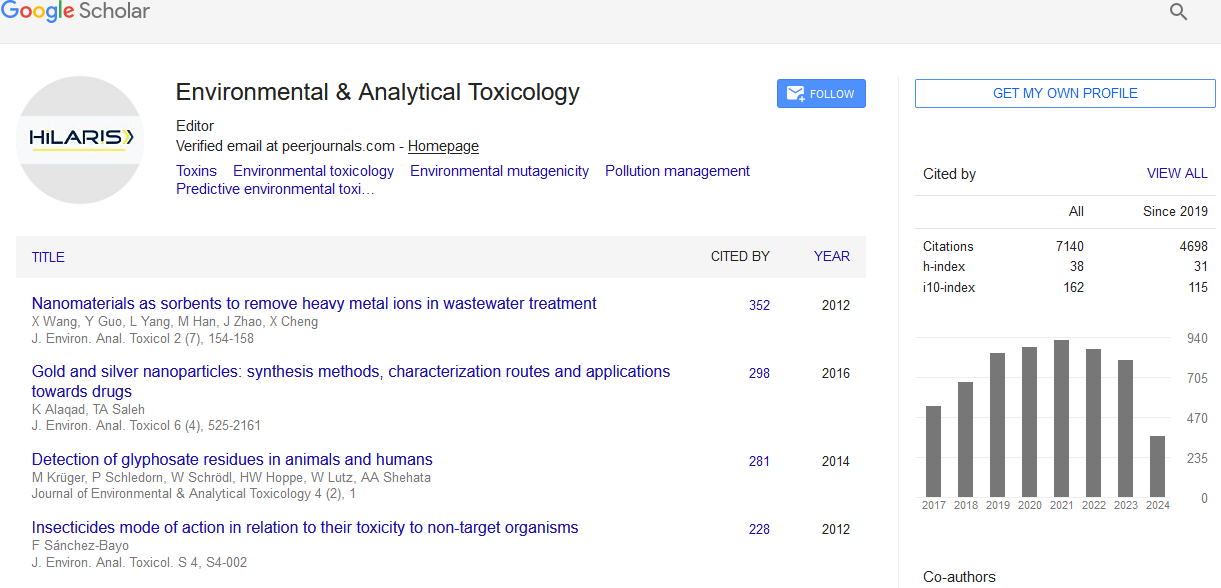
Environmental & Analytical Toxicology received 6818 citations as per Google Scholar report