Commentary - (2025) Volume 10, Issue 4
Received: 01-Aug-2025, Manuscript No. jcct-26-183225;
Editor assigned: 04-Aug-2025, Pre QC No. P-183225;
Reviewed: 18-Aug-2025, QC No. Q-183225;
Revised: 22-Aug-2025, Manuscript No. R-183225;
Published:
29-Aug-2025
, DOI: 10.37421/2577-0535.2025.9.323
Citation: Lima, João Batista. ”AI Transforms Cancer Trials: Efficiency and Outcomes.” J Cancer Clin Trials 10 (2025):323.
Copyright: © 2025 Lima B. João This is an open-access article distributed under the terms of the Creative Commons Attribution License, which permits unrestricted use, distribution and reproduction in any medium, provided the original author and source are credited.
Artificial intelligence (AI) is ushering in a new era for cancer clinical trial design and the monitoring of recurrent cancers, offering unprecedented capabilities in data analysis and predictive modeling [1].
AI algorithms possess the capacity to process and interpret vast datasets, enabling the identification of optimal patient populations for trials and the prediction of treatment responses. This strategic application of AI significantly enhances trial efficiency and increases the likelihood of success [1].
Furthermore, in the context of recurrent cancers, AI is proving invaluable for the early detection of disease progression, facilitating the personalization of salvage therapies, and providing real-time monitoring of treatment efficacy [1].
These advancements collectively contribute to improved patient outcomes and accelerate the development of novel therapeutic strategies. AI's role extends to optimizing patient cohort selection for clinical trials involving recurrent cancers. Machine learning models are adept at discerning subtle patterns within genomic, proteomic, and clinical data that can predict a patient's response to specific therapies [2].
This precision-driven approach is critical for designing more targeted and effective trials, thereby expediting the identification of promising treatments for individuals with relapsed or refractory disease [2].
The application of AI in monitoring treatment response in recurrent cancers is fundamentally transforming patient care paradigms. Through the real-time analysis of imaging data, biomarkers, and patient-reported outcomes, AI enables dynamic adaptation of treatment strategies [3].
This continuous monitoring capability allows for the early detection of treatment resistance or toxicity, prompting timely interventions and ultimately leading to improvements in overall survival [3].
AI-driven predictive modeling presents a significant promise in identifying patients who are at a high risk of developing recurrent cancer. By meticulously analyzing historical data and individual patient characteristics, these models can accurately flag individuals who might benefit from more intensive surveillance protocols or proactive treatment interventions [4].
This capability is crucial for enhancing the management of the disease trajectory and potentially preventing or delaying recurrence [4].
The integration of AI into the monitoring of clinical trials for recurrent cancers offers substantial benefits in streamlining data collection and analysis processes. Natural language processing (NLP) techniques are particularly useful in extracting relevant information from electronic health records, which expedites and enhances the accuracy of assessments concerning treatment outcomes and adverse events [5].
This is especially advantageous in the complex landscape of recurrent disease scenarios [5].
AI is a key enabler in the design of clinical trials for recurrent cancers that are both adaptive and personalized. By continuously analyzing incoming trial data, AI systems can provide recommendations for protocol modifications, such as adjustments in dosage or the incorporation of novel combination therapies [6].
The objective is to maximize patient benefit and to accelerate the overall drug development pipeline [6].
AI's inherent ability to analyze complex, multimodal data is fundamental to achieving a deeper understanding of the heterogeneity observed in recurrent cancers. This comprehensive integration of diverse data sources facilitates a more precise identification of therapeutic targets and supports the design of clinical trials capable of addressing the varied biological profiles present within recurrent disease populations [7].
The utilization of AI in the recruitment phase of clinical trials for recurrent cancers holds the potential to significantly accelerate patient enrollment. AI algorithms can efficiently match eligible patients from extensive databases with specific trial eligibility criteria, thereby overcoming a common and significant bottleneck in trial conduct and expediting the delivery of new treatments to patients [8].
AI-powered risk prediction models are instrumental in the early identification of patients who are likely to develop recurrent disease. These models meticulously analyze a wide array of factors, ranging from specific tumor characteristics to a patient's treatment history, to stratify risk with enhanced accuracy [9].
This enables timely intervention and the implementation of tailored monitoring strategies [9].
As AI becomes more integrated into cancer clinical trials, particularly those involving recurrent cancers, the ethical considerations and regulatory frameworks governing its use are continuously evolving. Paramount to the responsible implementation of AI and the building of trust among both patients and clinicians are the assurance of data privacy, the promotion of algorithmic transparency, and the guarantee of equitable access to AI-driven insights [10].
Artificial intelligence (AI) is revolutionizing cancer clinical trial design and the monitoring of recurrent cancers by enabling sophisticated analysis of extensive datasets. AI algorithms excel at identifying optimal patient populations, predicting treatment responses, and stratifying risk, thereby enhancing trial efficiency and success rates. For recurrent cancers, AI facilitates early detection of disease progression, personalization of salvage therapies, and real-time monitoring of treatment efficacy, ultimately improving patient outcomes and accelerating novel therapeutic development [1].
In the realm of recurrent cancers, AI plays a pivotal role in optimizing the selection of patient cohorts for clinical trials. Machine learning models can meticulously identify subtle patterns within genomic, proteomic, and clinical data that predict responsiveness to specific therapies, leading to more targeted and effective trial designs. This precision approach is crucial for accelerating the identification of promising treatments for patients with relapsed or refractory disease [2].
The application of AI in the monitoring of treatment response for recurrent cancers is a significant advancement in patient care. Real-time analysis of imaging data, biomarkers, and patient-reported outcomes allows for dynamic adjustments to treatment strategies. This continuous oversight can detect early indicators of treatment resistance or toxicity, enabling timely interventions and improving overall survival rates [3].
AI-driven predictive modeling demonstrates substantial promise in identifying patients at a high risk of developing recurrent cancer. By analyzing historical data and various patient characteristics, these models can pinpoint individuals who would benefit from more intensive surveillance or proactive treatment, thereby improving the overall management of the disease trajectory [4].
The integration of AI into clinical trial monitoring for recurrent cancers can streamline data collection and analysis. Natural language processing (NLP) is particularly effective in extracting pertinent information from electronic health records, which facilitates faster and more accurate assessments of treatment outcomes and adverse events, especially beneficial in complex recurrent disease scenarios [5].
AI is instrumental in designing more adaptive and personalized clinical trials for recurrent cancers. Through the continuous analysis of incoming data, AI can suggest protocol modifications, such as dosage adjustments or the inclusion of novel combination therapies, with the aim of maximizing patient benefit and accelerating drug development [6].
AI's capacity to analyze intricate multimodal data is essential for understanding the heterogeneity inherent in recurrent cancers. This comprehensive data integration allows for more precise identification of therapeutic targets and the design of trials that can effectively address the diverse biological profiles found within recurrent disease populations [7].
The use of AI in the recruitment phase of clinical trials for recurrent cancers can significantly expedite patient enrollment. AI algorithms are capable of matching eligible patients from large databases with specific trial criteria, addressing a major bottleneck in trial conduct and hastening the delivery of new treatments to patients [8].
AI-powered risk prediction models aid in the early identification of patients likely to develop recurrent disease, enabling timely interventions and the implementation of tailored monitoring strategies. These models analyze a multitude of factors, including tumor characteristics and treatment history, to stratify risk with greater precision [9].
The ethical considerations and regulatory frameworks surrounding AI in cancer clinical trials, particularly for recurrent cancers, are undergoing continuous development. Ensuring data privacy, algorithmic transparency, and equitable access to AI-driven insights are critical for responsible implementation and fostering trust among patients and clinicians [10].
Artificial intelligence is transforming cancer clinical trials for recurrent cancers by improving trial design, patient selection, and monitoring. AI algorithms analyze vast datasets to identify optimal patient cohorts and predict treatment responses, enhancing trial efficiency and success rates. In recurrent cancers, AI aids in early detection of progression, personalization of salvage therapies, and real-time monitoring of treatment efficacy, leading to better patient outcomes and faster development of new treatments. Machine learning models pinpoint subtle patterns for targeted therapies, while NLP streamlines data extraction from health records. AI also facilitates adaptive trial designs and the analysis of multimodal data for a deeper understanding of cancer heterogeneity. Furthermore, AI accelerates patient recruitment and identifies high-risk individuals for early intervention. Ethical considerations regarding data privacy and transparency are crucial for responsible AI implementation.
None
None
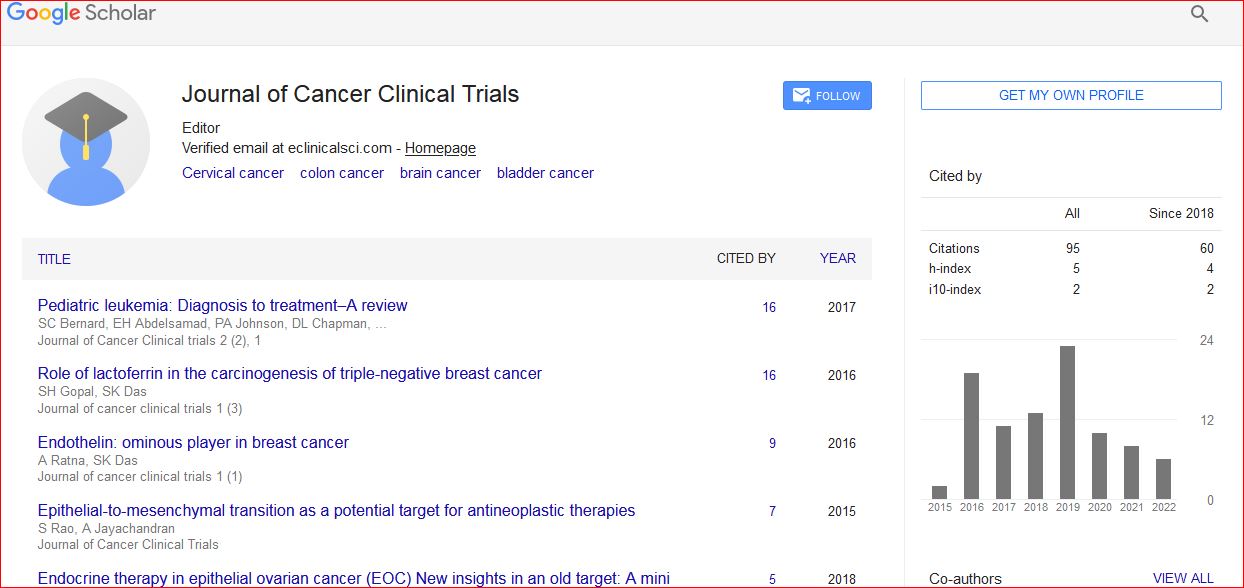
Journal of Cancer Clinical Trials received 95 citations as per Google Scholar report